
Dry Spell | AVUSD News | John Strasser | Fecal Matter | Crab Fed | Railway Fictions | Broken Rock | Support MendoLocal.News | Roofer's View | Shop Local | Red Ramaria | Transthoracic Echocardiogram | Double Exhibition | Sweet Days | Ukiah Gold | Weed Odyssey | Nathaniel Smith | Yesterday's Catch | SNL Sketch | Police Work | Protesting | Bringing Handgun | Still Waiting | Shyness | 25th Amendment | Rare Books | ICE Statement | Deporting People | Scouting Intruders | Loose Marijuana | Alcatraz Coyote | Catamount Relocation | SF Football | Oakland Redwood | Thought Experiment | Phil Ochs | James Place | RFK Diet | Butterbean Diet | Oswald's Brother | Can't Win | Che Guevara | Boomers | Lead Stories | Our Rulers | Melania 2 | Hello Hank | Real Crumb | Every Action | Nightshift | The Law | Present Impasse | Shine | Provincial Minutiae | Questioning Darwin
STEPHEN DUNLAP (Fort Bragg): Happy Ground Hog Day ! Phil saw his shadow only minutes ago so 6 more weeks of winter ! No really.
A foggy 48F this Monday morning on the coast. Lots of fog & clouds this week with spots of sun as the dry spell continues. Although the 10 day is now showing rain starting Saturday & lasting well into next week, hectic !
COLD TEMPERATURES this morning for the inland valleys with daytime temperatures mild for the season. Dry conditions will prevail with pleasant effects, similar to previous patterns with ridging in place. (NWS)
AVUSD NEWS
Dear Panther Community,
Happy February! We have been having a lot of fun at Anderson Valley Elementary School and Anderson Valley Jr/Sr High!
January was full of activities, including some intense basketball games and also Exhibition Night at AV Jr/Sr High. Leadership groups and community engagement groups at our schools worked together to keep things fun while also making plans for the future. The new year is off to a good start and we look forward to fun times in February!
With respect,
Kristin Larson Balliet, Superintendent
Upcoming District Events
- Feb. 09 at 4:00 AVES School Site Council
- Feb. 10 at 4:45 School Board Meeting
- Feb. 19 at 5:00 District-wide DELAC at AVES
- Feb. 20 at 5:00 Donkey Basketball at AVHS Gym
- Feb. 21 AVES Saturday Winter Camp
- Feb. 23 at 4:10 AVUSD Wellness Committee Meeting at AVES
School Culture
Watch for School Communications
The principals of AVES and AVJrSrHS, Mrs. Bailey and Mr. McNerney, are committed to making sure parents know what is happening on campus. Please read their weekly communications and reach out to them if you have any questions or concerns!
Foodbank Delivery
The over 1000 canned food items that were donated by AVES students and families in December were delivered to the Anderson Valley Food Bank. Nat did a wonderful job of heading up these efforts! Special thanks to AVHS ASB Officers Jenny, Joanna, and Aliya, and AVES students Samuel, Flint, Jayla, Adairis, Zephyr, and Orlando, who assisted in various aspects of the canned food drive, in addition to Belma, Cele, Mimi, Aihi and Bri F who helped make it happen!
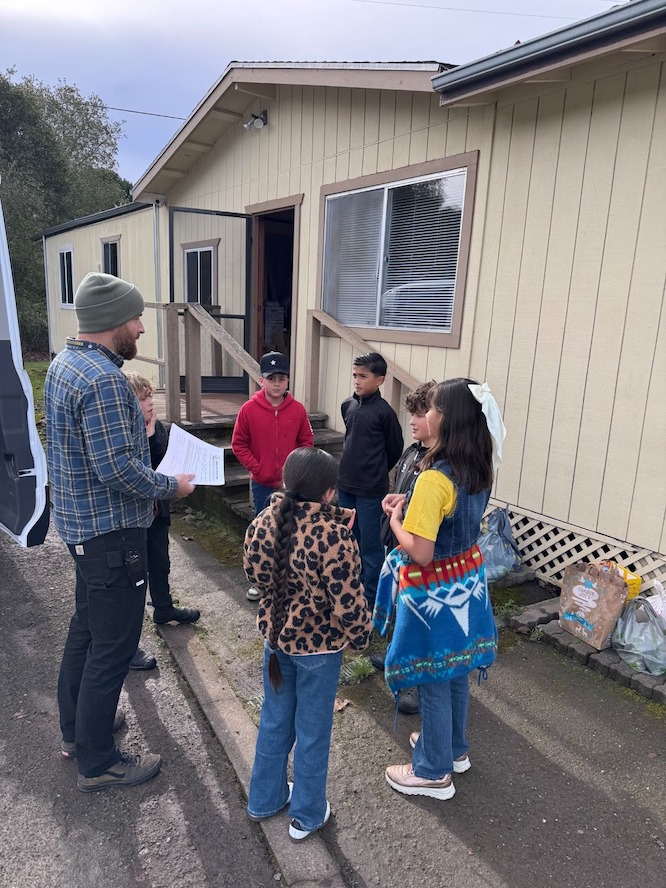
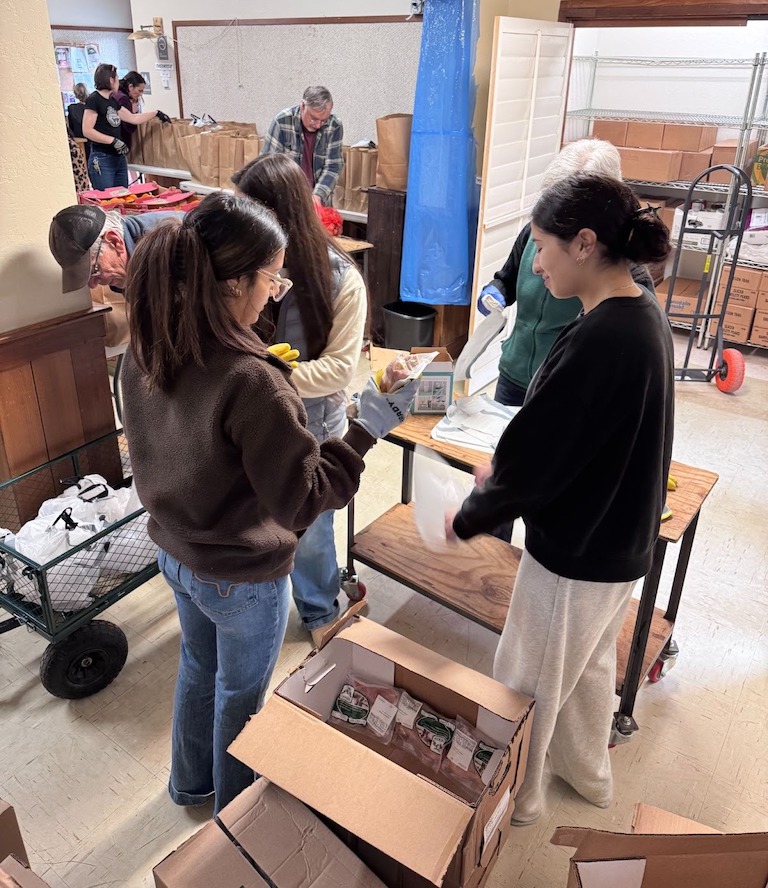
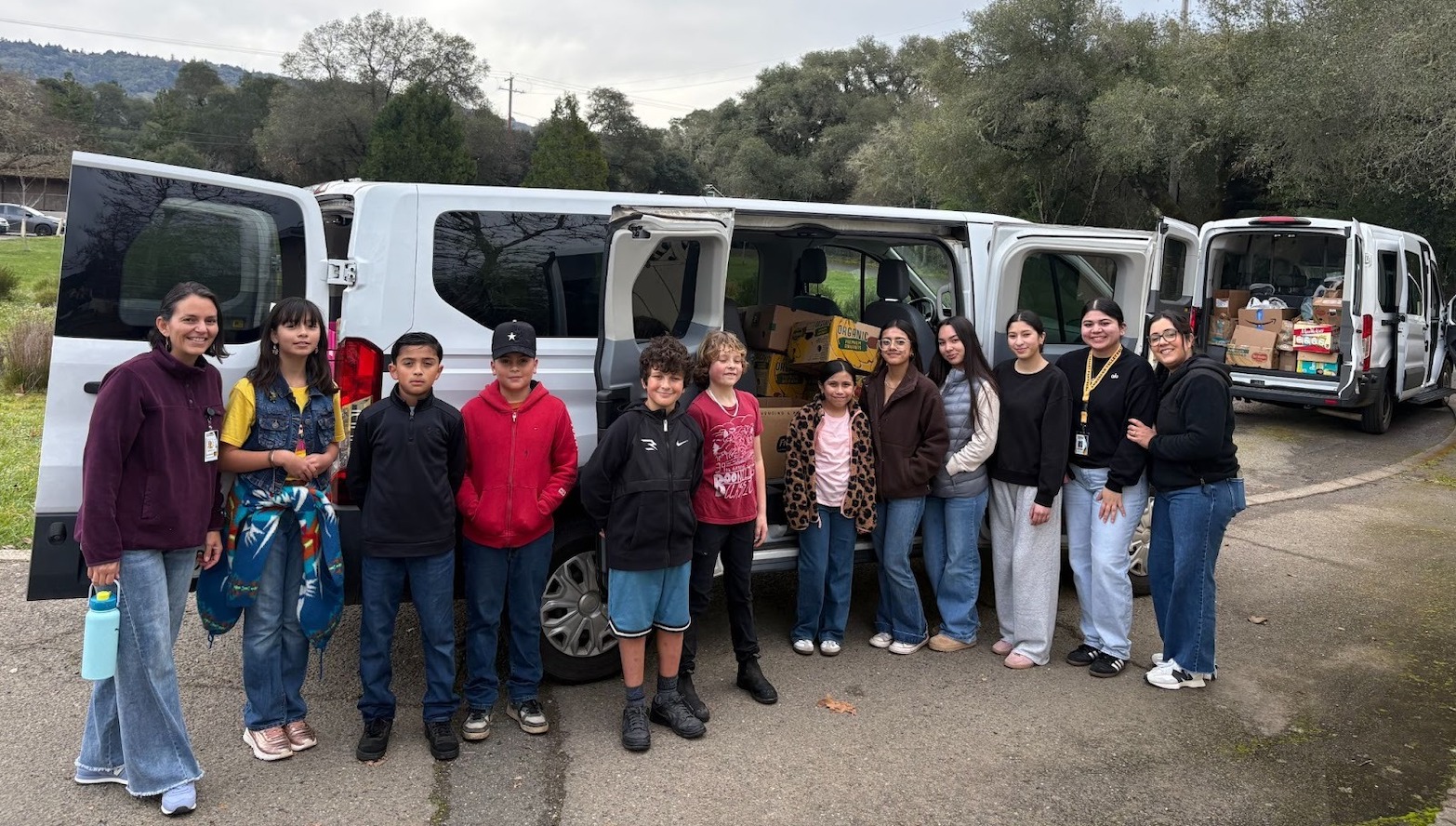
The Community Engagement Initiative (CEI) Team
This is a team of AVUSD students, parents, staff, and community members who have been meeting together to think of ways to get more parents and community members involved in working with our schools. This group has lots of great ideas and we look forward to sharing more in the coming months. The team will be traveling to San Diego in March to continue this work. Many thanks to Coordinator Nat Corey-Moran for organizing this group’s activities. Great things are on the horizon!
Student Achievement & Learning
Peachland Has Openings for 3-Year Olds!
If you know a child who has recently turned 3, please let their parent know that they do not need to wait until next year to sign up for preschool. They can start now! We are also taking registrations for next year, through MCOE’s centralized enrollment system. Here is an English and Spanish flier for the details. Spread the word!
FFA Degree Recipients
Congratulations to this year's CA State FFA degree recipients, Samantha and Jennifer!
The State FFA Degree is the highest degree given by the California FFA.
To qualify these members must:
- take agriculture education classes
- be an active member for at least 3 years
- have a project that earns or invests over $1000
- complete over 500 hours on their project
- perform 25 hours of community service
- and keep accurate records on their FFA activities
AVHS Teachers worked hard in their departmental teams last week, with MTSS Coordinator Ali Cook facilitating that work. Every department identified “Essential Standards,” meaning they agreed on what the most important things are for our students to learn in each subject area. We are so excited about the deep conversations and the plans that have been made to maximize student learning.
AVES Teachers have been working hard on mathematics instruction. Last week, they participated in demonstration lessons and observations, facilitated by consultants “Barb and Sarah,” with the focus on helping students to build critical thinking and conceptual understanding in math. All of this work will result in even better instruction and systems of support for students!
Systems of Support
AVES Kinder - 2nd Graders: Reading Difficulties Screener
This year, all California schools are required to give the first of an annual assessment for reading difficulties. This is for all students, K-2nd grade. AVUSD is using the Multitudes assessment. We will share students’ results with parents in the Spring. Additionally, any students identified as at risk for reading difficulties will be provided with interventions. This is good stuff! Catching reading difficulties earlier will allow us to provide early interventions; this is the most effective way to go!
AV Jr/SR HS Master Schedule Prep
Mr. McNerney and Mr. Howard are already working on next year’s school schedule! In order to do this, they will be reviewing student achievement data to determine who needs extra support courses and who may need an additional challenge.
Please remind your child to do their best on tests and to complete all their work. Please also encourage them to reach out for help if they are having a hard time with any subject. Tutoring, in addition to our intervention courses, is available! We are committed to providing students with a rigorous and supportive learning experience that prepares them for their futures.
Saturday Winter Camp
The last Saturday camp at AVES will be scheduled for 2/21/26 with a field trip to CV STARR during ASP. The bus will leave by 11:30 and return around 4:30. Charlotte Triplett and her team continue to do a great job of planning and organizing Saturday camps. See the office for details!
We Care About ALL Our Families!
There is new legislation in California called AB 49 and SB 98, in response to strong concerns about the impacts of immigration enforcement on students, families, and school communities. If you would like more information, see the CDE Resources for Immigrant Families web page at https://www.cde.ca.gov/immigration-toolkit or talk to your school principal or Mrs. Larson Balliet, AVUSD superintendent.
Please find links to additional information for families below:
- Mendocino County Office of Education: Immigration Resource Page
- Immigration and California Families: State Immigration Website
- National Immigration Law Center: “Know Your Rights” (English | Spanish | Additional Languages)
If you would like to be more involved at school, please contact your school’s principal, Ms. Jenny Bailey at AVES or Mr. Heath McNerney at AV Jr/Sr High, or our district superintendent, Ms. Kristin Larson Balliet. We are deeply grateful for our AVUSD families.
Sincerely yours,
Kristin Larson Balliet
Superintendent, AVUSD
JOHN STRASSER
John Strasser passed away suddenly in his home in Shelter Cove with his beloved dog by his side on January 24, 2026. He was 63 years old.

John was born in San Luis Obispo, CA and spent his teen years and early 20’s in Morro Bay. He received a bachelor’s degree in Mechanical Engineering from the Maritime Academy in Vallejo, during which he also became a Navy Reserve Officer with the rank of lieutenant JG. He then worked as a Merchant Marine in the shipping industry in the Great Lakes and Alaska.
During this time he discovered Shelter Cove and purchased a vacant lot in the early 1990’s. He built his home during his time off between maritime work. Affectionately known as the SpongeBob house, he incorporated portholes for windows, and painted it yellow and blue.
In the early 2000’s John purchased his farm outside of Garberville-Redway. He split his time between his two properties. John loved Humboldt County and exploring all of the beautiful tucked away gems in the area.
During his 35 years in SoHum he became a known member in the community. He had some very close friends he made wonderful memories with. He would tell stories of his years on the ships, and early years in the Cove. He always drove a truck, although he loved classic cars of all kinds. He always had a dog that would be named either Dude, Little Dude, Dink or Frisky Noodle.
His mom, dad and one sister preceded him in death. John is survived by his sister in Morro Bay, sister and brother in law in Washington state, two nieces and two nephews, many aunts, uncles and cousins, and some very good friends.
There will be a celebration of his life at a later date where we can gather to tell and hear stories.
John will be missed by all who knew him.
TOM CONDON: I apologize if this is not the forum for this, but I’d like to give a big shout out to the person or persons responsible for smearing fecal matter all over the porta san located at the playground and track. I’d hate to see the bathroom at your house.
RENEE LEE (AV Senior Center): In case you’re wondering…it basically takes 900 pounds of crab, 150 loaves of French bread, 40 pounds of butter, 5 gallons of Louie sauce, 40 pounds of lettuce and spring mix, 2.5 sheet cakes, a whole bunch of beer, wine and tequila and a ton of planning, donations and volunteers to put on a crab feed. Thank you all so much!

RAILWAY FICTIONS & OMISSIONS
Editor,
Re: WONDERING WHY Letter to Editor by Peter McNamee.
In a time when government funding is often distributed quite freely — including the $150,000 grant Mr. McNamee’s organization is using to “educate” the public about our property — it’s worth noting that we will fully repay all of our RRIF loan funds, with interest.
Yes, we also received a $14 million grant, but that funding is dedicated entirely to converting our locomotives to the lowest-emission fuel-based locomotives in the nation. Programs like this are common for both industry and individuals to help accelerate adoption of greener technologies that are more expensive and more complex to operate — much like incentives offered to consumers who purchase electric or hybrid vehicles. These subsidies exist to encourage behavior that aligns with broader societal goals, not to generate profit. We are contributing matching funds, manpower, years of planning, and will not profit from this project.
You also suggest that we failed to mention the California Attorney General in what you describe as “propaganda,” implying that the AG’s involvement represents a significant escalation. In reality, the Attorney General’s role here is largely procedural. I’d be happy to wager a plate of fish and chips at Sea Pal on the ultimate outcome. Moreover, your framing implies independent action, when in fact the AG is acting on behalf of the California Coastal Commission, at its request.
Since we’re discussing omissions, it’s worth noting that for years you have declined to disclose that you live nearly above Tunnel #1, and that your housemate was among those who initiated this conflict. Donne Brownsey was Chair of the California Coastal Commission when it first intervened in 2022. Since then, the Commission has opposed our efforts at nearly every step and continues to threaten legal action — even against the Federal Railroad Administration.
In this dispute, the Coastal Commission has asserted authority not only over the tunnel itself, but over sections of track located more than 30 miles inland. That interpretation stretches coastal jurisdiction well beyond any reasonable boundary. Watch out Willits, the Coastal Commission is almost to you!
We made repeated, good-faith efforts to reopen the tunnel and genuinely believed it could have occurred much sooner. Those efforts were delayed — repeatedly — by the campaign partly initiated by Ms. Brownsey against our railroad.
Have we received a loan and a grant? Yes. Both were awarded only after a competitive, multi-year review process. The funds are restricted to specific purposes, and disbursements occur incrementally — only after work is completed and independently inspected.
Finally, you describe it as “fiction” that we are a real railroad, while ignoring that the federal government affirmed our common-carrier status through both of these funding actions. You also disregard rulings by the Surface Transportation Board and the courts. It appears you are unwilling to acknowledge any outcome that contradicts your position — even if doing so prolongs a conflict to the detriment of the community.
Christopher Hart
Mendocino Railway

AN EDITOR'S APPEAL
$4,170 in pledges received, $10,000 to go to cover operational expenses
by Elise Cox
Dear fellow Mendo fan,
Thank you for subscribing to MendoLocal.News and for sharing our news with your friends and neighbors. In just five months, you’ve helped MendoLocal.News become one of the most-read news sources in Mendocino County. Your trust powers our work.
Thank you for joining us — and me, Elise Cox, MendoLocal.News’s volunteer editor and lead reporter — in our mission to deepen local news reporting in Mendocino County and ensure it is built on a solid financial foundation.
I want to give a special thanks to those of you who have also pledged financial support for our nonprofit organization. To date, pledges total $4,170, which is almost 30 percent of our estimated annual operating costs. (Mendo Local Public Media, which operates MendoLocal.News is a thoughtfully managed operation with that avoids unnecessary expenses.)
A quick note for current donors: We’ll begin collecting pledges this week. Charges will appear on your credit card from our fiscal sponsor, the Tiny News Collective. This ensures your donation is tax deductible.
Your support means we can obtain media liability insurance, pay for professional services like accounting, access court transcripts, acquire software subscriptions needed to produce our publication, and reimburse volunteers for their mileage expenses. These are essential ingredients that make strong local reporting possible.
But 30% is still a long way from 100%. And while we continue to actively seek grants and sponsorships from local businesses, we also rely on people like you — dedicated readers who support our mission of providing honest, fact-based reporting on interests vital to the well being of Mendocino County residents.
If you haven’t given yet, would you consider a gift today? While larger gifts ($100 and above) help us grow faster, we encourage small donations. Even amounts as small as $3 can bring us closer to achieving our fundraising goals and continuing our mission.
The fact is everyone who read MendoLocal.news gave us a quarter just once a year, our operational costs would be covered. For now, we are asking you to please give at a level that’s right for you. If you give more, we can do more.
You can pledge here on Substack or donate here on Monkeypod, an encrypted fundraising platform. Or you can also mail us a check via the address below — this saves costs on donation processing.
Charitable donations via check should be payable to “Tiny News Collective Inc,” with “Mendo Local Public Media” in the check memo or description line.
You may send donations to
Mendo Local Public Media
PO Box 362
Mendocino, CA 95460
Or
Tiny News Collective
#3868
111 North Wabash Ave. Ste.100
The Garland Building
Chicago, IL 60602
With gratitude,
Elise Cox

ASSIGNMENT: UKIAH - WHAT IT MEANS TO ‘SHOP LOCAL’
by Tommy Wayne Kramer
Twenty one years ago we bought a new refrigerator over at Pardini Appliance and it was a beaut: retro-style from curved corners to chrome handles, and coated in deep red airplane-grade paint.
A Northstar brand it was, and it was so cool we quickly went to work making it the centerpiece of our kitchen, which is black-and-white tile with marble here and there, and hardwood floors. To match our new red refrigerator we bought a new red toaster, a new red Kitchen Aid mixer, red clock and (courtesy of Pardini Appliance) a GE dishwasher with a red door matching the fridge.
So cute! (Wife’s words, not mine.)
That was, as mentioned, 21 years ago (I know these things because she keeps receipts). But a few weeks ago the jolly red fridge showed signs of terminal illness; the repair guy took its vitals, shook his head sadly and said we ought to prepare for the worst.
The next morning I went back to Pardini Appliance but Mark was absent. Trophy and I poked around Home Depot and eventually talked with a remarkably disinterested employee who knew nothing about refrigerators and chuckled about it.
We went to Friedman’s and were directed to the Kitchen & Bath display, and learned the only place to get a Friedman Appliance refrigerator was in Santa Rosa.
Back to Pardini’s. Mark answered the door, remembered the red fridge, and guesstimated it was purchased around 20 years ago. When he heard the news he murmured condolences, saddened that it might be destined for the Big Recycling Center in the sky.
Now you may not know it but the Pardini family name goes way back in the history of kitchen appliances. His ancient ancestors invented the ice cube, and more recently Mark’s grandfather sold Philco freezers to Eskimos and Westinghouse washing machines to nudist colonies.
Mark is content to keep his own customers satisfied here in Ukiah, and we put him to the test that afternoon at his shop on North State. He frequently deals with tough customers, but Trophy the wife (mine, not his) is a category of tough all on its own.
Our next/new refrigerator has to be retro and it has to be cute. It has to be delivered this afternoon and it has to be red.
Not to worry, or at least not much. Mark Pardini has heard it all before, sometimes louder, and has the right answer for every question.
Retro? Check.
Cute? Check.
Red? Maybe; These Northstars are imported from Canada and what with all these tariffs and delays and such . . . Mark’s voice trails off. But even if a brand new Canadian refrigerator in a fabulous cherry flavor might not get delivered to your house in the next three hours, what about I give you a loaner?
A loaner? A loaner what, asked my dear wife.
A loaner refrigerator, said the ever accommodating Mark Pardini. And to make room for it we’ll bring your old refrigerator back to the shop to perform an autopsy. Maybe we can bring it back to life. We have our ways.
Dear Trophy and I looked at each other. If there was a flaw in the plan it was Mark’s. We get a free rental that gets delivered free, a free trip to the Pardini appliance hospital, a free diagnosis, and Medicare will cover the rest??
Aww, just kidding about the Medicare stuff we said, ha ha. We have Blue Cross / Blue Shield.
(As of this writing lab tests are not yet back from Pardini’s emergency room. We have our fingers crossed but the truth is, a nice new Northstar in baby blue would also look smashing.)
Ukiah Can’t Help It
The city keeps trying to do what the city does best, and in this latest case it has renewed its war against the last corrugated metal buildings in town, at Perkins and Main Streets.
Two years ago the vintage buildings were to be sacrificed so citizens might instead experience the splendor and joy of a new Savings & Loan. Whee.
Bank plans changed but leave it to Ukiah to never give up. She’s at her best when given the opportunity to destroy old buildings and replace them with charmless anonymous tan-colored cubes.
Thus another chance to bulldoze irreplaceable, historically significant buildings has surfaced, and was gladly embraced by city council. Ukiah may be best at wiping out her past, but she’s also without equal in replacing the old with new and appalling eyesores.
And for what? For college student housing. Instead, why not convert the shuttered Thrifty Drug building into dorm rooms?
What a place. What leadership.
Or maybe you like bland, beige three-story housing rectangles, and if so TWK apologizes. Tom Hine plans to enroll at Mendo JC and major in modern dance.

MEMO OF THE WEEK
Transthoracic Echocardiogram
Patient Name: Bruce Scott Anderson
Date of Report: 1/29/2026
Patient DOB: 7/22/1939
Referring Phys: 124702 Sirisha Krishna Tummala
Height: 190.5 cm Weight:94.8 kg Referring Diag: T45.1X4A Gender:M BSA:2.24
Indication: Chemotherapy
Resting BP:122/80 mmHg
Date:1/29/2026
Study Location: 5305012
Conclusions: Image quality was fair. The patient's blood pressure was 122 mmHg/80 mmHg during the study. The heart rate during the study was 79. Color Flow Doppler was utilized for this exam. Spectral Doppler was utilized for this exam.
- The left ventricular volume is normal. LV function is normal. 2D LV ejection fraction is estimated to be 60 to 65%. There is upper limits of normal to borderline increased left ventricular mass by index. No segmental wall motion abnormalities present. Apically displaced accessory chords and pap muscles noted on contrast images. LV contrast was used to optimize images. There is no evidence of LV thrombus.
- The right ventricular volume is normal. Right ventricular function is normal.
- Left atrial size is normal. Right atrial size is normal.
- There is no hemodynamically significant valvular disease.
- There is Doppler evidence of impaired LV relaxation.
- The pulmonary artery systolic pressure cannot be determined due to the lack of a complete TR jet.
- The IVC is not well seen and RA pressure cannot be estimated.
- The aortic root is mildly dilated at the Sinuses of Valsalva.
Previous Comparison: No previous study is available for comparison.
Cardiac Chambers: Left Ventricle: The left ventricular volume is normal. LV function is normal. 2D LV ejection fraction is estimated to be 60 to 65%. There is upper limits of normal to borderline increased left ventricular mass by index. No segmental wall motion abnormalities present. LV contrast was used to optimize images. There is no evidence of LV thrombus. Apically displaced accessory chords and pap muscles noted on contrast images. LV Diastolic Function: There is Doppler evidence of impaired LV relaxation. Right Ventricle: The right ventricular volume is normal. Right ventricular function is normal. RV S' velocity is 16 cm/s. Left Atrium:Left atrial size is normal. Right Atrium:Right atrial size is normal. Cardiac Valves: Aortic Valve: The aortic valve is trileaflet. There is no restriction of the aortic valve leaflets. Mild leaflet calcification is present. No aortic regurgitation is present. Mitral Valve: The mitral valve anatomy and motion are normal. There is mild mitral annular calcification. Mild mitral regurgitation is present. Tricuspid Valve: Tricuspid valve anatomy and motion are normal. There is trace tricuspid regurgitation. Pulmonic Valve: Pulmonic valve anatomy and motion are normal. There is trace pulmonic regurgitation.
Other: Pulmonary Artery and Right Sided Pressures: The pulmonary artery systolic pressure cannot be determined due to the lack of a complete TR jet. Aorta: The aortic root is mildly dilated at the Sinuses of Valsalva. The ascending aorta is mildy dilated. IVC and Hepatic Veins: The IVC is not well seen and RA pressure cannot be estimated.
Measurements: Variable (Normal Range) Value 2D Measures (Normal Range) Value LVEDVI, mL/m2 52 ml/m² LVIDd, cm 4.9 cm (35-75 men , 29-61 women ) (4.2-5.8 men, 3.8-5.2 women) LVESVI, mL/m2 20 ml/m² LVIDs, cm (11-31 men, 8-24 women) (2.5-4.0 men, 2.2-3.5 women) 2D LV Ejection Fraction 62 % 2D Septal thickness, cm 1.2 cm (55-70%) 3D LV Ejection Fraction 2D Posterior wall dimension 1.0 cm (55-70%) (cm) LV Mass Index (TE or A/L), 84 g/m² 2D Septal/Post Wall Ratio 1 gm/m2 (50-102, men, 44-88 women) Aortic Root Size (2D), 4.0 cm ASC AO 4.0 cm (2.0-3.7 cm): LA Volume Index (16-34 29 ml/m² PV VTI (cm): 13 cm ml/m2): RVOT VTI (14-16 cm): 13 cm LVOT VTI (19-21 cm): 18 cm TAPSE (>1.6 cm): 2.5 cm LVOT SI: 35.3 ml/m² LVOT SV: 78.9 ml (Reference values taken from J Am Soc Echocardiogr 2015;28:1-39)
ARTISTS COLLECTIVE IN ELK featuring Sophia Sutherland and Kalahan Stoker in February

The Artists' Collective at Elk presents a double exhibition for the month of February, of ceramic figurative sculpture by Sophia Sutherland, and the digital artwork of our newest artist, Kalahan Stoker.
Sophia has been an artist and dancer since she was a child. "I have noticed that we are all artists," she says. "It was my good fortune to have been encouraged to express my creative spirit as I grew up. I drew, painted and played in clay as a child. "The medium of clay moves me into a dialog between my hands and the clay, allowing me to enter into another dimension that I and my clay tribe call 'the zone'. A delicious place. A place to re-create the world and myself.
Sophia's show is entitled Adornments/A Clowder of Cats. The show will feature new "hot out of the kiln" works of art. Each of the sculptures has an adornment added. "My works are overtly whimsical and covertly philosophical. I move between the 2nd, 3rd, and finally the 4th dimension. This dimension is where I can explore with my viewers the lost stage with creativity. I am grateful for this gift of when I am connected to my 'art spirit'."
Kalahan Stoker is a digital illustrator based on the Mendocino coast, where the redwoods and the ocean offer a quiet space for healing. After a period of learning how to navigate life with endometriosis and psoriatic arthritis, she has found the strength and inspiration to return to her art. Much of this new energy comes from time spent with her partner outdoors where they forage for wild mushrooms and hike the coastal trails with their three dogs.
Her work explores the playful side of nature and food, specifically through her charming digital drawings of avocado characters engaging in everyday life. Even though she is personally allergic to avocados and several other foods, she finds joy in giving them their own vibrant personalities. These illustrations are a lighthearted reflection of her life on the coast and the simple happiness of being back at her digital canvas.
The show will run from Feb. 1st through Feb. 28th. There will be a reception for the artist on the first Sat. in February, Feb. 7th, from 1 to 3 pm. The Artists' Collective at Elk is located at 6031 S. Hwy. 1, in Greater Downtown Elk, between the post office and the Maritime Cafe. It is open daily from 10 a.m. to 4 p.m. (707) 877-1128.
DOBIE DOLPHIN:
Back in the day when one could go to a BOS meeting in Ukiah and actually have a dialog with the supervisors, many of us from Albion were over there regularly, for one thing or another. Sometimes after a meeting, I would go with Norman to Lake Mendocino where he had a small sailboat. He would kick back with a 6-pack of Green Death (Rainer Ale) and let me sail the boat. There was never much wind, so we mostly luffed in the middle of the lake and I got to hear Norman stories. Those were sweet days.
UKIAH MINING NEWS as noted in this January 12th 1895 Mining & Scientific Press article:

THE WEED ODYSSEY
by Paul Modic
Remember when we just put a seed in the ground
and waited for October to come around
In those glory days the plant was very healthy
after a few years we all felt wealthy
From forty dollars food stamps to thousand dollar pounds
there were no mites or powdery mildew frowns
It was a moment in time, the money amazing
we were beginning pot farmers, the trails were a-blazing
Hiking for hours up and down mountains
looking for springs and places for gardens
There were lessons to learn especially about mold
the enemy within that destroyed the gold
Wood rats, ripoffs, and Camp claimed its share
copters invaded and the hippies were scared
We hid plants under trees and even up in them
with loppers we carved out our camo kingdom
After Camp came the nineties greenhouse years
cover it with remay and forget all your fears
Then the mites joined the mold in a symphony of terror
vacuuming webs off of buds will be a memory forever
After predator mites failed, with pyrethrum you could bomb it
then the last hippie ethics were spewed like vomit
It was probably an odd way for kids to grow up
saying don’t call the cops, especially the whup! whup!
Growers counted the cash and the prices kept rising
vacations to faraway beaches were not surprising
When coke came along we were like Hollywood
we snorted that sweet powder whenever we could
The frisky hippies had sex then crying babies
and built country schools in the booming eighties
The teenagers got the green thumb and planted out Usal
then biked the crop home in backpacks every fall
When medical was legalized the price dropped lower
everyone from everywhere came to be a grower
If you wanted to keep piling up many pounds of dank
you had to grow hundreds of plants to still make bank
It was harder to sell if your weed lacked aroma
they wanted clones with names, that put you in a coma
With houses and land the hippies became entangled
after the sinsemilla boomed across the triangle
Foreign girls greeted us with open smiles
hordes of trimmers come to work harvest for awhile
From the ends of the earth the young people came
trimming weed for easy money was the game
Everyone was in it for the cold hard cash
the colorful workers vanished after the crash
When the whole mess was legalized in twenty sixteen
the enforcer John Ford showed up on the scene
So that’s the story of a very green dream
we rode it for decades, starting when young and lean
It was a complete surprise which dropped in our laps
a forty year boom which finally collapsed
WHEN NATHANIEL SMITH DIED at Mendocino in 1906 the obituaries gave his age as 75 to 100 years. His age given to a census taker favors the smaller number. It seems very certain that Nathaniel Smith was born a free black in about 1831 in Baltimore Maryland which was a slave state at the time. Being a young , free black man in a slave state might have put him at risk of being impressed, kidnapped into slavery. For whatever reason, on 22 December 1847 he shipped out as a crew member on the ship “Rhone” The Rhone sailed from Baltimore to Rio de la Plata, Cape Horn and five stops along the west coast of South America finally departing Callao for Honolulu, then back to California. Smith left the ship in San Francisco on August 11th 1848. (Gold had been discovered back in January)
Settling in the Bay Area, Smith resided in the home of Benjamin Hill in Sausalito. He is listed in the Marin County census in 1850 as a servant in the Hill household. California became a state in that year, entering the Union as a free state which made his freedom much more secure. A few doors away from the Hill household, lived one Captain Fletcher and it is almost certain that Smith signed on with Fletcher who was planning to build a water-powered sawmill on the Albion River in the region of Sonoma County known as Mendocino. For whatever reason and under whatever circumstances, Smith left the enterprise and made his way down the coast where he settled near a small unnamed creek. He hunted and fished and lived close to a Pomo encampment. Around the same time a middle-aged Portuguese named Francisco Faria settled about a mile to the north. It is clear the two men, the only two English-speakers hunted and worked together.

The general location where they lived became known as Cuffey’s Cove. (Or possibly Cuffy’s Cove – there is no “correct” spelling and the cemetery has it spelled both ways) The origin of the place name is something of a mystery and there are several versions of the story, including a bear cuffing her cubs. The verifiable truth is that “cuffy” is archaic slang for a slave and, by extension, a person of African heritage. The most probable version is that the sailors plying the northern California coast referred to “that cuffy’s cove” But just to muddy the waters further, one John Coffey was an early settler there and it was even proposed to have been [Ivan] Kuskov’s Cove. Smith’s partner there made matters even less clear in later years when he told of a bear he fought, they came to call Old Cuffy because of the peculiar way she had used her forearms in the fight.
The given location of Smith’s home at Cuffey’s Cove would actually fall within the footprint of the present town of Elk. Specifically, it is said he lived at “the Indian Camp” which is the present-day schoolyard on the south bank of what was known later as Double Bridges Creek. Faria sold his land to James Kenney in 1855 and both Smith and Faria left the cove around that time. Faria went to Mendocino where there were already other speakers of Portuguese. Smith drifted inland to the Comptche area, but he also had activities in Mendocino. He married a Pomo woman named Calhasa Cherrepo also called Caroline Knight at Big River on November 9th 1856. They would have four daughters, Frances, Emma, Emeline, and Sarah. Frances died as a teenager under uncertain circumstances. He lived in the area another 51 years. He is reported to be buried at Mendocino but no grave marker exists.
— Chuck Ross
CATCH OF THE DAY, Sunday, February 1, 2026
DILLON BUCHANAN, 19, Willits. DUI.
JOSE DIAZ, 25, Ukiah. Domestic battery, willful cruelty to child, brandishing, criminal threats.
TRAVIS DOCKINS, 42, Willits. DUI.
JOSEPH FAUSTINA, 28, Willits. Domestic battery, vandalism.
DYLAN GOTT, 19, Ukiah. DUI.
JASON ROBINSON, 46, Eureka/Ukiah. Unauthorized entry into dwelling without owner’s consent, under influence.
THOMAS THORSON, 40, Nice/Ukiah. Disorderly conduct-alcohol, probation revocation.
JUSTIN TIMBERLAKE, 42, Fort Bragg. Petty theft with two or more priors. (Frequent flyer.)
KADEN WILSON, 29, Fort Bragg. DUI-any drug.
STEVE TALBOT:
A brilliant comedy sketch on Saturday Night Live that says a lot about our current political environment. The eyes and ears and minds are opening…slowly…among some Trump devotees, who are going to have a very hard time admitting they were wrong. This is hilarious and spot on. Watch the whole thing. "I may have changed my mind about Trump."
Incidentally, this new (to me) cast member Ashley Padilla is terrific. A real actress who nails this performance.
Also, overall, this was one of the best written, more political and entertaining episodes of SNL in a long time.

THE BEST PART OF PROTESTING is hanging out with total strangers who become friends. I was between two wonderful women yesterday, and in the course of two hours, we exchanged our life stories, encountering many commonalities.
Oh, and the chanting! "No ICE, no KKK, no fascist USA" was a big one yesterday. But this remains my favorite: " Tell me what democracy looks like. THIS is what democracy looks like!" Such rhythm.
Anyway, the feelings of community which are fostered are a wonderful antidote to fretting, as I'm sure my friends who attend these demos regularly know exactly what I mean.
— Deborah White
BRINGING A FIREARM TO A DEMONSTRATION
Editor:
Like many in this country and the world, I was saddened and sickened by the senseless deaths of Renee Good and Alex Pretti. Minneapolis is the leading edge of Donald Trump’s attempt to fundamentally change our form of government from a democracy to a fascist state. I wholeheartedly support our brothers and sisters in Minnesota as they face the faceless thugs acting on Trump’s behalf.
I was disheartened to read that Pretti was carrying a handgun. In September 1981 I was one of almost 2,000 people arrested for protesting the opening of the Diablo Canyon nuclear power plant despite its close proximity to an earthquake fault. Prior to that action, which involved almost 30,000 people, the Abalone Alliance provided nonviolent civil disobedience training for those of us anticipating arrest, in order to defuse potential volatile interactions with police.
Not actually being present in Minneapolis, I can’t say if the situation has degraded beyond the point of nonviolent protest, but it seems to me that bringing a handgun to a protest just provides an excuse for Trump and his henchmen to continue their march toward fascism. Is Gandhi passé?
Glenn McCrea
Santa Rosa

LAURA COOSKEY:
I’m just getting kind of tired of all this, “I’m shy and anxious around people, but I didn’t know it was actually a diagnosable problem that I could get treatment (aka “drugs”) for until I spent hundreds of hours on the internet…”
Why not back away from the internet and as we used to so un-empathetically say, get a life?
These low-level neurodivergence issues are just First World ways of taking normal-spectrum personality traits, such as shyness, and making them into excuses for all kinds of anti-social behavior. This is the worst kind – physically attacking someone for being in your fragile, special, brittle little place.
25TH AMENDMENT FOR TRUMP
Editor:
As I write this, our one-time allies in Europe and around the world are holding emergency meetings to try to figure out how to protect their people from us. What do they do in case the United States’ unpredictable, vengeful, amoral president decides to further disrupt the world economy and/or send U.S. troops to carry out his wildest fantasies?
I’m sure I’m not the only one thinking more and more about the 25th Amendment to our Constitution and its guidelines for determining incompetence and removing the president. It’s looking like we cannot wait for the midterm elections in November to halt the insanity. Have we reached a red line for Donald Trump-supporting Congress people yet? If not, how much worse must it get before they say enough?
I believe the world still believes in the basic goodness of the U.S. The world is waiting for us to act.
Pamela Tennant
Sebastopol

MARIN COUNTY CONFIDENTIAL:
"They Will Be Arrested": In Santa Clara, an Immigrant Elected to County Supervisor Pledges Arrest and Prosecution of ICE Agents Who Violate the Law. In Marin, No One Seems To Have Considered That.
Santa Clara County Supervisor and Bronze Star Recipient Otto Lee also honored the 40 killed by ICE over the last year. His impassioned speech has sparked discussion about the role of law enforcement.
Last Tuesday, the President of the Santa Clara County Board of Supervisors, Otto Lee, opened public comment with a frank and empathetic statement about the executions of Renée Good and Alex Pretti by DHS/ICE agents. Lee then boldly stated that any ICE officers who violate the law in Santa Clara, where ICE is expected to be stationed during the February 8 SuperBowl, will be arrested and brought to trial.
I first learned of Lee’s statement on Thursday night from an initial article in the reliable San Jose Spotlight. The actual statement was much stronger than what had been reported in the Spotlight.
What shocked me about Supervisor Lee’s presentation was the genuine empathy and respect he demonstrated not only for Renée Good and Alex Pretti, but for all the 40 individuals known to have been killed by ICE over the last year. Lee made a point to say the name of Keith Porter, Jr., a Black Los Angeleno who was killed in his own home by an off-duty ICE officer.
In contrast I have yet to hear any of the Marin Board of Supervisors mention any of the recent or past victims of ICE. They certainly have made no statement that local law enforcement will arrest ICE agents who violate the law in Marin. (In the last two meetings, the Supervisors for the most part looked terrified that anyone from the public had brought up the matter of ICE.)…
https://marincountyconfidential.substack.com/p/they-will-be-arrested-in-santa-clara
VIOLENCE NOT NECESSARY
Editor,
The U.S. has long deported people. Indeed, former President Barack Obama was referred to as “the Deporter in Chief” for the high numbers of deportations during his administration.
Deportations have occurred without invasion of our cities by an army of untrained, masked thugs, without multiple shootings of civilians and without harassment of people merely for the color of their skin or speaking with an accent.
Immigration and Customs Enforcement is a menace.
Christiana Tiedemann
Berkeley

COPS HAVE TO TREAT POT IN CARS DIFFERENTLY
by Nigel Duara
When it comes to impaired driving and the state’s open container law, a rolled and ready joint is more like a can of beer in giving police cause to search a car than a few crumbs of marijuana, according to the California Supreme Court.
The court’s reasoning: You can smoke a joint and drink a beer, but loose marijuana isn’t readily consumable.
In a ruling handed down today, the high court ruled that police must find marijuana in a condition that’s ready to be smoked if they are going to charge a driver with an open container violation.
“We hold that at a minimum, to constitute a violation of (the open container law), marijuana in a vehicle must be of a usable quantity, in imminently usable condition, and readily accessible to an occupant,” wrote Associate Justice Goodwin Liu in a unanimous opinion.
Loose marijuana found on a car’s floorboards is like spilled beer, the court ruled. “In assessing whether the marijuana is imminently usable or readily accessible, courts should consider whether the marijuana could be consumed with minimal effort by an occupant of the vehicle,” the court found.
The ruling reversed a magistrate judge, trial court and the California Court of Appeal, which had all agreed that the loose marijuana constituted an open container violation and gave police cause to search a vehicle.
Recreational marijuana has been legal in California since 2016 when voters passed an initiative allowing it. It remains illegal under federal law.
The case at issue was out of Sacramento, where police officers stopped a car and searched it, finding 0.36 grams of marijuana crumbs on the floorboards of the backseat, along with a tray on which to roll joints. The driver hadn’t been driving erratically, her registration and license were unblemished and she had no warrants out.
“No officer suggested he was concerned that (the driver and passenger) could have somehow, while riding in the front of the car, collected the scattered bits of marijuana from the rear floor behind (the passenger) for imminent consumption,” the court ruled. “Nor was there evidence of paraphernalia, such as matches, lighters, rolling papers, blunts, or vaporizers, that could facilitate the marijuana’s consumption.”
The Supreme Court also found that the officers did not have probable cause to search the car in the first place. The police had argued that the driver’s nervousness and possession of a rolling tray was sufficient to search the car, an argument the court rejected.
(CalMatters.org)
WILY COYOTE WHO SWAM TO ALCATRAZ GETS ‘MUCH FATTER’ ON PRISON ISLAND DIET
Officials are monitoring if the canine is preying on the island’s seabirds.
by George Kelly & Michael McLaughlin
A coyote that made a daring swim across San Francisco Bay to Alcatraz Island this month appears to be living its best life, according to wildlife observers tracking the unlikely journey.
The soaking-wet, shivering coyote can be seen struggling onto the rocky shore of the former federal prison in a video shot in early January by an anonymous tourist.
It’s a 1.25-mile journey from Aquatic Park through frigid, current-swept waters to reach the tourist attraction.
Janet Kessler, a “self-taught naturalist” who has documented San Francisco’s urban coyote population for years, shared concerns about the animal’s odds of survival. The swim would have drained the coyote’s body heat and energy reserves, she said, leaving it in desperate need of food, water, and warmth on an island with limited resources.
But a photograph taken by another unnamed visitor and shared online Saturday by Kessler shows what she described as a healthy coyote on Alcatraz nearly two weeks later.

“So he not only survived, but he is well and thriving,” Kessler wrote.
Alcatraz spans about 22 acres, far smaller than typical coyote territories. The National Park Service says coyote families maintain territories that “can span several miles.”
Aidan Moore, who works for Alcatraz City Cruises, said the coyote has been holed up near the parade grounds, where birds frequently nest. Bird carcasses have recently been found around the island, Moore said.
“He’s certainly much fatter than when he arrived,” said Moore. “We don’t know how long he’s going to be a resident here, because if he interferes with the nesting birds he might get relocated to the mainland.”
It is the first documented coyote on Alcatraz since the island was transferred to the National Park Service in 1972.
“Park biologists and staff are actively monitoring the coyote to better understand how it is surviving on the island and to assess any potential impacts to the seabird breeding colony,” the NPS said in a statement.
Kessler urged the agency to let the coyote remain on Alcatraz.
“He expended a huge amount of effort to reach the island,” Kessler wrote on social media. “If he can survive there, we should allow him to.”
Kessler and a UC Berkeley researcher said the coyote likely left the mainland due to territorial pressure from the city’s approximately 20 coyote family groups, each of which defends its turf against outsiders. With limited options for dispersing young coyotes — about 30 are killed by cars in San Francisco each year — this one apparently decided to strike out across the water.
Christopher Schell, an assistant professor at UC Berkeley who studies how carnivores adapt to urban environments, said coyotes rarely display this type of swimming endurance, but it’s not unprecedented. He recalled reports of coyotes swimming up to three miles to islands from Seattle and Tacoma, Washington.
“We’re just now coming to the realization of their swimming and navigation prowess,” he said.
Schell said the coyote’s successful crossing likely reflects intense competition for territory on the San Francisco Peninsula. Research conducted by his lab, in collaboration with Kessler, the California Academy of Sciences, UC Davis, and community science groups, has confirmed that the area is saturated with coyotes.
“High territoriality and competition may have pressured the animal to seek new opportunities or open niches that could have resources to sustain a population,” Schell said. “The gamble was likely made because competition on the peninsula was too stiff.”
He said a hands-off approach could allow the coyote to help regulate prey populations on the island, potentially increasing biological diversity.
But if it must be relocated, Schell said, authorities should consider if the animal could survive a move without hurting its health, then establish a viable domain elsewhere and avoid conflict with humans.
“That animal may be just as likely to get hit by a car if it is relocated, as it tries to cross a road that is unfamiliar,” he said.
“They have been able to successfully colonize so many different types of urban environments, habitats, and biomes across the North American continent that it is no surprise that one of their superpowers is also being able to have the necessary nautical navigation skills and stamina to successfully swim to nearby islands,” he added. “We still have a lot to learn about coyote flexibility, social ecology, and their intersections with the urban interface.”
(sfstandard.com)
MOUNTAIN LION CAPTURED IN PAC HEIGHTS TO BE RELEASED SOMEWHERE WITH FEWER BILLIONAIRES

HOW FOOTBALL WENT FROM A CRIME TO A LEGACY IN SAN FRANCISCO
by Peter Hartlaub
Long before the sport became a very lucrative profession, football began in San Francisco as a crime.
The Chronicle’s first account of a game in the city appeared in the police blotter in 1873, when a crowd of youngsters started playing on Sansome Street, just before dusk.
“At every kick given the ball a new (hooligan) was attracted to the spot,” The Chronicle reported. “The crowd … became so large that travel was obstructed and the quiet of the neighborhood seriously threatened, whereupon (two policemen) bore down on the riotous assemblage. They gathered two juveniles, John Burns and James McGrath, and bore them in triumph to the station house, taking the ball as evidence against them.”
Even the law couldn’t stop San Francisco from becoming a football town. The sport was a good match for San Francisco — a punishing and inspiring contest for a cold, gritty and working-class city.
San Francisco football has become known for huge crowds, championships, Hall of Famers, big contracts and big money that ultimately influenced the professional team’s bittersweet move to a home stadium in Santa Clara. But the heart and soul of football in the city, and the vast majority of its football history, involved people playing for the love of the game.
Burns and McGrath wouldn’t be outlaws for long. With Golden Gate Park and other ball fields under construction in the last quarter of the 1800s, there were football fields to play on and organized games. The Chronicle announced in 1877 that “a football match will be played this morning at the 10 o clock at the Recreation Grounds between San Francisco and Oakland High Schools” — the first of many 1870s games involving San Francisco educational institutions.
It was a casual pastime for 15 years, before the sport seemed to rise overnight into a local phenomenon. Organized teams appeared, charging entry fees. And the friendlier exhibitions between Bay Area schools started to turn into full-blown rivalries, with growing popularity as a spectator sport.
“Sportsman’s Niche — Decline of Pugilism in This City — Elevation of Football in Popular Favor,” an 1892 Chronicle headline read.
It was still 14 years before the first forward pass and more than a half century before the face guard, and spectators seemed both thrilled and titillated by football’s violence. Sports reporters covered early games like an ancient Rome gladiator match, often emphasizing the carnage over the athleticism and even the score.
“Cracked skulls, broken fingers, shattered teeth, dislocated ankles and bleeding noses were the only things in order at Central Park yesterday,” The Chronicle reported in 1892, covering a game between San Francisco and Berkeley high schools. “The players (showed) they knew very little of the rules governing the different points. They seemed to take special delight in butting into one another, and the player who could spill the most blood was considered the best player.”
Some of the first sporting matches mentioned in The Chronicle after the 1906 earthquake involved football. By the early 20th century, rivalries with schools across the San Francisco Bay were replaced with intra-city rivalries. And with the construction of Kezar Stadium in Golden Gate Park in 1925, the city had a worthy field for its second-most-popular sport after baseball.
The city’s 10 high schools agreed in 1925 to play each other, even though they were in different leagues under different rules. Polytechnic High was scheduled to play two games in one day — a tournament game against Lick-Wilmerding and a league game against Berkeley High, before the latter game was canceled at the 11th hour for safety reasons.
The Turkey Bowl between Lowell and Polytechnic drew 30,000 to Kezar during its first year in 1927, and then a near-capacity 50,000 in 1928. By the 1940s, the game had become a city high school championship.
College football had been a city institution since 1917, when the University of San Francisco started its football team, later playing at Kezar. San Francisco State started playing in 1931 at Cox Field.
San Francisco State football is synonymous with Vic Rowen, who coached the Gators from 1960 to 1989, winning big in the early years. Rowen didn’t have a winning season in his last 16 years at the school, but he mentored successful future college and NFL coaches including Andy Reid and Mike Holmgren.
The most notable, and difficult to stomach, college season in San Francisco history was 1951. The USF Dons went undefeated with stars Gino Marchetti, Ollie Matson, Burl Toler and Bob St. Clair. But the team declined an Orange Bowl invitation because Matson, Toler and other black players weren’t welcome in the South and their white teammates refused to leave them behind.
Declining a purse for a big-time bowl game that might have saved the team’s finances, the Dons folded the next year, forcing St. Clair to Tulsa for his senior year — the only season he didn’t play at home in Kezar Stadium.
The San Francisco 49ers arrived in 1946, in the upstart All-America Football Conference. Chronicle Sports Editor Bill Leiser hailed the decision as a huge move for the city’s sports scene, luring the first major-league sports team on the West Coast. “In pro football, we now are major league,” Leiser wrote. “And I think the teams will prove it just as soon as they start playing their regular schedule.”
But for the first games, Kezar Stadium was just a little over half full — with fewer spectators than some high school championship games. The 34-14 preseason win over the Chicago Rockets merited just three paragraphs in The Chronicle the next day. (Horse racing took up an entire page.) A full third of the coverage griped about the in-game entertainment.
“The promoters made one mistake,” The Chronicle wrote. “They put on a field show that ran way over half time. More than 40 minutes, instead of 15. The show was OK, but they’re selling tickets to a football game, not a halftime show.”
The 49ers began the regular season on Sept. 8 with a 21-7 home loss to the New York Yanks, although the 49ers were treated to a thrilling first touchdown — a pass from Frankie Albert to Johnny Strzykalski, who lateraled to Len Eshmont for a 66-yard score.
Although the league struggled, the 49ers grew into a success story behind stars including quarterback Albert and running backs Strzykalski, Eshmont and Joe Perry. After nothing but winning records in the first four years, the team survived a merger with the NFL and brought in a new generation of stars, including Y.A. Tittle, Hugh McElhenny and St. Clair.
In an age of eight-figure signing bonuses and social media brand-building, it’s a good time to revisit the early years of St. Clair. Signed to his first contract extension with the 49ers in 1954, the star lineman still had two jobs to support his family.
“The six-foot eight-inch 250-pounder played both offense and defense and was acclaimed ‘Rookie of the Year’ by many coaches,” The Chronicle reported, the day after he signed for an undisclosed salary. “During the off-season, St. Clair is an agent for a life insurance company, and lives in San Francisco with his wife and three children.”
Kezar Stadium was a star in its own right, with fans walking through Golden Gate Park to get to games. Always kid-friendly affairs, for years the Christopher Milk section was a good deal for young 49ers fans. In 1957, the 49ers made the Western Conference finals, with fans filling Kezar and lining the roofs of apartments outside the stadium. (The game was a heartbreak; the 49ers jumped ahead of the Detroit Lions before losing 31-27.) The 49ers, who moved to a football-renovated Candlestick Park in 1971, made the playoffs in 1970, ’71 and ’72 behind longtime 49ers quarterback John Brodie.
After losing through most of the rest of the 1970s, the team in 1979 hired Bill Walsh. The former Stanford head coach finished 2-14 in his first season, and frustrated 49ers fans wrote to The Chronicle, wanting Walsh and young quarterback Joe Montana gone.
“Bill Walsh spends too much time on public relations, and not enough time preparing his team for the following week’s game,” Karl Kruger of San Pablo wrote in a 1980 Chronicle letter to the Sporting Green. “This must be why the Bay Area press treats him like a winning coach. How would the media treat a .200 coach if he was the Ayatollah Khomeini?”
Walsh answered the critics on the field. Eddie DeBartolo Jr. stuck with his coaching pick, and the 49ers scored three Pro Bowl defensive backs in the 1981 draft. After a 13-3 regular-season record, and playoffs featuring The Catch and The Goal-Line Stand, the 49ers beat the Cincinnati Bengals on Jan. 24, 1982, for their first of five Super Bowl titles earned from 1982 to 1995.
For the parade after Super Bowl XVI in 1982, the team expected 20,000 fans to attend. Half a million showed up, climbing on street lights, pushing into the parade route and making it look like the fake cable cars provided for the players were being carried by the fans.
“The mass of screaming, horn-honking fans so completely clogged Market Street that afternoon traffic was paralyzed, and police ordered a last-minute detour in the route of the victory parade,” The Chronicle’s Jerry Roberts wrote.
There was nothing surprising about 49ers fandom in the years that followed. The city’s greatest sports dynasty seemed to have a renewable resource of football icons including Jerry Rice, Roger Craig, Steve Young and Bryant Young.
After the dynasty was over, the 49ers made one more run with head coach Jim Harbaugh, falling short at Super Bowl XLVII on Feb. 3, 2013. Two seasons later, the team’s home stadium had moved 44 miles south to Santa Clara, and Candlestick Park was demolished.
USF’s football comeback had ended in 1982, and San Francisco State shuttered its program in 1995. San Francisco was left without a professional or four-year college football team playing inside its city limits for the first time in almost 100 years.
But the stadium should be seen as half full. Mission High beat Lincoln 36-12 in the Turkey Bowl at Kezar Stadium last year, and San Francisco City College continues to field a team, beating Laney College 28-0 last weekend. This year, St. Ignatius and Sacred Heart Cathedral will play their 62nd Bruce-Mahoney game, honoring two alums who died during World War II service.
There will be at least four home football games in San Francisco this weekend. No contract holdouts will be considered. Everyone on the field will be playing for the love of the game.
OAKLAND'S LAST OLD-GROWTH REDWOOD IS A GNARLED, TWISTED ICON
by Sam Mauhey-Moore
If you didn’t know any better, you might look out over the forested valley at the edge of the Oakland hills and fail to notice Old Survivor among its fellow redwoods. It’s a bit taller than the others, though, and certainly scragglier. The branches at its crown are cartoonishly crooked; up close, its trunk is covered in burls. This is partially what saved its life.

Old Survivor is the name given to the last remaining old-growth redwood tree in Oakland, a nearly 500-year-old wonder that overlooks the East Bay from the top of Leona Heights Park. Old growth redwoods are mature trees that are typically centuries old — the oldest known coast redwood has been around for over 2,000 years.
In the 19th century, when Oakland was still known for gargantuan redwoods that were being razed to build a burgeoning San Francisco, Old Survivor was somehow left untouched.
According to Deborah Zierten, senior manager of education at Save the Redwoods League, the tree’s location probably played a role in its survival. Old Survivor grows out of a boulder on the edge of a steep slope, and harvesting its massive trunk and schlepping it down the hills would have presented a challenge to loggers, who used teams of oxen to drag felled trees to flatter land. Old Survivor’s longevity, Zierten said, can also be credited to its less-than-perfect appearance.
“It’s a little bit gnarly and bumpy,” Zierten said. “Aesthetically, it probably wasn’t that useful for the type of lumber they wanted to use.”
Compared to the trees that once surrounded it, the 93-foot-tall Old Survivor is runtish. Oakland’s redwoods once stretched over 300 feet tall and 30 feet wide — some were so tall that sailors used them as “navigation trees” when guiding ships across the bay. British naval officer Frederick Beechey wrote in an 1826 log that these trees were “too conspicuous to be overlooked,” and therefore could be used to avoid treacherous rocks submerged underwater, according to East Bay Regional Park District spokesperson Jen Vanya.
“The distance from the sailors’ ships to these trees was 16 miles, which attests to their size,” Vanya said.
The navigation trees were logged by 1855, when San Francisco was exploding into a booming Gold Rush city. By then, logging camps had cropped up throughout the East Bay hills, and Oakland’s ancient trees were quickly decimated in order to build San Francisco and its surrounding cities. The trees were logged even further after 1906, when they were used during post-earthquake rebuilding efforts. The second-growth forest that covers the Oakland Hills today is the result of extensive conservation efforts that took place in the early 20th century and now protect the area from any further logging.

According to Zierten, Old Survivor was rediscovered in 1969 by Oakland park naturalist Paul Covel. At the time, a count of its core rings determined that it was between 415 and 420 years old.
No longer at risk of logging, Old Survivor and its fellow redwoods now face a newer threat: climate change. Due to modern fire suppression tactics, there’s been an increase in the frequency and intensity of wildfires in and around redwood forests, Zierten said. While the redwoods themselves are fire-resistant, many of the trees around them are not, and their destruction hampers the biodiversity that helps redwood trees thrive. Local agencies are implementing new forest management plans in order to help counteract this, Zierten added.
The tree now sits on property that belongs to the city of Oakland. According to Vanya, there are no direct trails to its trunk, and its exact location isn’t disclosed in order to prevent the destruction of its surrounding habitat. But visitors can get a clear view of the top of the tree from the sidewalk on Campus Drive, across the street from Carl B. Munck Elementary School.
“The tree is such a symbol and a remembrance of the amazing trees that were part of the East Bay hills, and how incredible they once were,” Zierten said.
(sfgate.com)
KIRN AND TAIBBI
Kirn: I once had a situation where a drunk guy came at me while I had two little kids in tow, little kids. And that happened that I had access to a gun that was one inside a glove compartment of the car right next to me. And I reached for it and I thought, at what point would this guy coming at me and I wasn’t concerned for you, I was concerned for my kids. Would I actually do something? I had no idea. I knew that my nervous system would probably make that decision. People talk a lot about the training and better training for these people and I can’t imagine that there’s enough training in the world that they shouldn’t get more of. But at the same time, can you train for chaos? So it’s a very different kind of situation
Matt Taibbi: And I still don’t think there’s any way to interpret the Pretti shooting as a good shooting.
Walter Kirn: So you think he should be convicted of a crime? The guy who shot him? I don’t know. What would the crime be?
Matt Taibbi: I’m not sure. I mean wouldn’t be first degree murder, some
Walter Kirn: Kind of reckless indifference to life or something?
Matt Taibbi: Yeah, a criminal, I don’t know. Criminal endangerment. I’m not sure that was a criminally negligent homicide. Maybe something like that. I dunno, I’m not an expert in this. When we looked at cases in New York that made headlines, the situations were completely different. We’re talking about these shootings and how to look at them and they’re just very different things from the police shootings that I looked at
Walter Kirn: Let me try this little thought experiment, and I’m open-minded on this. I am not driving toward any foregone conclusion. I’m really not. If you stipulate that the law enforcement goals are legitimate, then come with me on this thought experiment. Someone has just robbed a bank. They’re leaving the bank and the police are in pursuit. I pull my car in front of the police and start screaming at them. You trash, you asshole, dah, dah, dah, dah. The guy is escaping or whatever. I’m armed. I’m armed, and I am impeding this arrest. Would you look upon that any differently than what we’re seeing?
Matt Taibbi: Look, I think all this stuff is difficult.
Walter Kirn: Whatever one thinks of the legitimacy of the ice operation in general can’t help but color their reactions to these incidents.
Matt Taibbi: That’s what I mean. That’s what makes this so difficult to do from a distance, which maybe we shouldn’t do.
Walter Kirn: Let me give perhaps a more apt example than I just did. What if it should develop that New York police walking the beat in New York City were set upon in an organized way and a constant way day after day by people spitting on them, denying their right to police the streets of New York, denying their right to cross the street when they wanted blocking access for their vehicles to various streets when they tried to drive down them. What if that became the status quo in terms of a certain contingents attitude toward law enforcement? Could law enforcement continue? No. No, it couldn’t.
Matt Taibbi: And it is very frustrating because everyone is so hyper emotional about the whole thing, but it’s going to come down to the legitimacy of the ICE operation and a judgment about the legitimacy of the protest from a First Amendment perspective, like getting in somebody’s way or shouting them down or preventing them from doing their jobs or whatever it is, but that’s mostly not what they’re doing, right?
Matt Taibbi: I’m just saying that one could equally make the argument that there’s a ton of video out there of ICE agents talking about how we’re going to put you on a nice little list or whatever it is, and there’s just threatening behavior in the other direction that’s unwarranted, inappropriate delegitimizing. But this type of protest is something that we’re just not used to here in the states. It’s a different thing.
Walter Kirn: I’m stress eating. I’m stress eating, okay, right on the air that shows I’m not a professional podcaster. I’m shoving coffee cake into my mouth during the stressful part.
Matt Taibbi: The protesters are organized by the logistics network in the name of the masses, the protestors giving ultimatums to the government and threatening mass uprisings. The government has two choices, retaliate with force or accept the demands. The third and final phase follows, which entails the nonviolent overthrow of the government. And this is usually when you start hearing calls for people to step down, et cetera, et cetera. And there’s always an element of trying to cripple the functions of state, freeze them, make it impossible for things to keep going. You either have to crush the uprising or you’ve got to agree.
PHIL OCHS
The boy who would become America's most passionate protest singer grew up watching his father disappear.
Dr. Jacob Ochs came home from World War Two broken. He'd served as a combat medic at the Battle of the Bulge, and what he saw there shattered something inside him that never healed. The diagnosis was manic depression. The reality was a childhood where Phil's dad was there one day, gone to a mental hospital the next.

The family moved constantly. New Mexico. Texas. New York. Ohio. Wherever Jacob could find work as a doctor between breakdowns. Phil learned early that nothing stayed the same for long.
At fifteen, he made a choice that seemed to contradict everything he'd later become. He enrolled at Staunton Military Academy in Virginia. The boy who would sing "I Ain't Marching Anymore" spent his teenage years in uniform, learning discipline and order.
But music was already calling.
By sixteen, Phil was the principal clarinet player at Capital University's music conservatory. Classical training. Serious stuff. Then he discovered Woody Guthrie's records, and everything changed.
At Ohio State, Phil split his time between the journalism building and folk music clubs. He wrote for the student newspaper by day, played guitar by night. He formed a duo called the Sundowners with his roommate Jim. They played the campus coffee houses, singing about justice and truth.
One semester before graduation, Phil made the choice that would define his life.
He dropped out. Packed his guitar. Headed for Greenwich Village.
March 15, 1963. Gerde's Folk City. His first paid gig. Twenty-five dollars for a night of singing to strangers in a smoky basement club. Phil had found his calling.
Greenwich Village in the early sixties was electric with possibility. Young singers gathered in coffee houses, sharing songs and dreams. Phil's apartment on Bleecker Street became a hangout spot. Bob Dylan would stop by. Joan Baez. Tom Paxton. They were all kids then, all believing music could change everything.
Phil's approach was different from the others. While Dylan dug for deeper truths, Phil grabbed headlines and turned them into songs. He was a singing journalist. Current events set to melody.
His first album came out in 1964. "All the News That's Fit to Sing." The title said everything about his mission.
Then came the song that made him famous.
"I Ain't Marching Anymore" hit America in 1965 like a thunderclap. Phil sang as every American soldier who ever carried a rifle. From the War of 1812 through Vietnam. Each verse building to the same powerful declaration: I ain't marching anymore.
The song became the soundtrack of the anti-war movement. College kids sang it at protests. Draft dodgers hummed it walking into recruitment offices. It gave a generation the words they needed to say no to war.
But Phil wasn't just writing songs. He was living them.
He married Alice Skinner in 1963. They had a daughter, Meegan. But the marriage couldn't survive Phil's total commitment to the cause. He was always leaving for another protest, another rally, another fight for justice.
Civil rights marches in the South. Labor strikes in Kentucky. Anti-war demonstrations from coast to coast. Wherever there was injustice, Phil Ochs showed up with his guitar.
For a few years, people mentioned Phil and Bob Dylan in the same breath. The twin voices of protest folk. But Dylan eventually moved on to other kinds of music. Phil never did. He couldn't. The world's pain was too loud in his ears.
In 1967, hoping for mainstream success, Phil moved to Los Angeles and signed with A&M Records. He added orchestras to his sound. Sophisticated arrangements. The critics hated it. The albums didn't sell.
But Phil kept showing up at protests anyway.
Then came 1968. The year that broke him.
Martin Luther King Jr. was shot in April. Bobby Kennedy in June. Phil felt each death like a personal wound. But nothing compared to what he witnessed in Chicago that August.
The Democratic National Convention turned into a war zone. Phil was there in Lincoln Park, singing to protesters as Chicago police went wild. He watched cops beat kids bloody while the whole world watched on television.
Something died in Phil Ochs that week in Chicago.
His next album said it all. "Rehearsals for Retirement." The cover showed his own gravestone, death date listed as Chicago, 1968. By Phil's reckoning, he had died there. Everything after was just an afterlife.
His drinking got worse. His mood swings grew violent, just like his father's. In 1971, desperate for connection, he traveled to Chile and met Victor Jara, a folk singer fighting for justice in South America. They became instant friends, kindred spirits separated by language but united by purpose.
Phil kept traveling. His activism made him enemies. He was arrested in Uruguay. Imprisoned briefly in Argentina. Barely escaped Bolivia alive.
Then came the attack that would destroy everything.
December 1973. A beach in Tanzania. Robbers jumped Phil in the darkness, strangling him and leaving him for dead. When he woke up, he discovered the worst possible news.
His vocal cords were damaged. The top three notes of his range were gone forever.
A singer without his voice is like a painter without eyes. Phil's instrument, his life's work, his entire identity had been stolen in a few violent minutes on a beach thousands of miles from home.
He became convinced the CIA had arranged the attack. Given that the FBI kept a 500-page file on him, the paranoia wasn't entirely crazy.
Then came news that finished him completely.
September 11, 1973. Military coup in Chile. Phil's friend Victor Jara was rounded up with thousands of others. Taken to a stadium. Tortured for days.
They broke Victor's hands and dared him to play guitar. He kept singing until they killed him.
The loss of Victor, combined with his damaged voice, sent Phil into a spiral he would never escape. He organized a few more benefits. Helped put together the "War Is Over" celebration in Central Park when Vietnam finally ended. But the fire was going out.
In 1975, Phil Ochs disappeared.
In his place came someone who called himself John Butler Train. Train claimed he had murdered Phil Ochs. He carried weapons everywhere – a hammer, a knife, a lead pipe. He believed assassins were hunting him.
Friends tried to help. His brother Michael tried to have him committed. Nothing worked. Phil spent months living on New York streets, disheveled and psychotic, a ghost of the passionate young man who once made Carnegie Hall ring with protest songs.
Eventually the Train personality faded, but what returned wasn't really Phil anymore. Just a hollow shell who spent his days on his sister's couch, watching television and playing cards with his nephews.
A psychiatrist diagnosed bipolar disorder. Prescribed medication. But it was too late.
April 9, 1976. Phil Ochs hanged himself in his sister's bathroom. He was thirty-five years old. His fourteen-year-old nephew found the body.
Three months later, Madison Square Garden's Felt Forum filled with 4,500 people for a tribute concert that lasted six and a half hours. Pete Seeger sang Phil's songs. Joan Baez. Dave Van Ronk. Tom Paxton. All the voices of their generation, mourning the conscience they had lost.
Phil wrote about 200 songs in his twelve-year career. He believed with every fiber of his being that music could change the world. For a few bright years in the 1960s, it almost seemed like he was right.
"There but for fortune may go you or I," he once sang. Fortune was cruel to Phil Ochs. But his songs survive, still marching, still protesting, still asking the questions that powerful people would rather not hear.
The boy who watched his father disappear into mental illness disappeared the same way. But the songs remain. And sometimes, when the world feels darkest, we still need someone willing to say: I ain't marching anymore.

I ATE LIKE RFK Jr and was shocked by how I felt.
what happened to my body after eating his meals every night
by Luke Andrews
I dreamt up this article running on a treadmill, heart racing, sweat pouring down my face, as I pushed myself to a new top speed.
I'd just finished three days of eating like Health and Human Services Secretary Robert F Kennedy Jr and, honestly, I felt like I was on fire.
While most politicians' diets leave you wondering how they are still standing (looking at you, Diet Coke and McDonald's-loving President Donald Trump), the HHS secretary may actually be on to something.
RFK Jr, who turned 72 this month, follows a carnivore-leaning diet built around meat, whole foods, vegetables and even the occasional processed indulgence: bacon.
He also practices intermittent fasting, eating only between noon and 7 pm. Research on this is mixed, with some suggesting it can boost weight loss, mental clarity and lower the risk of serious disease, while some studies suggest it can lead to nutritional deficiencies, dehydration and heart problems.
Having put myself through several grueling diet and exercise routines in the name of journalism, I decided to attempt his diet to get inside the mind of the man who is leading America's health.
I had planned to do this for a week, but it was not cheap (I spent $100 on three days worth of food), which led me to pivot to just three days.
However, after just 72 hours on the RFK Jr meal plan, I felt energized and focused, and was curious to see what else this controversial routine could do to my younger-but-not-exactly-toned body if I followed it long term.
Earlier this month, RFK Jr turned America's food pyramid upside down this month, updating it into one that closely mirrors his diet plan, telling people to prioritize protein, healthy fats and full-fat dairy and avoid processed foods and grains.
He said of his carnivore diet on the podcast The Excerpt: 'This may not be right for other people, but I lost 40 percent of my visceral fat. It was a really extraordinary benefit. The way I feel, my mental clarity, my word retrieval. I had noticeable improvements.'
Although I was thrilled with RFK Jr's diet overall, I must admit that to begin with it was something of a challenge.
According to multiple sources, RFK Jr skips breakfast and doesn't touch a single morsel of food until noon.
As a religious breakfast eater, I found following this left me doubled-over with stomach pains. But, consoling myself that RFK Jr would have at least have had a drink, I tried to quell my hunger with his favorite beverage, black tea.
When 12 pm finally came around, I ravenously devoured his breakfast - yes, despite it being lunchtime, RFK Jr enjoys a traditional breakfast meal of bacon, four scrambled eggs and more black tea.
This meal itself was delicious, although I wasn't entirely sure whether that was because RFK Jr is a culinary genius or because by noon I was so hungry that even my pencil was starting to look appetizing.
Overall, it contains about 400 calories and 32 grams of fat, equivalent to about a third of the FDA's recommended daily fat intake for someone following my standard diet of about 2,300 calories.
After this, the health secretary pivots to grazing, snacking on a 3/4 cup of pistachios, 3/4 cup of peanuts and several slices of dried mango.
I would cram these down after my breakfast, peanuts first — which are completely unappetizing to me — then pistachios, and finally the mango slices, which satisfied a craving for something sweet.
However, mango should be eaten sparingly as just nine slices are estimated to contain 27 grams of natural sugar, about half the FDA recommended amount, and as much sugar as in a Red Bull energy drink.
After my late breakfast and afternoon snack, I was feeling satisfied, not weighed down, calm, and not impacted by any post-meal sleepiness.
There was no lunch for me because RFK Jr skips this meal.
For dinner, eaten just before 7pm, the health secretary indulges in a 12oz rare ribeye steak cooked in beef tallow, the melted fat from cows, alongside green beans and asparagus.
Reports say there are no sauces or seasoning.
Given that I normally fall in the door from work at about 7 pm, sticking to this time was impossible and I actually ate around 8 pm.
I will admit that I disagreed with RFK Jr on the best way to cook a steak.
I felt it would be akin to a crime to cook such an expensive steak without seasoning, so I opted to douse my steak in Montreal Steak seasoning and I paired it with redcurrant jelly, a British sauce that is a jelly made from redcurrants.
I also dumped his beef tallow recommendation and swapped it for olive oil because I was concerned about consuming that much fat.
The USDA says two tablespoons of beef tallow, the amount needed to cook a steak, contains 26 grams of fat. This, combined with a ribeye steak that contains 68 grams of fat on average, means that I would have eaten 94 grams of fat in a single meal, or above the FDA recommended 90 grams per day for a 2,300-calorie-a-day diet.
After the first day, I was surprised to feel satisfied, happy and not as though I needed any additional snacks.
I also felt mentally clear, and found myself spending the evening, rather than slouched on the sofa in front of Netflix, working on an upcoming article, energetically vacuuming the apartment and rapidly reading my book. I suddenly found the time and energy to call my mother, too.
Scientists say this could be because the foods in the RFK Jr diet steadily release energy throughout the day, whereas the standard American diet mostly contains refined carbohydrates, which provide a sudden energy boost followed by a dramatic energy crash.
Over the next two days, this routine continued - starvation in the morning followed by steady energy, clear thoughts and a relaxed feeling through the rest of the day.
I had the same exact meals each day.
I would say I was much more productive at work too, and my weight lifting performance in the gym didn't suffer, which surprised me given the morning hunger.
But by mid-morning on day two, I was suddenly wracked by this strange unquenchable thirst. I just couldn't get rid of it, no matter how many black teas I consumed. I also downed a few bottles of water, to no avail.
This may have been because I consumed a lot of salt, with the more salt you consume prompting more water to be pulled from your cells, triggering thirst.
RFK Jr's diet contains about 1,200 milligrams of salt overall, but with my additions of Montreal Steak Seasoning, which contains 1,000 milligrams of salt in a teaspoon, I likely went over the FDA's recommended limit. The agency says people should consume no more than 2,300 milligrams of salt per day.
Overall, I consumed 2,700 calories per day on this diet, more than the 2,500 calories recommended per day for a man or 2,000 for a woman. These estimates do not factor in exercise level, however, which raises requirements.
I also ate 150 grams of protein, well above the 69 grams per day recommended for an individual of my weight, and 201 grams of fat, also well above the daily guideline.
Doctors warn that a high fat diet raises the risk for health conditions including stroke, heart disease, obesity and type 2 diabetes. They are particularly concerned about saturated fat, found in beef, which they say can cause plaque to build-up in blood vessels more rapidly raising the risks of complications.
But advocates on a carnivore diet would counter that their chosen meal plan helps with weight loss, boosts insulin sensitivity and reduces inflammation, which can help to reduce the risk of heart complications.
One thing to really note is that RFK Jr's diet was not cheap. A ribeye normally costs just shy of $20 for a standard version in Manhattan. But, if you get a high-quality version, the cost is north of $40 a steak.
That's not so challenging if you are the health secretary earning $250,000 per year, but not quite the same for the average American.
Drawbacks aside, I found this diet invigorating, exciting and even educational about my body.
I would definitely try it again. Just not yet.
BUTTERBEAN:
“I was 23 years old working in a mobile-home factory here in Jasper when my buddies dared me to fight in a Toughman competition. They said they'd pay my entry fee. But I was too heavy. Weighed 420 pounds. So l had three weeks to lose 20 pounds. All I ate for those three weeks was chicken and butter beans. That diet had some, uh, gassy side effects. But it worked. I lost the weight and was ready to go, even though I'd never been in a fight in my life.”
— Eric 'Butterbean' Esch

THE OLDER BROTHER of Lee Harvey Oswald, and a former Marine, Robert Oswald was asked and answered the following question: "In your mind, are there questions about whether Lee shot President Kennedy?"
"There is no question in my mind that Lee was responsible for the three shots fired, two of the shots hitting the president and killing him. There is no question in my mind that he also shot Officer Tippit. How can you explain one without the other? I think they’re inseparable. I’m talking about the police officer being shot and the president. You look at the factual data, you look at the rifle, you look at the pistol ownership, you look at his note about the Walker shooting. You look at the general opportunity — he was present. He wasn’t present when they took a head count [at the Texas School Book Depository]. You look at all the data there, and it comes up to one conclusion as far as I’m concerned — the Warren Commission was correct." Interviewed by Bill Rockwood for Frontline broadcast on PBS WEDU November 19, 2013. Ruth Hyde Paine also has stated the exact same sentiment. This then is the firm belief of the two people who knew Lee Harvey Oswald better than anyone (it is widely held that Lee Harvey Oswald was an intensely isolated, emotionally disturbed, and "loner" figure who lacked meaningful friendships throughout most of his life, with his interactions with Marina Oswald, his brother and the Paines being exceptions driven by dependency rather than close friendship) and Robert and Ruth Paine had nothing to gain monetarily or any other way by their comments regarding him.
"THERE IS A SENSE of muted desperation in Democratic ranks at the prospect of getting stuck—and beaten once again—with some tried and half-true hack like Humphrey, Jackson, or Muskie… and George McGovern, the only candidate in either party worth voting for, is hung in a frustrated limbo created mainly by the gross cynicism of the Washington Press Corps.
"He’d be a fine President,” they say, “but of course he can’t possibly win.”
— Hunter S. Thompson, "Fear and Loathing on the Campaign Trail '72"

FIFTY-EIGHT YEARS AGO, deep in the mountains of Bolivia, one of the most recognizable faces on Earth met his end. Ernesto “Che” Guevara — the Argentine doctor who abandoned medicine for rebellion, who fought beside Fidel Castro to ignite the Cuban Revolution — was captured by CIA-trained Bolivian troops.
Wounded, surrounded, and cut off from his men, Che was taken to a tiny schoolhouse in the village of La Higuera. For a full day, he sat in the dirt, calm and unbroken. To his captors, he declared with defiance: “I know you’ve come to kill me. Shoot, coward — you’re only going to kill a man.”
At 1:10 p.m. on October 9, 1967, the shots rang out. The revolutionary who dreamed of liberating all of Latin America fell silent. Yet his image — that piercing stare beneath the black beret — became immortal, etched into history as a symbol that transcended his death.
Today, those stark black-and-white photographs have been revived in color, revealing not just the red and green of his uniform, but the full spectrum of a complicated legacy. To some, Che remains a beacon of rebellion and justice. To others, he embodies violence and failed ideology.
But whether remembered as hero or heretic, one truth endures: Che Guevara’s death transformed a man into a myth. And that myth still marches on, carried by generations who see in his face the eternal struggle between freedom and power.
ON-LINE COMMENT OF THE DAY
The Boomers hollowed out society, and are living large — and long — off of housing equity, social security and Medicare that succeeding generations will not get to enjoy. But they do it without overt racism and antisemitism.
LEAD STORIES, MONDAY'S NYT
How Trump Appears in the Epstein Files
The Government Published Dozens of Nude Photos in the Epstein Files
Release of Three Million Epstein Pages Falls Short, Survivors Say
They Said They Weren’t Close to Epstein. New Documents Show Otherwise.
U.A.E. Firm Quietly Took Stake in the Trump Family’s Crypto Company
Trump Says Kennedy Center Will Close for 2-Year Reconstruction Project
How the Supreme Court Secretly Made Itself Even More Secretive
Snow Drought in the West Reaches Record Levels
Grammy Takeaways: Bad Bunny and Kendrick Lamar Take Top Awards
“OUR RULERS for more than half a century have made sure that we are never to be told the truth about anything that our government has done to other people, not to mention our own.”
— Gore Vidal

BACK TO THE MACHINE GUN
I awaken about noon and go out to get the mail
in my old torn bathrobe.
I'm hung over
hair down in my eyes
barefoot
gingerly walking on the small sharp rocks
in my path
still afraid of pain behind my four-day beard.
the young housewife next door shakes a rug
out of her window and sees me:
"hello, Hank!"
god damn! it's almost like being shot in the ass
with a .22
"hello," I say
gathering up my Visa card bill, my Penny saver coupons,
a Dept. of Water and Power past-due notice,
a letter from the mortgage people
plus a demand from the Weed Abatement Department
giving me 30 days to clean up my act.
I mince back again over the small sharp rocks
thinking, maybe I'd better write something tonight,
they all seem
to be closing in.
there's only one way to handle those motherfuckers.
the night harness races will have to wait.
— Charles Bukowski

“IT IS FAR BETTER not to act at all than to act in vain, fragmentarily, inadequately, like the countless, superfluous and inane majority of men…Action is a disease of thought, a cancer of the imagination. To act is to exile oneself. Every action is incomplete and imperfect. The poem that I dream is faultless until I try to write it down.”
— Fernando Pessoa
NIGHTSHIFT
Marvin, he was a friend of mine
And he could sing a song, his heart in every line
Marvin sang of the joy and pain
He opened up our minds and I still can hear him say
Oh talk to me so you can see what's going on
Say you will sing your songs forevermore
Gonna be some sweet sounds coming down on the nightshift
I bet you're singing proud, oh I bet you'll pull a crowd
Gonna be a long night, it's gonna be alright on the nightshift
You found another home, I know you're not alone on the nightshift
Oh, you found another home, I know you're not alone on the nightshift
Jackie (hmm), hey what you doing now
It seems like yesterday when we were working out
Jackie (oh), you set the world on fire
You came and gifted us, your love it lifted us higher and higher
Keep it up and we'll be there at your side
Oh say you will sing your songs forevermore, evermore, evermore
Gonna be some sweet sounds coming down on the nightshift
I bet you're singing proud, oh I bet you'll pull a crowd
Gonna be a long night (gonna be a long night), it's gonna be alright on the nightshift
You found another home, I know you're not alone on the nightshift
Gonna be some sweet sounds (sweet sounds) coming down on the nightshift (ohh on the nightshift)
I bet you're singing proud (you're singing proud), oh I bet you'll pull a crowd (oh yeah)
Gonna be a long night, (gonna be alright) it's gonna be alright on the nightshift (on the nightshift)
You found another home, I know you're not alone on the nightshift
Gonna miss your sweet voice (sweet voice), that soulful noise (that soulful noise) on the nightshift (the nightshift) (on the nightshift)
We all remember you (remember you), ooh your songs are coming through (oh whoa whoa whoa whoa)
At the end of a long day (a long day) it's gonna be okay (okay) on the nightshift (on the nightshift)
You found another home, I know you're not alone on the nightshift
Gonna be some sweet sounds (sweet, sweet sounds) coming down (coming down) on the nightshift (ooh ooh yeah)
I bet you're…
— Walter Orange (1984)

"OVER AND OVER AGAIN I have said that there is no way out of the present impasse. If we were wide awake we would be instantly struck by the horrors which surround us … We would drop our tools, quit our jobs, deny our obligations, pay no taxes, observe no laws, and so on. Could the man or woman who is thoroughly awakened possibly do the crazy things which are now expected of him or her every moment of the day?"
— Henry Miller, The World Of Sex
SHINE
Smoke and sky spiders fill the air
as missiles smash into Gaza
and powerful men drive needles
into the flesh of young girls.
Turns out Chomsky partied with Epstein,
so now I have to take up vaping
and go fill a shoebox with polaroid photos
of dead birds in car parks.
I’ll pretend I’m doing it ironically
so no one mocks my prayer cards
for a dying world.
Sometimes the Buddha looks like the Buddha.
Sometimes he looks like bleached coral reefs,
or rapefinger plutocrats with pointy teeth.
Sometimes he looks like a woman in her early fifties
sobbing snot-nosed and red-faced
at the cruelty of it all
in pajama bottoms
and a Pink Floyd t-shirt.
The war drums are getting louder,
and the bank boys are getting horny again,
and the flesh of the innocent is so soft
and so easy to digest,
and the darkness hides so much,
and the light makes so little difference.
But we shine it anyway.
We shine it anyway.
— Caitlin Johnstone (2026)
"I VIEW EACH WORLD RELIGION, including Judeo-Christianity and Islam, as a complex symbol system, a metaphysical lens through which we can see the vastness and sublimity of the universe. Knowledge of the Bible, one of the West's foundational texts, is dangerously waning among aspiring young artists and writers. When a society becomes all-consumed in the provincial minutiae of partisan politics, all perspective is lost."
— Camille Paglia, American academic, social critic and self-described 'dissident feminist

The results of Our Esteemed Editor’s transthoracic echocardiogram are almost complete gibberish to my untrained eye, but his vitals look damned good. I hope that this wall of medical jargon augurs well for a vigorous recovery from whatever miseries his medicos are planning to inflict.
Extra points to anyone who can use apically in a sentence.
This entire process has often been mysterious, but the worst of it for me, a male child of the 50’s, has been exposing my nude bulk in front of young women, or medical women of any age, and the large majority of my many doctors have been women, smart, brisk young women, like the one who did my EKG. Because I can’t talk I carry around a small Etch-a Sketch-like pad I write my questions on. When I scribbled “What is this machine?” Madam EKG snapped, “I can’t read your writing,” thrusting my pad back at me as if she was torn between merely handing it back or hitting me with it. Zero curiosity about my aborted question. And when I didn’t respond to her terse demands to roll this way and that she gave me a couple of impatient shots to my rib cage. But give me her any time over the fake bonhomie of most of them.
Bruce–May the month of May come soon and get you, at least to some degree, out of their clutches. Hang in there…
The technician moved the ultrasound probe apically over the image of the heart.
.
Any medical procedure that calls for an auger, though, nope unless absolutely necessary.
Apically. The immense beast swarmed apically up the side of the Empire State Building.
Is the echo cardiogram good or bad?
I’m afraid to ask.
I’m sorry Bruce.
Scalia was a justice without heart, took us down a false path, and cost us dearly. Hunter Thompson was right.
Scalia was right. Congress and the President are supposed to have a heart and make the laws to reflect that. The Supreme Court makes sure what the other two do is legal. Otherwise the USSC becomes the de facto legislative body. The famous line from the movie the “Fugitive” applies, “I don’t care.” And if we don’t like how the Court rules, change the law.
Here’s another view of Scalia: It touches on the harm he helped inflict on Americans with lesser power, and on his snide, know it all approach to anyone who disagreed with his patently conservative arguments.
“On every one of the most controversial issues to come to the court for three decades, it was Scalia who articulated the conservative vision”
By Erwin Chemerinsky, dean and distinguished professor of law and Raymond Pryke professor of First Amendment law at the University of California, Irvine School of Law
“Scalia will be most remembered for his staunch conservatism and his championing of his originalist approach to interpreting the Constitution. His conservatism was manifest in his fervent opposition to abortion rights, to affirmative action, to gay rights, to limits on campaign spending and to his strong support for gun rights under the Second Amendment, the death penalty and to limiting the powers of the federal government. In other words, on every one of the most controversial issues to come to the court for three decades, it was Scalia who articulated the conservative vision. And no one in the court’s history has expressed these views more forcefully than he did.
Scalia often supported these positions by claiming that the Constitution must be interpreted based on its original understanding. According to Scalia, the meaning of a constitutional provision is fixed at the time of its adoption and can be changed only by amendment. No one in the court’s history was more explicit or more consistent in expressing this philosophy, both on and off the bench, than Scalia.
Scalia, too, will be remembered for bringing a combativeness to the court. This was evident at oral arguments, but it will best be remembered for his many opinions that attacked and ridiculed those with whom he disagreed.”
My little blue-blazer prep school in Baltimore required juniors to write an independent research paper on a topic of their choosing. Being somewhat rebellious, even back then, much to the consternation of the Ivy League faculty, I chose to write a biography of Che Guevara. My sources were some press articles, a biography of his formative years written by a friend (My Friend Che, by Ricardo Rojas), and his Bolivian Diaries, newly translated into English half-way through my research. At the time, I could understand why he did what he did, given the imperial predations of El Norte throughout South and Central America. My judgment in retrospect is that he was a fool, not for his ambition and commitment to revolution, but for his failure to assess his own fitness for the task. Guevara was an asthmatic. Much of his diary concerns his struggle to breathe in the humid, pollen rich jungle, and his quest of epinephrine to break his asthma attacks. While the C.I.A. claimed victory in his assassination, canonizing him as a martyr symbol of revolution against imperialism, the truth is that asthma and hubris felled Guevara, and the man executed was a mere husk of his former self.
Rebellious “Back then”??? Jade you’ve been a rebel as long as I have known you and we wouldn’t have you any other way!
Carry on old friend!
Shame on Walter Kirn for his ridiculous extemporizing on whether it was cool to murder Alex Pretti. And shame on Matt Taibbi for playing along with his idiotic “thought experiments” like there was any merit to them. Walter should have stuck to eating the coffee cake.
Strongly agree re Kirn.
What was the story behind the red coral photo?
I should have included the word “Fungus” in that title. Red Coral Fungus is a common name for Ramaria araiospora. We get lots of Ramaria here in the Coast Range, mostly of the cream-colored variety, but the red ones really catch your eye when they appear.
For sure, what an odd bit of musing, like they were loaded. WTF.
I believe the world still believes in the basic goodness of the U.S. The world is waiting for us to act.
Pamela Tennant
That statement is basically true. But the world is getting weary of waiting and don’t want to be anywhere near the “act” when the waiting is done. I just hope you don’t break everything in the process.
Here’s a second for that Pardini Appliance endorsement.
It’s the first place to go.
To Christopher Hart: you can blather on all you want, it doesn’t change the fact that the Skunk Train is a privately owned tourist attraction. You are not a real train any more than a whale watching boat is a ferry. You should not have access to tax-payer dollars unless a referendum votes to make your company public. And then any profits would go back into public coffers.