
Warm Equinox | Wild Iris | Popcorn Man | Banner Brigade | Mendocino Water | Spring Blooms | Bill Jenkins | Rhododendron Season | Legacy Planning | AV Honey | AV Burners | Ricky Del Fiorentino | Seed/Scion Exchange | Candidate Friend | Zero Information | Local Events | Bad People | Boonville Getaway | Captain Lansing | Yesterday's Catch | Navarro Workshop | Ignore History | I Protest | Tamaca Palms | Increasingly Fascist | Stop Craziness | On Pissants | Contact Craig | Bad News | Boat Night | Farmworker Movement | California Wine | Republicans Lead | 1815 Eruption | Wilder Weather | Uri Bay | Sea Go | Douche Patel | Unknown Pleasures | White Male | Gender Bending | Made Me | Lead Stories | Mount Sinai | AIPAC Threat | Unanswered Questions | Surprise Attack
YESTERDAY'S HIGHS: Ukiah 91°, Boonville 90°, Covelo 89°, Laytonville 88°, Yorkville 87°, Fort Bragg 73°, Point Arena 61°
STEPHEN DUNLAP (Fort Bragg): Spring arrives at 7:46am this morning, & it arrives with 44F under clear skies. According to satellite the fog has moved well offshore, but will it stay there ? The fog forecast changes with every update. I'll go with mostly sunny but fog at times until further notice. A chance of a sprinkle Tuesday night, we'll see ?
UNSEASONABLE WARMTH with widespread minor heat risk in the interior is forecast to abate this weekend into early next week. Coastal northerlies will increase on Saturday after passage of a front. Next chance for rain is expected Tuesday into Wednesday. (NWS)

‘MENDO’ POPCORN VENDOR KNOWN FOR QUIRKY ANTICS ARRESTED FOR ALLEGEDLY SERVING CANNABIS‑LACED POPCORN TO FORT BRAGG KIDS.
by Frank Hartzell
A man well‑known around Mendocino County for his mobile kettle‑corn business was arrested by Fort Bragg Police on Wednesday on three felony charges following an 8‑month investigation. Michael James Fraser, 55, is accused of lacing his popcorn with THC, the psychoactive component of cannabis, and one of the charges includes poisoning a child. Fraser is a familiar figure at local events and Reggae festivals, but it was a sale in Fort Bragg in July 2025 that triggered the lengthy investigation leading to his arrest. How much cannabis was in the popcorn?
It’s hard to imagine that no one suspected Fraser might have been lacing his popcorn with cannabis. While adults may shrug off THC as a mild joke, cannabis exposure in children is a different matter entirely; research has shown it can have harmful effects on developing brains. Investigators have not yet released the ages of the children involved, nor is it clear whether Fraser sold the popcorn exclusively to adults at times or whether minors had broader access.

Fraser’s own website and advertising made it clear his popcorn carried a kind of wink‑wink reputation. Years ago, Frank ran into him outside a convenience store in the Ukiah area and bought a bag of his kettle corn — extraordinary, yes, but also undeniably odd. The whole encounter struck me as interesting enough to pursue as a story at the time, but I never followed the thread. In hindsight, this was a really good untold story. And if he was suspected of this in July 2025, did he go on selling this to kids or was this a one time incident (allegedly?). Why wouldn’t this be a health department matter first, if dangerous food was being sold. If somebody was selling food that would make a person sick, there would (or at least should) be immediate action.
Fraser sold his popcorn at Reggae on the River and other festivals — and, fatefully for him, in Fort Bragg in July 2025. At some point, a child or children reportedly consumed the popcorn, and someone complained, or perhaps the kids became ill; investigators have not yet clarified what triggered the initial report. We’re working to confirm those details and will update this story as soon as we have them.
According to the press release, the investigation culminated in a 7:20 a.m. raid Wednesday at a warehouse in Willits. It’s a solid release from Commander McLaughlin — clear, detailed, and professionally assembled. But it’s a shame that many outlets will simply post it verbatim. There is so much more to this story than the official version. As it stands, Fraser will be condemned as some kind of cartoon villain, thanks to the slap‑and‑run habits of so‑called “news” sites that treat press releases as finished journalism. The arrest and search took place at a warehouse in the 100 Block of South Street. South Street is the little stub of road north of the Willits Safeway. If you came into Willits on SR 20 and went straight at the one block road named South Street. There is gun shop, a print shop, a big tattoo place and the convenience store on the corner.
Try to imagine this landing in 1978. People would have demanded more — context, character, the why and the how. Now the official viewpoint is too often treated as the whole story. We’d love to hear from readers who remember Fraser, bought his popcorn, or crossed paths with him at festivals. Stories like this deserve a fuller telling. As Always you can reach us at [email protected]
(mendocinocoast.news)
THE BANNER BRIGADE (photos by Trudy Morgan, Ukiah): Wednesday afternoon on North State Street by the Ukiah fairgrounds.

THE MCCSD/MUSD WATER SUPPLY & STORAGE PROJECT — AN UPDATE
by Mark Scaramella
Earlier this month, commenting on the Supervisors’ recent decision to allocate $500k of hard to come-by County funds to “water security, we mentioned the big, well-publicized $5 million water project grant for the town of Mendocino obtained back in 2022 during the three year drought. Supervisor Ted Williams made a brief splash announcing that he had finagled the grant with the area’s state reps, claiming credit for what was supposed to be a 500,000 gallon storage tank system with associated plumbing for the perpetually parched town of Mendocino. We continue to be amazed at how such a seemingly straight-forward project could cost $5 million, as bureaucracy, planning, engineering and other complications cause costs to escalate but do nothing to provide actual water. The project limped along in planning for a while and then was merged with a parallel water project for the Mendocino Unified School District nearby which added even more complexity to the project.
Fortunately, Mendocino resident Christina Aranguren of MendoMatters, who has been following this project crtically from the outset (and who is a former Director of the Mendocino City Community Services District, recently provided an update on the now-combined project which is now called “the MCCSD/MUSD Water Supply & Storage Project:
Ms. Aranguren writes:
“I'm attaching new information discovered after-the-fact in a March 12 agenda of the Mendocino Unified School District's Board of Directors meeting, Item 8.1. This is despite continuing requests to be noticed of any future meetings or updates pertaining to the project. Once again, MendoMatters and the Fury Town Water Association were not notified in advance that MUSD [school district] would be discussing the matter. It's no wonder, then, that members of the public were not in attendance to provide oral comment and/or ask questions; e.g., where are the hydrological studies we've been patiently waiting for?
“Another item, ‘8.7, MUSD Consideration of a Recycled Water Agreement with the Mendocino City Community Services District,’ a project which requires that a third large tank is constructed on the Water Supply & Storage Project site, commanded far more attention and discussion from the board. It's worth a listen.
“The MCCSD is scheduled to hold a Board of Directors meeting on Monday, March 23. Whether the Water Supply & Storage Project will be on the agenda remains to be seen, as they've avoided discussing it for quite some time while directing members of the public with questions or concerns to MUSD [the school district] instead. Monday's meeting [of the MCCSD Board] should also prove interesting as the board is expected to appoint a pair of new directors after two resigned on January 26, leaving the board with a skeleton crew of only three members. When the unexpected resignations were announced at a Board of Directors meeting that same day, the MCCSD President offered no reason for the pair of resignations; however, a subsequent request for information revealed that both directors cited their relocation outside the district as the reason. Curiously, both resignations were submitted to the MCCSD Superintendent within a little over an hour of each other.
“Roughly two weeks later on February 12, an addendum regarding the Recycled Water Project from the MCCSD Superintendent reported that the district had obtained informal approval of a soils disposal site north of Mendo owned by one the former directors who is willing to accept up to 6,000 cubic yards of soil removed by the project's construction. No terms were provided.
Incidentally, MCCSD meetings have not been covered by a reporter since late 2024.”
From the Mendocino School Board agenda packet:
- Project Status
The project continues moving forward with active construction. Current activities are the continued construction of the control building, construction of the emergency generator pad, and finishing the tank foundations. The tank installation crew is expected to arrive on site Monday March 9, 2026 to begin erection of the two tanks. We are also expecting the short retaining wall along the eastern edge of the site to begin construction soon. The overall expected construction completion date is now July 2, 2026. There was some additional delay associated with the most recent rains.
We are currently working with the California Department of Fish and Wildlife (CDFW) and the Regional Water Quality Control Board (RWQCB) on details for the restoration of the small stream on the MUSD property that currently drains to the back side of the Maintenance Building. The spring channel was filled and diverted into culverts and ditches many decades ago, and the diversion of the spring to the back of the Maintenance Building has been a nuisance. MUSD would be well served to relocate the stream away from the building and restore the channel. It would also restore habitat in the Environmentally Sensitive Habitat Area (ESHA). CDFW agrees and would like the work done as a deferred condition of approval for the conversion of Test Well #7 to a production well. We believe there are sufficient remaining funds in the project to complete this work, but depending on the timing of an approved Coastal Development Permit (CDP) amendment by the County Planning Commission and procurement of the requisite resource agency permits, a time extension on the State Water Resources Control Board (SWRCB) grant MUSD received may be necessary. If the CDP amendment is approved without appeal there may be enough time to complete the stream restoration this year during CDFW’s allowable construction window. The grant agreement currently requires all project construction to be completed by October 30, 2026, and CDFW’s construction window ends on the same date. If the CDP amendment is appealed like the original project was, a time extension on the SWRCB grant would be needed. Should this occur, we believe the SWRCB would be willing to extend the grant. We also believe the Coastal Commission would deny any appeal again due to the multiple positive benefits the project is bringing to MUSD and the community.
1.1 Funding Update
As described in the January 8, 2026 Project Status Update Memorandum, the Department of Water Resources (DWR) Urban Multibenefit Drout Relief (UMBDR) grant program ended December 31, 2026. This was the grant obtained by MCCSD. We obtained an extension until March 31, 2026, with the final reimbursement request due by April 14, 2026. Ordinarily they would require that the project be 100% complete before releasing retention withheld, but because MUSD will remain under contract with the State Water Resources Control Board until the project has completed construction, they are allowing release of retention in the final reimbursement. Based on progress to date and DWR’s willingness to allow the project to continue after the grant program has ended, we believe we will be able to complete the project without any funding challenges. However, because significantly fewer test wells were completed than originally planned, we do not anticipate spending all the available funding, and it is expected that some funds will be returned to DWR.
MCCSD was also informed today that DWR has submitted an Extension of Liquidation (EOL) to the Legislature to extend funding for the Urban and Multibenefit Drought Relief Program (Program) for two more years to allow more time to complete the full scope of the project. This request is still in process and there are no guarantees that it will be approved. If the EOL request is approved in June 2026 with the State’s budget, the Program will be able to reimburse eligible costs incurred after March 31, 2026 once an amendment to the existing agreement with MCCSD is executed and claimed costs are verified. If successful, this extension may afford the opportunity to perform additional work on the project.
Mark Scaramella Notes: Holy Smoke: MCCSD, MUSD, CDFW, RWQCB, SWRCB, DWR, County Planning Commission… That’s at least six government bodies with their mitts on the project, plus ESHA, CDP, UMBDR, EOL, EIR, and who knows how many other program and grant requirements? For a couple of water tanks and some plumbing.
All for a tiny coastal school district whose primary focus is supposed to be education.
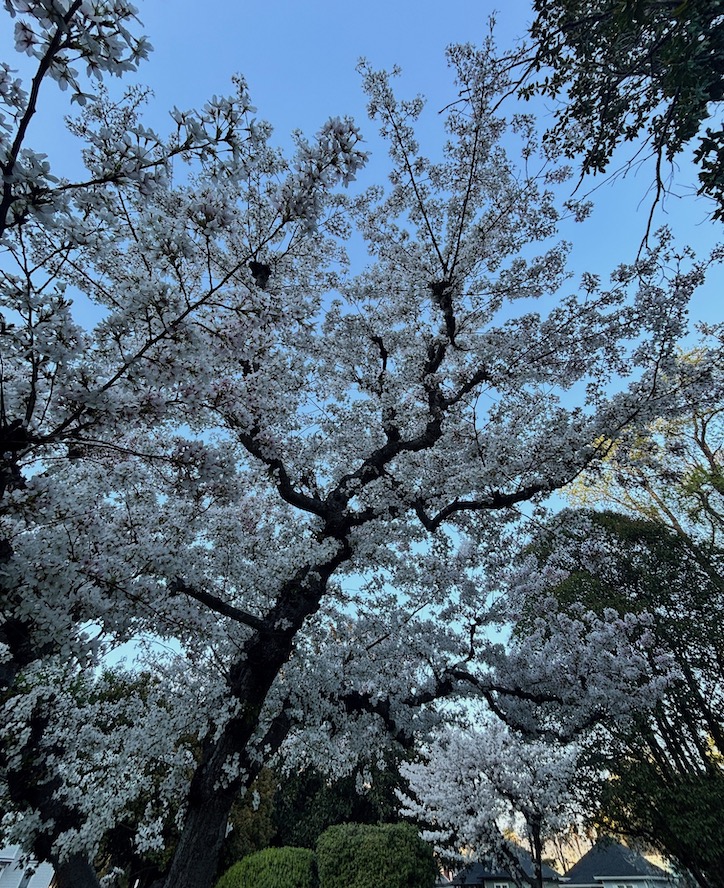
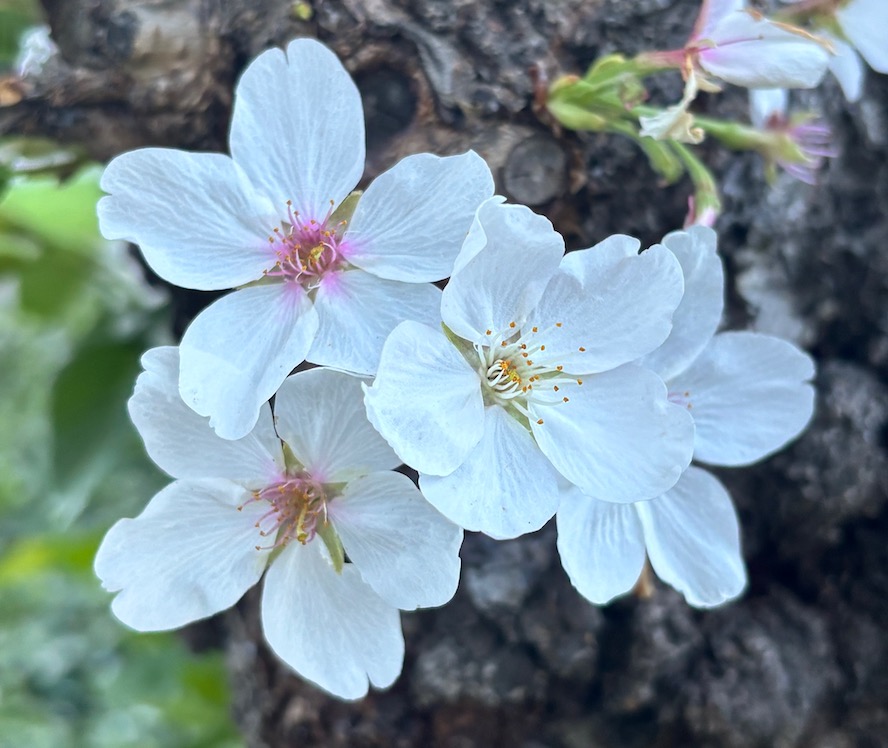
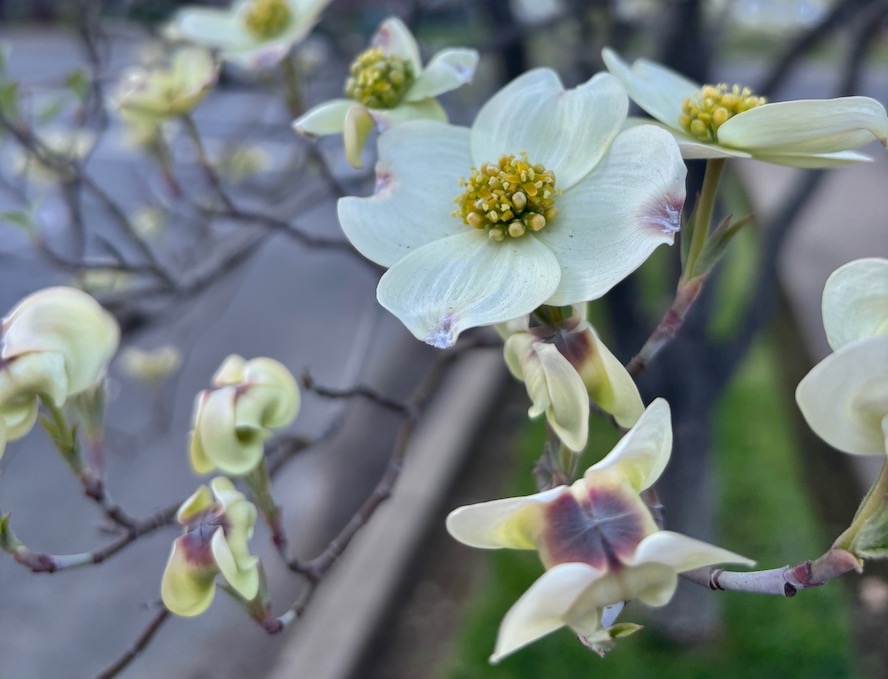
PRETTY SPRING BLOOMS (Dora Briley)
WILLIAM (BILL) OLAF JENKINS JR.
William (Bill) Olaf Jenkins Jr., 88, of Little River, California, passed away unexpectedly from a dissected aorta on March 1, 2026, at the Adventist Mendocino Coastal Hospital. He was a resident of Little River for the past 20 years.
Born on August 28, 1937 in Palo Alto, CA. Bill was the son of Williams Olaf Jenkins, Sr. and Katherine Jane Lawrence Jenkins. He loved living next to the Pacific Coast. He enjoyed every minute with his little dog Cindy.
He served in the army from 1958 to 1962. He retired from Kodak in Dublin, CA after 25 years.
Bill is survived by his son Gary Jenkins and wife Vivian of Oroville, CA and daughter Maria Williams of Springdale, AR. Two grandchildren and two great grandchildren.
He was preceded in death by his parents, William and Jane, brother David Jenkins and sister Susan Elisabeth Paup.
Per his request there will be no services.
RHODODENDRON SEASON IS CALLING and Fridays just got a whole lot prettier.
Join us for a guided Rhododendron Walk at the Mendocino Coast Botanical Gardens, led by Dennis McKiver of the American Rhododendron Society’s local chapter. The first Rhododendron Walk kicks off this Friday, March 20, and continues every Friday through April 24 from 1:00–3:00 PM, beginning at the main entrance.
During peak bloom, more than 1,000 rhododendrons light up the Gardens in a spectacular coastal display you don’t want to miss. Stroll among one of the Gardens’ signature collections—featuring 124+ species and 315 taxa, many cultivated right here on the Mendocino Coast by passionate local growers. It’s part nature walk, part insider tour, and all-around spring magic.
These walks are free with Gardens admission. MCBG Members attend free! Sign up at https://www.gardenbythesea.org/rhodo-walks.
2026 Walk Dates: Mar 20 • Mar 27 • Apr 3 • Apr 10 • Apr 17 • Apr 24
Come wander, learn, and maybe find your new favorite bloom.

FREE AV LAND TRUST WORKSHOP
Saturday March 21st 10-1pm, Anderson Valley Volunteer Fire Dept Meeting Room
Planning for your Legacy: a Succession Planning Workshop. This half-day workshop will feature Alexander C. Rich, an Estate Planning Attorney based in Ukiah and Willits, Scott Pilchard Financial Advisor with Western Skies Advisory, who specializes in property succession, and Price Sheppy, Conservation Director with Anderson Valley Land Trust, who will talk about community and family values associated with legacy planning, and using conservation easements as an option.
This will be a participant-driven workshop based on how in-depth the group wants to go with the information. There will be time for questions.
We still have plenty of room for more people to attend the workshop, and Spanish language translation will be made available upon pre-registration. Participants can register at www.andersonvalleylandtrust.org.
LOCAL ANDERSON VALLEY HONEY FOR SALE!
$45 per quart. Contact Misha at [email protected] to arrange a Boonville pickup.
KATY TAHJA: CALL OUT TO AV BURNERS (Burning Man Attendees)
I know there is a camp of Anderson Valley folks at Burning Man every year. I’d like to talk with them. Please contact Bookfairy Katy Tahja at [email protected].

THE 40TH ANNUAL SEED & SCION EXCHANGE
by Terry Sites
It was a seed lover’s dream come true. Those who found themselves at the Anderson Valley Grange on Saturday morning March 14th could have their choice of hundreds of seed packets free for the taking. Enthusiastic farmers and gardeners had to hold themselves in check to keep from sweeping the unbelievable variety on show directly into their shoulder bags. Whether you favor vegetables or flowers, there was plenty to get excited about.
This event was sponsored by the AV Food shed and Cloud Forrest Institute. Barbara and Rob Goodell are heavily involved in the organization of the event and must be commended for their contribution to our plant based community.
If gathering seeds was not your aim, the grafting demonstrations and free scions to take home for grafting were a whole other opportunity. At the back of the hall The Philo Apple Farm's Tim Bates was behind a long table filled with twigs. A lifetime of experience as an orchard man made him a likely target for grafting questions. There were many other scions available.
What is a scion you may ask? “A scion is a young shoot or twig of a plant especially one cut for grafting or rooting.” A second meaning: “A descendant of a notable family” as in “he was the scion of a wealthy family” is also pertinent. These twigs that can give rise to new varieties when grafted onto existing trees are indeed descendents of notable families in the plant kingdom.
There were ongoing talks in the Grange dining room.
10:15-11:45 - Basic Grafting by David Ulmer, 12-1 - Basic Seed Saving Josh DeVries and 1:15-2:15 – Farm Talk Round Table with Camila Guerrero.
The Grange was packed with enthusiastic growers. There was lots to see and many tips to absorb. For example, did you know that if you take a jar and put some rotten meat in it then insert a funnel, flies will fly in but will not be able to fly back out? If you take the jar to your garden with your plants needing pollination and remove the funnel, the flies will come out to pollinate. Did you know that in the book, “How to Grow Mushrooms” you can find a recipe that will allow you to inoculate a woodland location and harvest your own chanterelles or even morel mushrooms? Did you know that 14% of all humans grow 100% of the food we eat?
Seed savings is the foundation of the food system.
I was struck by the “glow” that some of the presenters emanated. They were so eager to share and so excited by what they know and were learning. I asked Josh Devries, head gardener at Orr Hot Springs, about this. He said that these growers gathered for the event had so few opportunities to be around other like-minded plant geeks that this day was important for all of them. Thomas Jefferson said, “I’m an old man but a young gardener.” The fountain of youth just might be found somewhere inside the love of plants and growing.
Camila Guerrero told us, “In the end everything works.” This is her summation of the process of adaptation that over the long haul all living things experience. It’s a very positive way to look at the future. She also told us that in the plant world there is a point where plants stop competing for resources and begin to co-operate. This is another great “words to live by” metaphor.
Lots of organizations were represented at the exchange. “Field of Dreams,” and “Agroecology,” among them. If you are a grower or a plant appreciator you can find your people for sure,
For more information look to avfoodshed.com/winter-abundance-fair. Also check out, “going to seed.org” and the book, “Seed Savers Exchange” which is a terrific resource.

VOTE FOR FRIEND, A JUDGE FOR ALL PEOPLE
(Candidate Statement for Superior Court Judge Candidate Colby Friend of Willits for Voter Pamphlet, June Election)
Judges like pilots, cannot afford an uncaring day at work. When you come before a judge what is at stake matters deeply to you. You deserve a judge who will listen attentively and give your matter careful and intelligent consideration. I will be a judge who does not prioritize corporations, so-called “elites” or establishment over people. I will not stand on endorsements from established legal insiders. We all deserve access to the Courts, and I will be a judge for all people.
I received my education at University of Virginia and Iowa Law. I am a dedicated local attorney, engaged parent, and community-minded citizen willing to participate in local public life and advocate for the issues I believe affect our community.
Increasingly this world is influenced by an establishment class who hold themselves above the law. Our Constitutional rights to free speech, to peacefully assemble, among others, are being threatened by government overreach. We need a Judge with courage to stand with the people, not the establishment. Justice is blind. My commitment is to apply the law fairly and ensure every person who enters the Courtroom is treated with respect.
FRANK HARTZELL:
Authorities have failed us. As friend Crystal said below, stay out of the water for now! Everybody. Its just sensible. Normally we would get something from them saying that. Posting something passively on Facebook does NOT COUNT.
NO POST ON FACEBOOK now 20 hours later by DFW!! Its about sturgeon! Also remiss here. are State Parks, who owns most of the beaches, including BR. Maybe they are putting up signs? Noboedy knows. Fear is everywhere authorities. 3. County Sheriff. 4. County disaster folks, who never do anything as far as I cfan see.
Those who COULD help even if not their job
Cities of FB and Point Arena. Close waters there and tell people when it will be safe and use the occassion to do education.
Big River Beach is now closed. Authorities have issued ZERO information about anything, which is a horrible shame folks. They simply dont realize that its PART OF THEIR JOB TO STEP UP during something that terrifies people and is not really a reason to fear sharks, btw, they LEAVE IT TO THE MEDIA WHICH IS IRRESPONSIBLE TO A LARGE DEGREE. There should have been press releases right away. (Frank adding this to Linda's story) They should be telling us RIGHT NOW IF its safe to go out, if other beaches are being closed, if the shark is being purused etc… Instead, DEAD AIR. The county's disaster dept, which hasnt shown up for a Tsunami (that ended up small, but still) should be involved, LOL, fat chance of that. Even in Jaws, the authorities were at least there to issue denials and such. UPDATE to the RaNT. LOL. I just had a friendly exchange with a surfer friend who called me a landlubber. I am NOT that. True- I know nothing about surfing and have never tried. 2. I am a wannabee fisherman, except with a spear who has to beg and borrow info about commercial fishing especially and find friends who are good at fishing, Im not. 3. I am a champion tidepooler. In the 8th grade I took a college course on oceanography, winnning a contest. I have been madly in love with tidepools ever since and wade up to my neck. I took pictures of about 100 abalone on Monday, only to fall in and lose my car keys, throwing the camera as i went to the bottom (it landed softly on the sand, but I could barley walk after this whole adventure and Brutus helped rescue me while Casear took the oppty to flee the leash and run 100mp into the distnance).I didnt realize the car keys were missing until we got back to the van and got to hang out soaking wet with the other homeless for three hours in Mendo till LInda woke up. LOL I need NEWS of what the hermit crabs are doing as much as human news. I love spearfishing and could tell teh authorities amazing stuff about the tidepools, if they would listen but they dont. And I am terrified of sharks, my bud. Just really , really think its not time to cause a lynch mob environment. Its still more likely to get struck by lightning and 1000x times more likely to get killed by the waves than the sharks. But me and the dogs wont be going near the water, the Noyo, the Navarro or Big River.
LOCAL EVENTS (this weekend)


BAD DOG PEOPLE (Coast Chatline)
Jean: We can't bear to buy plastic bags for our dogs' "calling cards," when we know there are lots of long-sleeved newspaper bags going to the landfill. If you're a daily newsprint newspaper subscriber, we'd love to have your bags, and will pick them up on a regular basis at your convenience. We're in Mendo, but are happy to travel between say, Albion and Inglenook and points between. Thank you in advance!
Daney Dawson: On that subject, I've noticed a strange phenomenon in my neighborhood and elsewhere. Little bags of doggie poop, sitting beside the road. People, if you're not taking the doggie poop with you, don't put it in a plastic bag! Just leave it there to decompose. The plastic bag will be there forever and is litter.
Jean: This is a common phenomenon in Marin. I've seen a public trailhead, outfitted with a wastecan, with dozens of them in a 15-20' radius. Missed the can? Oh, well. I'll pick it up on my way back…but then they don't, and in the meantime, everyone is greeted by them. People also leave them alongside trails. Charming. Some of those bags are biodegradable, but it takes a LOOOONG time, and many of those trailheads are in the MMWD watershed. EEEEeeeew.
I'm seeing more of this along the Headlands in Mendo. I tell myself it's out-of-towners, but when it's midweek in the winter, it's harder to convince myself.
Still haven't gotten any offers for newspaper bags. As we walk, we pick up trash and other poopers' bags, so you'd be doing a good turn for the environment, too! If you want to store up Sunday-paper bags over a long period, that works, too!
Thanks again, and let's hope people stop doing this sh---y thing!
BOONVILLE, AN UNRIVALED, FULL CIRCLE GETAWAY EXPERIENCE
by Dannah Nielsen
Out of sheer good fortune (or a million years of evolution, take your pick), California is bountiful in its number of lush wine-growing regions across our golden state. A well-known fact, but yet still a contentious conversation with locals anywhere, as I was reminded my first evening settling in to the Boonville Hotel, aptly nestled in the smack center of the Anderson Valley wine country and also aptly nestled smack center of a tale as old as time: the tale being, of course, about superior grape growing soil.
We (myself and my new found friends and I) sat around the bar, glass in hand, and talked of the good old days: when Napa soil was rich, and tastings were free. Now, a local insisted that Anderson Valley is positioned as prime soil real estate. I don’t hold my degree in Viticulture, but I do know how to have a good time, and based on my weekend in Boonville, I’d hedge my bets that she knew a thing about this dirt she spoke of.
Anderson Valley boasts what any good wine region boasts: a two-lane highway dotted with dozens of tasting rooms around every curve, a small handful of tiny towns in between, and unsuspecting 5-star restaurants, coffeehouses, and mercantiles next to organic farm stands weathered down by decades of travelers. Where to even start?
To appreciate all this region has to offer, one would need either a weekend getaway (as we did) or a series of day trips spent driving in to explore. We arrived at the Boonville Hotel on an early Spring day, expecting a charming, quaint stay but not truly expecting the luxurious experience it turned out to be. This welcome was the first clue we were in for something unique- a getaway unlike anything typical.

The Boonville Hotel has its beginnings as a Roadhouse, and as with so many historic flagships, many colorful memories and peak moments have formed in its wake. It also serves as a signal to travelers that one cannot just arrive for the wine but must stay for an entire culinary adventure. We began our own trek with an absolute must-do when in Boonville: a smorgasbord of a cheese-forward charcuterie board with wine tasting at Penny Royal Farm, enjoying livestock and vineyard views, all made in-house. We then rolled our glutenous selves North from there, but not without first feeding the goats who so generously fed us.
We made several more winery stops along Highway 128- too many to individually review, actually; however, there was a common theme throughout each: The welcome, the joyful conversations, and the weathered and worn countryside vibes. It seemed there was an unofficial ambiance the winemakers were all collaborating on, or perhaps it was built in with the rolling hills and rolling fog. Our economic support included Maggie Hawk, Husch, Goldeneye, Toulouse, and Lula Cellars- only a small handful of the many tasting rooms that are sprinkled left and right on the 11 miles from Boonville to Philo.
But for those who are less inclined to study viticulture by the glass, there is good news- California State Parks has carved out some adventures of its own with the very local Hendy Woods and Navarro River, both easily accessible by car and further on by foot. Flat trails loop around old-growth redwood trees and on down to the water, making it easy for all ages and abilities to enjoy some solitude amongst Mother Nature’s giants. I’ve never met a redwood tree I didn’t love, including ones that have fallen to expose their massive and wondrous root systems. An attraction in itself.
Other attractions worth mentioning are the locally sourced businesses that also beckon from the highway. Perhaps it’s a California thing, but I am here to convince the masses to join the movement of supporting your local farmstand. Anderson Valley has a few you can quickly pull over for the showstopper for us, being Philo’s Apple Farm, and Filigreen’s, when in season. There are also a few country stores and mercantiles that share local art and craftsmanship, as well as the favorite Pepperwood Pottery. A short drive up a gravel road leads you to a small botanical garden filled with a collection of sheds that are home to various ceramic masterpieces, both inside and out. To walk the path is to enjoy a moment of whimsy created by Doug Johnson, his impact spanning over 50 years of pottery.
As mentioned earlier, a trip to Boonville is actually an unsuspecting culinary adventure-that is, if you haven’t done your homework. But here are the provided cliffnotes: Jumbo’s WinWin burger joint is a surprising and delicious step back in time, a homage to the retro diner we all deeply miss from our childhood. Don’t be intimidated by the long lines; they move quickly!

Paysanne is the coffee and sweet treat shop your dreams are made of, and despite coffee houses being a dime a dozen, Paysanne has somehow designed itself to stand apart- conformity not in their language or their palette. The hand-painted ceiling alone challenges your beliefs of what realm you’re currently in as the barista hands over your carefully crafted latte art.
And for the first time ever, I feel compelled to share a restaurant we regrettably did not enjoy due to timing, but are planning a whole follow-up trip just to experience: Offspring, a handmade pasta and pizza restaurant sourcing local ingredients and local talents. Peeking in on their dining room, and their social media, has left us with a severe case of FOMO and a bit of embarrassment at the thought of writing a story highlighting Boonville without mentioning or trying this town jewel.
However, the Boonville Hotel and Restaurant is the true town beacon on multiple fronts, and leads the way with bold charm and innovation throughout the whole region. The proprietors, a network of family (and friends that are like family), have chosen a color palette, a collection of artists, visionaries, a common design vibe that touches everything from the furniture to the room keys, and seemingly created an entire mission of serving this community and its visitors with an unmatched experience that spans up and down the Valley. The Restaurant here contends with the best of the best- as they should. Descendants of The French Laundry, and collectors of Michelin stars, the chefs design their menu each day from what is growing in their onsite garden and from local farms. A full circle culinary adventure that should be on every Californian’s Must-Do bucket list, we cannot recommend this getaway enough.
To experience the Boonville Hotel, book your stay at www.boonvillehotel.com
To plan your adventure around the Anderson Valley, visit www.avwines.com
For more ideas on exploring Boonville and all of California, follow @ca.love.fornia on Instagram.
(Ukiah Daily Journal.)
CAPTAIN LANSING’S INTRODUCTION TO MENDOCINO
edited by Averee Mcnear

David Frederick Lansing was born September 14, 1809, in Albany, New York. From the Albany genealogical records, it appears that the original Lansing (also spelled Lansingh or Lansinck) came to New York from Holland around 1650. Like many New England youths, David went to sea at an early age. His first long voyage was on board a whaler, which spent three years in the south Pacific. The young Lansing loved life at sea. He proved to be quite an able seaman and, being of some intelligence, became a Captain in his early twenties. He made many voyages around Cape Horn and earned moderate success as a whaler.
In 1849 Captain Lansing and his family, wife Charlotte Whipple and two daughters Mary and Charlotte, boarded the Hanna Sprague in New York harbor and sailed around Cape Horn to San Francisco. They arrived on November 12, 1849. The entire voyage took 175 days to complete, consisting of 18,000 nautical miles.
According to records kept on the ship, a committee composed of Alfred Wheeler, Samuel J. Bookstaver, Charles F. Clarke, and Maurice Twiss presented Captain Lansing with a resolution saying that he “combined the courtesy and generous impulses of a manly heart and the skill and sagacity of a seaman perfect in his profession … while we are about to separate from him, we tender to him our earnest thanks as an expression of our full satisfaction, and our best wishes for his future welfare and prosperity.” Not much else is known about Captain Lansing or his family during the years 1849-1852, other than Charlotte giving birth to Francesca “Fanny” Lansing sometime between 1851 and 1852.
In 1852, life for the Lansing family changed considerably. David became Captain of the brig Ontario, a 557 ton ship built in New York in 1812 by A&N Brown. The Ontario was to carry machinery owned by Henry Meiggs for the building of a sawmill at Big River, later known to be Mendocino City. E.C. Williams, William H. Kelley, and J.E. Carlson were all on the ship. Meiggs employed Lansing to pilot the ship to Mendocino Bay and remain as supervisor of shipping at the new undertaking.
Meiggs ran into financial difficulties in 1854 and left the country. Five men, Aldred Godeffroy, William Sillem, John Freundt, J.B. Ford, and E.C. Williams, reopened the mill under the name Mendocino Saw Mill the following year. They retained Captain Lansing as harbor master and shipping superintendent until 1874. Walter Jackson states in The Doghole Schooners that Captain Lansing spent many days in a rowboat locating dangerous underwater rocks and reefs in Mendocino Bay and marking them as menaces to navigation. Lansing was instrumental in saving the lives of many from a watery death when they happened to be unlucky enough to be aboard a vessel that had gone up on the beach or was being dashed to pieces against the rugged cliffs surrounding the Bay. Captain Lansing often remarked that he had witnessed the deaths by drowning of at least fifty persons in the Bay as the result of shipwrecks, capsizing rowboats, falls from cliffs, or from being washed off the rocks while fishing.
Shipping served as the most efficient lifeline to the Mendocino coast prior to the railroad age. Lumber, agricultural products, passengers, and freight were shipped between San Francisco and Mendocino by means of schooners. Lansing was the first to supervise this operation out on the Point.
To date no records remain containing explanations of day-to-day operations on the Point. Captain Lansing and his associates left us precious little information expounding on the excitement or monotony of transferring lumber, goods, and passengers out from the Point to the schooners. It seems, though, that under the supervision of Captain Lansing the operations were carried out efficiently.
When he arrived in Mendocino, Lansing’s plans included bringing his family up from San Francisco as soon as possible. He built one of the first houses in Mendocino. Because the lumber cut by the mill in Mendocino was green rough stock, Lansing considered it unsuitable for the construction of a home for his family, so he purchased the lumber for his house in San Francisco. After Charlotte and David died, in 1867 and 1877, respectively, their daughter Julia lived in the family home for some time. Julia married James Morrow in 1874, and he intended to build an addition to the house and convert it into a hotel. The Morrows moved away from Mendocino but returned in March 1888. Today the house [on the northeast corner of Main and Howard Streets] is still standing.
(This piece was excerpted from the Mendocino Historical Review, Spring 1985. The Kelley House Museum is open Friday-Sunday, 11am-3pm. Visit the Kelley House event calendar for a walking tour schedule: https://www.kelleyhousemuseum.org/events/month)
CATCH OF THE DAY, Thursday, March 19, 2026
RILEY ANDERSON, 26, Ukiah. Battery with serious injury.
ELIAS BEARD, 43, Albion. Controlled substance for sale/transportaation, paraphernalia, vehicle registration tampering, probation revocation.
MARK BILAFER, 59, Vallejo/Ukiah. Reckless evasion.
LORENZO CRUZ, 37, Ukiah. Burglary, controlled substance with two or more priors, paraphernalia, appropriation of lost property, obtaining personal ID without authorization.
DEREK EASTEP, 40, Ukiah. Paraphernalia, evidence tampering, probation revocation.

IGNORING MEDICAL HISTORY
Editor:
Perusing the obituary notices, an unfortunate habit, I found a stark history lesson. A woman died shortly after her 100th birthday. Her brother died at age 12 from meningitis, now a vaccine-preventable disease. We ignore history at our peril. Ironic that Robert F. Kennedy Jr. does as well.
Dr. David L. Smith
Santa Rosa
DON'T PAY
Editor:
When the media report consistently for months that a majority of American voters do not support or want to help pay for evisceration of federal service functions, destruction of historical monuments, aggression in Gaza, the rollback of climate protection legislation, ICE raids all over our country, war in Iran or other ill-conceived initiatives of the administration, I conclude that we are being subjected to taxation without representation. I object. I refuse to pay on April 15. I will tell the president and my legislators. It will be a small act of civil disobedience, and it will not change the world. Since I don’t owe much (a couple of thousand), the penalties and fees won’t amount to much. But it will be a slightly stronger protest than joining the No Kings rally on March 28. Maybe others will join me.
Elizabeth Boardman
Santa Rosa

PETE & LARRY
Editor:
It has often been said that the first casualty of war is truth. In an effort to perpetuate that trope, “War” Secretary Pete Hegseth complained about CNN’s coverage, saying “the sooner David Ellison (right-wing billionaire pal of the president) takes over that network the better.” Ellison’s Paramount Skydance is applying to Trump’s government for approval of the acquisition. The notion that Hegseth would so boldly foretell such government action is bad enough. But the larger implication should truly terrify those who treasure a free press.
Trump and Hegseth are unhappy with CNN’s war coverage. They boldly admit that when their buddy Ellison gets his permit, they will just make the free press network CNN disappear. So in the future when someone says “the war will end when I feel it in my bone(spur)s” in response to some moronic presidential announcement, it can just be censored out by our increasingly fascist government.
Farewell, free press.
Eliot Lee Daum
Santa Rosa
WRONG ANSWER
Editor:
I recently attended a memorial for a friend, a career Air Force officer and Vietnam veteran. The service touched my heart deeply as I listened to the wonderful things said about him, especially by friends who were veterans. It was moving to hear “Taps” played and watch the ceremonial folding of the American flag. I felt a sense of patriotism and love for my country, something I had not felt for a long time.
I thought of my uncle, Nathan, who served in World War II. He suffered terribly from what they called shell shock. I thought about all he stood for and how much he loved this country. With feelings of patriotism, and thinking about the commitment these men made, I found myself asking, “What’s going on?” How is this happening? We are at war, the killing of innocents, schoolchildren and teachers and bombing hospitals. It is not only immoral, but downright crazy. We talk about putting the Ten Commandments in every school while we violate every one of them.
As a woman, mother, grandmother and great grandmother, I say stop the craziness. If war was the answer, we would have had peace a long time ago.
Elaine B. Holtz
Santa Rosa
MITCH CLOGG:

In America, a pissant is an inconsequential person and the smallest of many ant species. They are black, highly social bugs. I like them. They have excellent manners. Watch them at work. They travel to and from the nest, scouting for food (sugar’s their fave) and carrying it back to the nest. Going and coming, they stop at every other ant, identify themselves, greet and go on their way.
I prefer not to kill pissants because they’re nicer than me, and I feel I know a bit about their habits and personalities. That is, I thought I did, like they are more a problem in rainy weather. I assumed it was because it’s too wet, and they come in the house to escape flooding.
So how come the house is overrun? It’s dry. Wretched February was the nicest I can remember. Winter 2026 has been a rather pleasant one on Wheeler Street, precip coming in relatively brief, intense storms, overhead rivers that dumped a good supply and quit. My rain gauge is a peanut-butter jar. The few intense rains have kept it well filled. Now, say I reluctantly, we need ONE MORE RIVER. Otherwise, there will be a shortage of lettuce, and the whole damn state will burn down, come spring, summer and fall. (BTW, spring starts early this year. Spring will slip in Friday morning at 7:46, March TWENTIETH.)
But this was about ants. It could be about my age, Trump Derangement Syndrome (the present’s phrase for “despair”), global climate, ICE or any number of current topics, but it’s about ants because enough already with those other things. They all point to the failures of Nature’s Human Experiment and humanity’s failure of the Democracy Experiment. I can’t bear it.
One day, passing a neighbor’s house, we saw a big box with a refrigerator in it, outside the front door. Some delivery people had left it there. I thought maybe the guy needed a hand wrestling it into place. No one answered my knock. The door was unlocked. My neighbor lay on the kitchen floor, looking at the ceiling through slitted eyes. “Shit,” thought I as I knelt for a closer look and saw pissants crossing his face, calmly, politely and busily. Man, what a job those ants had facing them!
SI was with friends who hadn’t yet come in. So I came back out the door, muttering imprecations. Why me? I don’t even know the guy. Why am I the one to find him? I’ve seen way too many motionless bodies. I saw this man alive shortly before. He was out back, picking huckleberries on the vacant property. I was familiar with his face but didn’t know his name. I asked him what he did with huckleberries. He made liqueur. Maybe that’s what got him down. Too many fermented huckleberries. Anyway, my take on pissants, despite their excellent manners, is complex.
TAKE A LOOK
God Realization, American Postmodernism, and the Sound of No Hands Clapping.
Warmest spiritual greetings, Realize that one's true identity is found in deepest meditation, when the body and the mind are nowhere seen. This is the state of "prior to consciousness". This is "God Realization", and hence one no longer identifies with the world, knowing that God, or the Divine Absolute, alone is real.
What one does on the planet earth in terms of social action happens spontaneously, with no interference by the individual, whose mind has been spiritually absorbed. Like an expert dancer, no step is missed.
There is nothing left to achieve. The brahmic vrittis (spiritual thought waves) have taken over, the body-mind complex is an instrument only, and the ego is understood to be the fantasy which it is.
I am available on the planet earth, and may leave the homeless shelter in Washington, D.C. at any time because I've no further reason to be there. The D.C. Peace Vigil is gone, removed by the current presidential administration because it was declared out of synch with the new aesthetic upgrade for the District of Columbia. After 44 years 24/7 365 opposing nuclear weapons and war, we did succeed at making our collective statement. Individuals from the group continue to make political statements in front of the White House.
There is $5,350 in the bank, $235.27 in the EBT account, $27.14 in the wallet, and enough health insurance for a family of four. I am available on the planet earth for spiritually sourced direct action. Please contact me.
Craig Louis Stehr, [email protected]
RE:

Marco McClean:
I wrote here, “What is happening in the painting The Bad News, by Leslie Thrasher? I can imagine story after story applying. If you know what the artist intended, please say it,” but before I clicked to post that, I asked ChatGPT. Here’s its answer:
The Bad News (1926) by Leslie Thrasher is a cover illustration for Liberty magazine, part of a weekly serialized visual story called “For the Love o’ Lil.” It’s one frame in an ongoing soap-opera-like narrative, not a standalone allegory.
The situation is very specific: A man named Sandy sits at a table, clearly upset. Across from him, his romantic interest Lil is being charmed by a rival—Babe Dolan, a confident lifeguard. Babe is flirting and promising to train Lil to be a swimmer. Lil is captivated and paying attention only to Babe. Meanwhile, a waiter arrives with the bill. Sandy, humiliated and sidelined, has to pay for the whole outing—using nearly all the money he has.
Sandy is losing the girl. He’s being replaced right in front of him. And he’s literally paying for the privilege of watching it happen.
That combination—romantic defeat plus financial insult—is the bad news.
Bob Abeles:
Intrigued to see where ChatGPT got its training data for this illustration, I researched the series and tracked down the October 2, 1926 issue of Liberty Magazine. Leslie Thrasher produced a series of cover illustrations for Liberty Magazine following Lil through several years of her life. Accompanying each illustration, a brief story describing the depicted scene was provided by the illustrator. Here is what Leslie Thrasher wrote in the October 2, 1926’s number:
SANDY JENKINS sat through an entire dinner watching Babe Dolan, the athletic lifeguard, doing his best to vamp Lil Morse. That was certainly no treat to Sandy. But when they’d finished, with nothing left but coffee and cigarettes, and the waiter hovered around with the check in his hand, Sandy tried everything he could think of to let Babe know that the time had come to loosen up.
Not a chance. Babe was busy listening to his own voice, and Lil sat spellbound.
“I could train you so’s you could swim the Channel faster’n Gertrude Ederle and this Miss Gade both put together,” Babe was telling Lil.
Sandy could only scowl in scorn. But there was the waiter, gently insistent. Sandy peeked at the check. Holy smokes, $11.40! He had just $13.25 with him and wouldn’t get his allowance for nearly a week. In lofty disgust he handed the waiter a ten-dollar bill and three ones, saying as loud as possible:
“Keep the change.”
“I could make you the champeen swimmer of the world,” Babe Dolan was telling Lil.
“And she listens to that big cheese!” was Sandy’s thought.
I think you’ll agree that it is a much more interesting and nuanced story than ChatGPT’s.
OVERNIGHT STAY ON SAUSALITO BOAT PROVES THE BAY NEVER SLEEPS
by Carl Nolte

It was a beautiful Saturday night in early spring, perfect for a late dinner in Sausalito by the dock of the bay. The last ferry had sailed, and the moon had come up. San Francisco glittered across the bay. So, I thought to myself, why not make the evening last? Maybe I’ll spend the night on the boat.
There’s something about staying aboard a boat all night even if it is tied to the dock. It was as if the boat were expecting you. Jack London and his wife, Charmian, kept a 30-foot sailboat named Roamer on the Napa River, and toward the end of Jack’s life it was a refuge.
By then he was rich and famous and lived and wrote on a fabulous ranch in the Valley of the Moon. But sometimes life ashore was too much. He thought of himself as a sailor on horseback, and he missed the sea. “I began to grow restless,” he wrote in a short essay on small boat sailing.
On those days, Jack and Charmian packed up their sailing gear, “and we are off for Vallejo where the little Roamer lies, waiting, always waiting for the skiff to come alongside for the lighting of the fire in the galley stove, the pulling off of the gaskets, swinging up of the mainsail … and for the twirling up of the wheel as she fills away and heads up Bay or down.”
I thought of that as I stepped aboard my own boat. I felt it move a bit as if we were going to sail away. But I was not about to fire up the engine, back out of the slip and head out into the dark Saturday night. Instead I set up a bit of water for a pot of tea and sat on a chair aft and listened to the wind.
After a bit, instead of turning to, as real sailors say, I turned in. I’ve had boats for a long time; different boats with different berths, but as every small boat sailor will tell you, no matter how comfortable the vessel is, the mattress is always hard, and no matter how vivid the sea dreams are, the nights in port are always long.
Sausalito at night is quiet: The citizens are all asleep, no sirens, no noise. But in the harbor there is sound: the slap and rattle of the shrouds if a wind comes up, the creaking of the floating wooden dock as the tide rises or falls. Sometimes a mooring line will come taut and you hear it, even in your sleep. The boat moves, even on a calm night, and you feel it under your back. It is a reminder that you are not on land. The salt water is always alive. The bay never sleeps, not ever.
A fitful sleep and then first light. A special time, I thought, not 5 in the morning, not 6, not night, not quite day. I was told that photographers and painters like first light. It brings out the quality of the world. Once, when I was on a hiking trip in the Yosemite backcountry, I was shaken awake before dawn by a photographer friend. “Get up,” he said, “You are missing the light.”
I knew what he meant. Back in my sometimes salty past, I got to sail as a volunteer ordinary seaman aboard the SS Jeremiah O’Brien, a historic ship. On this trip, we were heading south along the coast bound home from Seattle to San Francisco. I had the 4 to 8 watch, 4 to 8 in the morning and 4 to 8 in the afternoon. “You’ll like it,” the mate said, “you see sunrise and sunset, both.”
I liked the morning watch best. Rolled out of the bunk before dawn, I’d stand on the bridge wing for a bit until my eyes got used to the dark. The mate would give me the course, and I’d relieve the man at the wheel. I could see the horizon after a bit and then the forward end of the ship clearer and clearer. What I liked best was seeing the stars sink into the ocean. Starlight fading.
I was thinking of the deep water on my Sausalito Sunday morning, watching the night fade and the day start.
Dawn came soon enough in the Sausalito harbor, almost 7. Some clouds, a hint of fog from the Golden Gate, the rising sun heading up just south of Angel Island, the morning sunrise reflected in the still waters of the harbor. A sea light, poet Lawrence Ferlinghetti called it.
A new day. Sunday morning at sunrise. But I had business in the city that day, so enough dawdling. A quick cup of morning coffee, black, the way sailors drink it. Check the mooring lines, give the boat a little tap on the nose, just above the bow. See you next time.
Then off to the morning bus. Sausalito’s streets were empty, not even a bicycle. A wisp of fog on Mount Tamalpais. Nothing else.
The Golden Gate bus came, bound for San Francisco, on time for a change. It was full, but all the passengers got off, laughing and speaking Spanish. When the bus pulled out headed for San Francisco on a Sunday morning run, there was only one other passenger.
There was hardly any traffic. Over the bridge, into the city, up Lombard Street to Van Ness Avenue, off at Union Street to switch to a Muni bus, running down Van Ness, a swing onto Mission Street and heading south.
You never know what you will see on a bus in the city: visiting tourists, lost souls, ordinary San Franciscans.
Sometimes, coming from a night on a boat in Sausalito and landing in San Francisco is like a voyage to some exotic foreign port.
San Francisco can be beautiful on Sundays, but not before the city wakes up. And not at 15th or 16th streets and Mission. There are people on the street, slouching, sitting in heaps or trash, perhaps left over from a bad urban dream. There are two sides to every Sunday dream.
(sfchronicle.com)
THE FARMWORKER MOVEMENT WAS ABOUT MORE THAN CESAR CHAVEZ
by Briana Torres

For decades, Cesar Chavez has been treated as the moral icon of the Latino civil rights struggle. In San Francisco and other cities and towns across the country, his face appears on murals, his name is stamped on streets and schools, and his legacy is honored with a federal holiday. For many Americans, Chavez represents the fight for justice for farmworkers, and his name is often the first mentioned when people speak about Latino leadership in America.
I remember sitting with my Latino debate group in high school in Texas, where we dedicated a day to watching a 2014 film about Chavez. We were encouraged to admire him, to march in his name and to see him as someone to look up to. He was presented to us as an icon, a good man who fought for dignity and justice for Latino workers.
That was the version of Chavez many of us were taught. But hero worship is dangerous.
A New York Times investigation published Wednesday has brought renewed attention to allegations that had circulated for decades that he sexually abused, raped and groomed women and girls connected to the farmworker movement. Survivors described abuse at the movement’s headquarters in California, including allegations involving girls as young as 13. According to those accounts, these were not isolated incidents but part of a pattern enabled by a culture that prioritized protecting Chavez’s image over protecting the women and children within the movement.
The reporting shocked many readers. But the truth is that Chavez’s reputation was already strained long before this week’s headlines; historical records from 1979 show a long history of his divisive rhetoric and troubling internal practices.
The silence surrounding Chavez was not accidental. Movements often protect their leaders in order to protect the cause itself. In Chavez’s case, preserving the heroic narrative became more important than confronting the harm. Women were discouraged from speaking out, and exposing misconduct was framed as a betrayal of the movement that would destroy the union and undermine the struggle for farmworker rights.
This is the cost of leader-centered narratives. When a movement allows its history to revolve around one man, speaking out against him begins to feel like betraying the revolution itself. Truth becomes secondary to protecting the image of the leader.
This dynamic is a moral and structural failure. Federal sexual harassment law under Title VII of the Civil Rights Act of 1964 recognizes how authority figures can exploit power over subordinates. The farmworker movement of the 1960s and 1970s operated in deeply male-dominated spaces where that power often went unchecked. Chavez’s saint-like public image became a shield that rendered victims invisible.
But the fall of an icon does not require abandoning the cause. When an icon collapses, people often feel forced to choose between defending the man or abandoning the movement he represented. That is the wrong choice. The farmworker movement was never Cesar Chavez alone.
Hero worship does more than distort history. It protects abusive men while erasing the collective effort that builds movements in the first place. The farmworker struggle was carried forward by thousands of workers who organized, marched and risked their livelihoods to demand dignity in the fields. Families fought for fair wages, safer working conditions and the basic right to organize.
And it was built by leaders like Dolores Huerta, who also recounted being sexually abused by Chavez.
While history often casts Huerta as Chavez’s ally or second in command, she was in fact a central architect of the United Farm Workers. She co-founded the union in 1962, helped lead the 1965 Delano grape strike, negotiated the union’s first contracts and coined the movement’s most enduring rallying cry: “Sí se puede.” She was a strategist, an organizer and a negotiator who helped sustain the movement through some of its most critical moments.
Yet Huerta rarely occupies the same place in American history. Our culture has long struggled to see women as the face of revolutions, and misogyny has often pushed women’s leadership to the margins. Movements that are centered around a single, male hero frequently push women’s contributions into the background. Once a man becomes the symbol of a cause, protecting him can become synonymous with protecting the movement itself.
The problem is not only what Chavez did. It is that the farmworker movement allowed its history to revolve around one man in the first place. This “great man” theory of history erases the collective labor that builds social movements and creates the hero worship that allows misconduct to remain hidden for decades. As history shows, unchecked power often leads to exploitation; Chavez used his position to subject women and girls to years of systemic mental and physical abuse
Since this moment forces a reconsideration of Chavez’s legacy, it should also force a correction in how we tell the story of the farmworker movement.
The movement’s history does not need to disappear because Chavez failed to live up to the heroic reputation built around him. And it needs to stop revolving around him. Recognizing the leadership of Huerta and the thousands of unnamed farmworkers who built the United Farm Workers is a good place to start.
Justice movements cannot depend on heroic narratives. They must be strong enough to confront the truth.
The farmworker movement was never just about one man. It was always a collective struggle for dignity and justice. And if history is going to remember that struggle honestly, it must finally give the people who built it the recognition they deserve and ensure that those who abuse power are never again protected by the narratives we build around them.
(Briana Torres is an attorney and the Maeve McKean Women’s Law and Public Policy Fellow at Georgetown University’s O’Neill Institute for National and Global Health Law and the National Health Law Program. Her work focuses on health law, reproductive justice, civil rights and gender equality.)
THE MOMENTS THAT HAVE DEFINED CALIFORNIA WINE OVER THE LAST 10 YEARS
by Esther Mobley

The changes to California wine over the past decade have been monumental.
When I joined the Chronicle in 2015 to cover the beat, wine in America felt ascendant. I arrived in the middle of a decade during which California retail wine sales within the U.S. ballooned from $30 billion in 2010 to $47 billion in 2020, according to the Wine Institute, a nearly 57% jump. The beverage finally seemed to be shedding its reputation as an obsession for snobs, and — thanks in no small part to a new wave of boundary-pushing winemakers from California — was instead becoming a worthwhile interest for people of all stripes.
No one could have known it at the time, but the wine industry was approaching the end of innocence. Soon, Wine Country would be forced to confront the era of mega wildfires. Climate change would threaten to alter the flavor of our wines. The rise of natural wine would lead to an ideological clash between the industry’s establishment and its avant-garde. Consumers would start to feel that California wine — and, in particular, the experience of visiting Napa Valley — was just too expensive.
Then, of course, the pandemic and its aftermath would fundamentally alter the way our society interacts with alcohol, leading to a downturn in wine consumption and an industry crisis that will by now sound deeply familiar to even a casual reader of this newspaper.
As I depart from my role as the Chronicle’s wine critic, I’ve been reflecting on this extraordinary transformation over the last decade-ish in California wine. Here’s what I see as the period’s major inflection points.
2015: Rosé went viral
Remember when the wine industry’s biggest controversies revolved around obnoxious rosé hashtags? Yes Way Rosé, Rosé All Day, Drink Pink, Brosé. This was peak rosé craze, the culmination of pink wine transforming from something saccharine and tacky (Sutter Home white Zinfandel) to dry and classy (Whispering Angel). The shift in quality in the aughts and early 2010s was legitimately exciting, but by 2015 rosé had gotten too popular for its own good — people saw it less as a wine and more as a beach accessory. Its dominance on Instagram (especially the celebrity-founded White Girl Rosé brand) would turn out to be an early precursor of the social-media influencer era: Now, wine content would be reaching a wider than ever audience, but the content, like many of the made-for-Instagram rosé brands, was frequently trash.
2016: The new cult wines
In the ’90s, Napa Valley’s so-called “cult Cabernets” changed the game. This exclusive set — Harlan, Screaming Eagle, Colgin, Bryant, Araujo, Grace and Dalla Valle — produced ultra-expensive wine in ultra-scarce quantities. By 2016, however, the fever had broken. Although the cult Cabs still enjoyed (and continue to enjoy) an audience, the zeitgeist had moved on from those wines’ luscious, full-bodied richness to an entirely new flavor. This era’s trophy wines — Arnot-Roberts, Ceritas, Dirty & Rowdy, Sandlands and Ultramarine — were mostly from Sonoma County, not Napa; were far less expensive; prized lower alcohol levels; embraced a wide range of grape varieties, not just Cab; and had a scrappy, approachable feel, a far cry from the exclusivity that the original cults had cultivated. Unlike the cult Cabs, which had all been fairly similar in profile, these wines occupied the full flavor spectrum. It marked a sea change in California wine style.
2017: Wildfires came for Wine Country
California has always been acquainted with fire. But the cluster of wildfires that erupted in Napa and Sonoma counties in 2017 — including the Tubbs Fire, which wiped out entire neighborhoods of Santa Rosa, and was at the time the most destructive wildfire in the state’s history — signaled a new, disturbing normal. A handful of wineries, including Signorello, White Rock and Paradise Ridge, were mostly or entirely destroyed. This was the year when people really started worrying about smoke taint, the phenomenon whereby wildfire smoke can impart unpleasant and irradicable flavors into wine grapes (even if no one yet had any good answers about how to address the problem). In retrospect, however, the 2017 fires’ impacts on the wine industry would come to look relatively minor compared with what the subsequent years would bring.
2018: Land-use issues divided Napa Valley
The 50th anniversary of the Napa Valley Agricultural Preserve — the first land-preservation effort of its kind in the country — happened to coincide with a highly controversial ballot measure in the county in 2018. Ostensibly, Measure C asked voters whether wineries should be limited in their ability to cut down oak trees in order to plant vineyards. But really, it was about much more: Had Napa Valley planted so many vineyards that its vintners were actually harming the natural environment? Does agriculture constitute a protection of the land, or a devastation of it? These arguments weren’t new for Napa, but Measure C (which ultimately failed at the ballot box) brought them to the fore in an unprecedented way.
2019: A reckoning with climate change
By 2019, progressive-minded California wineries were thinking hard about how climate change was affecting their wines — and now, many vintners began interrogating the basic tenets of modern viticulture. In Napa Valley, a few outspoken winemakers audaciously questioned whether Cabernet Sauvignon could really remain the region’s cash crop forever, arguing that warming temperatures could soon push it into a zone where it might no longer taste good. Wineries such as Spottswoode and Larkmead began planting heat-tolerant grape varieties — including Portuguese grapes like Touriga Nacional or Spanish ones like Tempranillo — as experiments, moves that seemed controversial at the time but have since become much more common.
2020: Wildfires, wildfires, wildfires
As if 2020 weren’t bad enough for the obvious reason, the year proved to be downright apocalyptic in Wine Country, with a series of fires that would in some ways change the course of the California wine industry. Dry lightning strikes throughout the state hit at the beginning of harvest, rendering many grapes smoke tainted before the season even started; a month later, the devastating Glass Fire destroyed or damaged more than 30 Napa Valley wineries. The impact on grapes was so widespread that many wineries decided not to produce or release any wine at all from the 2020 vintage. The disasters prompted a wave of new research into smoke taint and wildfire prevention for wineries.
2021: Natural wine hit the big time
The natural wine movement had been gaining momentum in the Bay Area for several years, but by 2021 it had established itself as a formidable presence. In certain neighborhoods of San Francisco and Oakland, it no longer felt niche; it was the default. Every new wine bar that opened, it seemed, was a natural wine bar, and suddenly many (including Bar Part Time, which opened in 2021) served exclusively zero-zero wines — the most extreme arm of natural wine, in which nothing is added or taken away during the winemaking process. Natural wine has continued to operate like a wedge issue, provoking strong reactions among many in the wine industry’s mainstream, but there was no denying its sway in the region’s larger culture or the influence it was already having on the winemaking establishment.
2022: Wine tasting got too expensive
The summer of 2022 was unusually slow in Napa and Sonoma, with far fewer tourists than the region was accustomed to seeing during peak season. In the moment, the culprit seemed obvious: cost. The average price of a hotel room in Yountville that summer was $934, a $200 jump from 2021. In Napa Valley, $500 tastings weren’t unheard of. All that kept many would-be Wine Country visitors home — though, in hindsight, the drop in tourism was almost certainly also an early omen of the wine-consumption downturn to come.
2023: White wine reigned supreme
Sales of red wine reliably outpaced those of white wine in the U.S. throughout the ’80s, ’90s and early 2000s. But as drinkers gradually shifted toward lighter, fresher styles (see: the earlier rosé craze), white wine became dominant. By May 2023, according to Nielsen, it represented nearly 49% of still wine sales volume, as opposed to red wine’s 45%. This trend was borne out in the year’s two most eye-catching acquisitions: Gallo, the country’s largest wine company, acquired Massican and Rombauer. In some ways, the pair couldn’t be more different — Massican was an artisanal line of cerebral, Italian-inspired whites; Rombauer, a behemoth that defined the California style of buttery, toasty Chardonnay — but they shared one key trait, being known for white wines.
2024 to present: It all came crashing down
The story of the last two years has been clear and unrelenting: People are drinking less. Global alcohol consumption has cratered, creating a domino effect in a sprawling, multibillion-dollar industry. Wineries are closing, vineyards are being pulled out, people are losing their jobs. The U.S. wine industry has seen downturns before, but never like this.
So far, the industry doesn’t seem to know how to respond to this unfolding crisis. Although there have been efforts to rebrand wine — for example, as a balm for loneliness — the most likely scenario may be simply a contraction of the overall industry. If there are fewer wine drinkers, there must be less wine.
Where does California wine go from here? Regardless of what the market-analytics reports say, there are some encouraging signs. Quality has never been higher. The state’s winemakers are producing a wider array of styles and grape varieties than ever before, adapting their winemaking to a changing climate — in some cases, shifting their farming practices in an attempt to mitigate some of climate change’s harshest effects. It’s a hard time to be a California winemaker. But there’s never been a better time to be a California wine drinker.
TWO REPUBLICANS LEAD RACE FOR CALIFORNIA’S NEXT GOVERNOR AS NEW POLL PUTS PRESSURE ON DEMOCRATS
by Daniel Farr

California Democrats were warned to get their act together months ago. Back off, consolidate, pick a front-runner or risk splitting the vote.
They ignored the advice. Now the numbers are in and the results are brutal.
A new UC Berkeley-LA Times poll shows the 2026 race for governor is a total mess for Democrats. Support is scattered across a crowded field while Republicans Steve Hilton and Chad Bianco have quietly pulled ahead.
The data tells the story. Not a single Democrat tops 13% while the GOP contenders sit in the high teens. 16% of voters remain undecided leaving the door wide open for an historic upset.
Hilton leads with about 17% followed by Bianco at 16%. Democratic heavyweights Eric Swalwell and Katie Porter are in the low teens. Billionaire Tom Steyer sits around 10%. Other Democrats like Xavier Becerra Antonio Villaraigosa and Matt Mahan all trail in the single digits.
California uses a top two primary system where the two highest vote-getters regardless of party move on to the general election. That means Democrats risk being completely shut out of November if they cannot consolidate.
Their vote is split across eight serious candidates while Republicans have just two. Party insiders and California Democratic Party Chair Rusty Hicks warned candidates to assess their viability and consider bowing out. The advice went largely unheeded.
Analysts say the very structure of the top two system favors Republicans when one party runs a glut of candidates. Even if Democrats make up 60% of voters and Republicans 40%, splitting that 60% among four or more Democrats could allow two Republicans to finish ahead simply because vote percentages get diluted.
The poll also shows a disengaged electorate. With over 16% of voters undecided, many Californians have not connected with any candidate’s message. That favors Republicans who avoided a free for all and rallied their base.
Other polls show Republicans and Democrats essentially tied and in some cases with Republicans slightly ahead. The race is far from settled but dangerously unstable for Democrats.
The handful of Democratic heavyweights should have at least combined forces or hammered out a pecking order. Instead they stayed separated, each holding a slice of support too small to matter on its own.
That fragmentation under a top two system rewards simple plurality and now the possibility of a historic California upset is real. If Democrats do not act fast they could hand the governor’s mansion to Republicans at a time when the state faces soaring gas prices, housing crises and heated debates over crime.
A political earthquake that few saw coming could be just around the corner.
(New York Post)

THE WEATHER IS GETTING WILDER; SOME SEE A DIRE SIGNAL IN THE DATA
Several of the Earth’s systems are changing faster than predicted as global temperatures rise, scientists say.
by David Gelles
Scientists who study global warming are currently wrestling with a question that, while seemingly technical, is profoundly consequential: Is climate change accelerating?
The debate spilled into the open this month, after new research found that the rate of global warming has nearly doubled over the last decade. The findings set scientific circles buzzing, and not all researchers agree with the conclusion.
But while the debate about accelerating global warming remains unsettled, a growing number of scientists do agree on another troubling development: The effects of climate change are intensifying in ways that have surprised even experts.
Many of the consequences of global warming — such as more intense storms, warming oceans and melting glaciers — are arriving faster and more powerfully than many scientists had expected.
“Key impacts are exceeding what models predicted when it comes to extreme weather, the intensification of hurricanes, ice sheet disintegration and sea level rise,” said Michael Mann, a professor of environmental science at the University of Pennsylvania.
This week in the United States, extreme weather pushed temperatures above 100 degrees Fahrenheit in parts of California and the Southwest, even as it is still winter, and recent research has found that the duration and intensity of heat waves is accelerating. At the same time, blizzard conditions whipped the upper Midwest and severe thunderstorms moved east from Arkansas to the Gulf.
Around the globe, anomalous weather and shattered records are sending new waves of concern through the scientific community, which was already well aware that some ecosystems are showing signs of intense stress.
“Things are getting really outside of what humans have ever seen,” said Friederike Otto, a professor of climate science at Imperial College London. “Almost every part of the world is experiencing these extreme events.”
The debate
An acceleration in the pace of climate change could have dire implications for a planet grappling with more powerful storms, floods and heat waves.
Global average temperatures have already climbed nearly 1.5 degrees Celsius above preindustrial levels, a threshold that is seen as crucial for avoiding the worst effects of climate change.
A study about the pace of global warming, published on March 6, found that, even after accounting for other phenomena such as volcanic eruptions, solar radiation and natural variability, the rate of global warming has accelerated since 2015.
“Over the last 10 years, the warming trend has been faster than in the previous decades,” said Stefan Rahmstorf, a climate scientist at the Potsdam Institute for Climate Impact Research in Germany, and one of the authors of the study, which appeared in the journal Geophysical Research Letters.
Dr. Mann was among those who were unconvinced. He said the evidence for an uptick in the rate of warming was “not statistically detectable,” adding that “the anomalous warmth in recent years was due to a natural El Niño spike.”
El Niño is the warm phase of a natural climate pattern that shapes weather patterns worldwide, typically bringing wet and cool conditions with increased flooding to the southern United States, and warmer, drier winters to the northern United States and Canada.
It appears that El Niño may return this summer, raising the prospect of even more extreme weather in the months ahead.
Warming oceans
As the atmosphere warms, so do the seas, which have been showing signs of strain in recent years. Ocean temperatures are hitting record highs around the globe, resulting in mass coral bleaching from the Caribbean to Australia, and a sharp decline in fish populations.
The oceans, which absorb more than 90 percent of the excess heat trapped in the Earth’s atmosphere, are warming at an accelerating rate, leading to bathtub-like temperatures off the coast of Florida.
Each of the past eight years set a record for ocean heat, with the rate of ocean warming roughly doubling over the past two decades compared with the longer-term trend.
Marine heat waves now affect more than half of the global ocean in a typical year, according to the National Oceanic and Atmospheric Administration. The world experienced its fourth global coral bleaching event starting in 2023, with reefs across the Caribbean, Pacific and Indian Oceans suffering extensive damage. It was still in progress in 2025.
Glaciers, ice and rising seas
As oceans have warmed, the North and South poles have both experienced abnormal heat, and in Antarctica, the Thwaites Glacier is melting at an alarming rate. If it breaks apart entirely, global sea levels could rise by two feet over the course of several decades, putting millions at risk.
Antarctic sea ice is also plummeting, with the four lowest readings in the 47-year satellite record all occurring over the past four years.
“Sea ice loss in Antarctica is very concerning, because if it continues to melt, we risk self-perpetuating processes, whereby you expose more of the ocean, and that warms the surface of the ocean,” said Bethan Davies, a geologist at Newcastle University. “It’s a tipping point.”
Outside the poles, other glaciers are also melting at an accelerating rate.
For the second consecutive year in 2024, all 58 of the main glaciers tracked by the World Glacier Monitoring Service across five continents lost mass, the greatest average ice loss in 55-years of records. The European Alps lost roughly 10 percent of their remaining glacier volume in just two years, while Venezuela became the first Andes nation to lose all of its glaciers.
Melting glaciers can push sea levels higher. Worldwide, the rate of sea level rise is now picking up pace, more than doubling since satellite measurements began in 1993, leading to warnings about the fate of coastal cities from Miami to Jakarta.
Connected systems
The changes to Earth’s natural patterns reveal an interconnected web of ecological systems that are undergoing profound changes beyond what many researchers have predicted.
Scientists say the culprit is clear: Ever since the Industrial Revolution, the relentless burning of fossil fuels like coal, oil and gas has been adding heat-trapping gasses to the atmosphere, leading to a sharp rise in global temperatures. The hottest year in recorded history was 2024, and each of the 10 warmest years on record have come in the past decade.
Since 1997, when nations agreed to limit planet-warming gases as part of the landmark Kyoto Protocol, humanity has released more greenhouse gases than in all prior history. The temperature rise associated with that growing volume of heat-trapping gas has kicked in, and is continuing to rise.
And at the same time, the ability of the planet’s natural systems to absorb planet-warming gasses like carbon dioxide appears to be diminishing. Oceans, which have absorbed much of the carbon dioxide that humans have added to the atmosphere, are becoming less efficient at storing carbon. The same is true for forest and soils.
“Taken together, we see the first signs of a planet that is losing resilience, or losing strength to buffer heat stress,” said Johan Rockström, director of the Potsdam Institute for Climate Impact Research. “The consequence of such loss of resilience will be increased rate of warming.”
(NY Times)

WATCHING THE SEA GO
Thirty seconds of yellow lichen.
Thirty seconds of coil and surge,
fern and froth, thirty seconds
of salt, rock, fog, spray.
Clouds
moving slowly to the left―
A door in a rock through which you could see
―
another rock,
laved by the weedy tide.
Like filming breathing―thirty seconds
of tidal drag, fingering
the smaller stones
down the black beach―what color
was that, aquamarine?
Starfish spread
their salmon-colored hands.
―
I stood and I shot them.
I stood and I watched them
right after I shot them: thirty seconds of smashed sea
while the real sea
thrashed and heaved―
They were the most boring movies ever made.
I wanted
to mount them together and press play.
―
Thirty seconds of waves colliding.
Kelp
with its open attitudes, seals
riding the swells, curved in a row
just under the water―
the sea,
over and over.
Before it’s over.
— Dana Levin (2014)
F—K KASH PATEL
by Drew Magary

The current FBI director and his many controversies…
As we no longer have a functional journalism industry in the United States, it has fallen to me, a man who’d really prefer to be filling out an NCAA bracket right now, to alert you to the various criminal losers who serve as the face of Trump 2.0. I’ve introduced you to Vice Asshole JD Vance, of course. I’ve also given you a primer on War Department chief Pete Hegseth, who’s hard at work triggering World War III while also frantically searching for the nearest open liquor store. Who else have I had to take notice of against my will lately? Oh right: alleged dognapper Pam Bondi, newly deposed Homeland Security chief Kristi Noem, and Noem’s would-be successor Markwayne Mullin, whose confirmation hearings are going swimmingly as I type this.
I wish that was the end of the list, because that would mean I’ve introduced you to all of these scumbags. It would mean that the evildoers running this country into the ground are finite in number. But you and I both know that Trump 2.0 has a near endless supply of crooks, Nazis and Duke graduates to draw from. So here’s the latest one:
Those are the shoes of Kash Patel, current FBI director and a man who couldn’t find Nancy Guthrie even if the woman called him directly. You might remember last month, when Patel used taxpayer resources to fly himself to Milan so he could pretend that he was a member of the gold medal-winning U.S. hockey team. It’s hard to make chugging beer uncool, but Kash Patel managed it. Astounding.
And yet that’s hardly the only way that Patel has managed to embarrass his country before or since. We’re talking about a leading innovator in the field of wanton douchebaggery here, and it’s my reluctant duty to illuminate why that is. Christ.
A quick sketch: Patel rose up through the state of Florida’s “justice” system, after which he moved up to the federal government, where he served as a national security prosecutor under President Barack Obama and then, during President Donald Trump’s first term, worked all the way up deputy director of national intelligence. After Trump was voted out of office in 2020, Patel turned to podcasting (they all end up having a podcast), where he spewed pro-Trump, Joe Rogan-grade conspiracy theories. He also started up the Kash Foundation, a nonprofit entity that gave some of its money away, including to Jan. 6 insurrectionists, but largely existed to elevate Patel’s personal brand. Here is the merch shop to prove it. Take note of all the logos on display at that link, including an altered Punisher emblem, as they’ll factor into the end of our story.
Once Lazy Hitler moved back into the Oval Office in 2025, he appointed Patel head of the FBI. After being confirmed by the Senate, the New Yorker reports that Patel used his position to fire FBI agents who were looking into the Jan. 6 riot, to fire more agents looking into GOP efforts to futz with the 2020 election results, and to fire one agent who had a Pride flag on his desk. While making all of those cuts, Patel treated the bureau’s remaining resources as if he owned them. He had agents serve as an unofficial security detail for his civilian girlfriend. He kept an FBI jet on call for himself in Florida instead of dispatching it to Providence, Rhode Island, after a mass shooting at Brown. He couldn’t even be bothered to investigate Charlie Kirk’s killing properly. In between all of that negligence, Patel also made frequent, unwelcome excursions into the sports world, including that disgraceful trip to the Winter Olympics. This is not a man who knows how to earn his beer.
That brings us to last week, when Patel decided that the best way to train the bureau’s young starlings was by inviting UFC fighters to come train them. His statement:
“This is a tremendous opportunity for our FBI agents to learn and train with some of the greatest athletes on earth—helping the world’s premier law enforcement agency be even better prepared to protect the American people.”
Good to know that, should one of my loved ones ever be abducted, the FBI agent tasked with avenging them will know how to execute a flawless rear naked choke on a CPR dummy.
This workshop served no practical utility for rookie agents, or for the citizens those agents have been hired to protect. It was just a crosspromotional event designed to benefit UFC CEO Dana White. White is friends with Donald Trump, so much so that he got Trump to host a UFC event right on the White House lawn later this year. This explains how the UFC and FBI have joined forces to waste everyone’s time. It also explains the shoes. Let’s have a look at those bad boys one more time.
These are undeniably better kicks than the oversized Florsheims that Trump is forcing the rest of his Cabinet to wear, but that’s the last nice thing I’ll say about them. Because Kash Patel’s shoes are wack. The Punisher skull isn’t just a longtime fascist signifier, but also a hackneyed one. The 9 on the side to connote Patel’s standing as the Bureau’s ninth-ever director is the nerdiest s—t I’ve seen since Elon Musk’s last tweet. And Patel’s personal K$H logo is so embarrassing that even Tom Brady’s marketing team wouldn’t have conceived of it. I bet those shoes don’t even give Kash decent arch support.
I’m so tired of this s—t. I’m tired of having to learn about any of these awful people. I’m tired of them starting wars, shooting innocent people, and frittering away billions of tax dollars that you and I pay to have a functional government. I’m tired of them wearing ugly shoes, paying each other empty compliments, and pretending like they’re anything but mediocrities. And I’m REALLY tired of them ruining things that you and I might otherwise enjoy. That includes the Olympics, but it also includes things like medicine, education, transportation, surfing around on the internet, and not dying in a nuclear holocaust.
In theory, a powerful official like Kash Patel would also want you and me to enjoy such things. He might even work to protect that enjoyment, as a true professional might. Instead, he’s just another needy loser like the rest of them. So as far as I’m concerned, he can take those custom shoes of his and stick ‘em right up his Ka$hhole.

ON-LINE COMMENT OF THE DAY
There is a lot I don't know about a lot of things, but after being a white male for more than 70 years in the U.S. I know a bit about what that entails. And my conclusion is that if you can't make something of yourself as a white male in this country that pretty much falls on you. There are probably a few times in my life where being a white male didn't work for me, but I'm sure there were as many or more times when it was an advantage. I find the whole "poor me" thing about anti-white discrimination to be ridiculous.
GENDER BENDING, an on-line comment:
Gender is to biology what astrology is to astronomy, a way for humans to imagine that the natural world is concerned with our needs, feelings and desires. But the galaxy doesn't care what day or time you were born and your sexed body doesn't care that you might not "feel" like a man/woman. This is just good old-fashioned American salesmanship combined with therapeutic narcissism, where the internal is externalized and strangers and/or theorists decide who and what you are and how you should live and feel.
The True Authentic Self™️ is the god of our age, who lives in every mirror and needs a constant stream of products to keep his/her psyche together. We seem to have raised a generation of emotional cripples and called it "Liberation".
This is the best explanation for Gender Theory I've found:
Sexism: “The woman must do the dishes”
Feminism: “Anyone can do the dishes”
Gender ideology: “Whoever does the dishes is the woman.”
“IF I COULD THINK of a way to do it right now, I’d head back to Louisville, sit on the porch drinking beer, drive around Cherokee Park for a few nights, and try to sink back as far as I could into the world that did its best to make me. It’s not hard to get tired of interminable palms and poinciana, and I could do at the moment with a single elm tree on a midnight street in the Highlands."
— Hunter S. Thompson, ‘The Proud Highway’
LEAD STORIES, FRIDAY'S NYT
Trump’s Complaint About Israeli Strike on Gas Field Exposes Divergent Strategies
Trump Says He Won’t Send Troops to Iran But Leaves Wiggle Room
As Attacks Shake Markets, Trump Seeks to Reassure Americans
War Narrows Fed’s Path to Rate Cuts as Trump Demands Immediate Relief
Oil Gives Back Gains After Surging on Fears Over Energy Supplies
Trump’s Handpicked Arts Commission Approves Gold Coin With His Face on It
General Says U.S. Boat Strikes Are Not Answer to Country’s Drug Problem

AIPAC is an unregistered foreign agent whose continued existence poses an existential threat to the survival of America.
— Scott Ritter
CHRIS HEDGES:
Joe Kent just revealed the last thing Charlie Kirk said to him:
“The last time I saw Charlie Kirk on this Earth was in June, in the West Wing.”
“He looked me in the eye and he said … Joe, stop us from getting into a war with Iran.”
“One of President Trump’s closest advisors was vocally advocating for us to not go to war with Iran and for us to rethink, at least, our relationship with the Israelis.”
“And then he’s suddenly publicly assassinated and we’re not allowed to ask any questions about that?”
“The investigation that I was a part of [with] the National Counterterrorism Center, we were stopped from continuing to investigate.”
“But there was still a lot for us to look into that I can’t really get into.”
“There’s unanswered questions.”
“We know, because of the text messages that have been made public, that Charlie was under a lot of pressure from a lot of pro-Israel donors.”
JEFFREY ST. CLAIR:
During a Thursday White House press gathering with Sanae Takaichi, the new prime minister of Japan, Trump was asked why he didn’t alert Asian and European allies about the planned strike on Iran. He snapped in reply: “We didn’t tell anyone about it because we wanted a surprise. Who knows better about surprise than Japan?” Then he turned to a visibly stricken Takaichi and said, “Why didn’t you tell me about Pearl Harbor?”

What a bizarre comparison and a presumably unconscious admission for the criminality of the US surprise attack on Iran. The parallel isn’t exact, however. Japan limited itself to attacks on a US military base, while Trump smart bombed an Iranian girls’ school.
It is truly sad and terrible that cesar chavez could get away with abusing women and girls for so long. They were afraid to speak out because they thought they would not be believed. That is still true today, listen to women when speak out! Maybe we should change every place name from cesar chavez to Dolores Huerta! She co-founded the United Farm Workers, she led the movement, she stood on the front lines and inspired so many!
+1–Thank you, Chuck, that’s a great idea.
One more thing, do not be afraid of sharks, be afraid of humans. There have been seven shark encounters reported in Mendocino County since 1950 a statistical blip. My friend Ann from Westport is still, a month later, in rehab recovering from when some visiting idiot crossed the double yellow and hit her head on while she was driving home. You are in much more danger driving to the beach or the park, fear the two legged animal not nature.
JEFFREY ST. CLAIR
A reminder, there are no rules in war. The ME has been the best example of this since before history. I wouldn’t say there is more or less criminality with anyone there from Israel and Trump to Hamas to Assad, and Hussein. And don’t forget the Iranian Ayatollahs. Don’t feel sorry for any of them, either. Their culture embraces conflict, and they have revered their culture for many thousands of years. The suckers are the strangers who they drag naively into their wars. That includes Jeffrey St. Clair.
The Middle East is no more savage than Europe or the US, Asia, or any other group of human monkeys…and don’t feel sorry for any of them…they’re all a bunch of warmongering monkeys striving constantly for dominance over their fellow human monkeys. An example of a trait passed down since the species evolved. Kaputalism is no more an offshoot of the trait, centered on the goal of increasing wealth. The trait will eventually lead to human extinction, if overpopulation doesn’t do the job before that happens.
At one point in history Europe could have been looked as an equivalent to the ME. But three things happened there that have yet to happen in the Muslim World: The Reformation, the Treaty of Westphalia, and the Enlightenment. The only Bedouin tribe to experience these events were Jews. That is likely why they currently are the dominant Bedouin tribe in the ME.
The Zionists exist only because of US aid and military support. And, they are as violent and murderous (remember the recent genocide they continue to inflict on Palestinians). Don’t forget, too, that Iran has being the seat of the Persian Empire in its past. You seem to get off on bad-mouthing Middle Easterners and lauding Jews, Middle Easterners who migrated away, of their own volition, first to Europe and North Africa, a long time ago. Then, thanks to the US and to European guilt over Hitler’s bad behavior, the west gave them Palestine and told Palestinians to take a hike. By the way, Europe and the US are no better or worse than the Middle East, except perhaps in the eyes of racists with a superiority complex. Remember Vietnam?
I have stayed away from expressing who is right and who is wrong in ME wars. I have stated that the West, particularly the US, makes a fundamental mistake in assuming other cultures think just like us. We do that all the time, and pay a big price for it.
That’s a good one, George. When all else fails, turn to denial.
The “West”, i.e. us, is the biggest conglomeration of savages on the planet. Has been, no matter how many lies to contrary that ‘our duly elected’ government representatives have peddled and continue to peddle. It’s always the other folks who are at fault, never us. We started with the people who came here long before we arrived, and continue to the present with whomever we choose as the current “threat to ‘world peace’, hypocrisy and ignorance to the core… Savagery is the curse of the human species and will be the extinction of us.
The Gelles NYT article re wilder weather and global warming was good but missed noting the likely impact of the possible collapse of a weakening current of the Atlantic Meridional Overturning Circulation (AMOC): Europe and eastern USA would freeze. Perhaps triggering a reversal of current migration movements?? (Would be ironic!!)
More on Pissants:
As Mitch Clogg writes today, beyond the real small bugs, there’s the slang meaning, rarely heard these days:
“The meaning of PISSANT is one that is insignificant —used as a generalized term of abuse.”
(Merriam-Webster)
I well recall this slang use, as my mother used to tell me of the time we lived in Barstow, CA, when I was 5 or 6. She heard me when I was watching out the front door as some older kids walked by our house. My description of them shocked her—“Look at those pissants,” I boldly said. She had no idea where I picked up that language. I was justly chastised.
From KB: I don’t know why this is bothering me as much as it is, given every other nightmare that’s out there, but I find it incredible that there is almost no coverage of a set of fires raging in Nebraska that have burned around 800,000 acres between the two sites. Not a misprint: Eight hundred thousand acres. In March. In Nebraska. On googling, one can find a NY Times article on it, but good luck finding the article on their website. Anyway, just fyi:
https://www.nytimes.com/2026/03/18/us/nebraska-wildfires-evacuations.html
Re Online Comment of the Day about white people poor-me-ing about how hard it is to be white.
Three minutes of Louis C.K. about ten years ago on how thoroughly good it is to be white:
sweet Nature glows bright
the secret of death is life
Spring flowers sprout hope
+1
Vote for a friend?
Mr Friend has not been so friendly to my professional staff. Our civil clerks have been bullied by him in a regular basis to the point I have had discussions with county counsel about him.
When he tells my civil clerks people will be out in the cold at Christmas because they are honoring signed evictions by our magistrates, I consider that to be very low.
These ladies are bound by law to accept and honor the orders from our judges, my deputies have a duty to serve these orders.
Obviously he was attempting to have my staff violate the law for the benefit of his practice. Now he wants to run for judge?
Ignoring Medical History
Excuses himself for (wait for it) historically violating his own personal rules.
re This NYT piece: “Trump’s Complaint About Israeli Strike on Gas Field Exposes Divergent Strategies
President Trump said he told Prime Minister Benjamin Netanyahu of Israel he disapproved of the attack, which sent energy markets reeling. But Israeli officials said the Americans were informed beforehand.”
Isn’t it obvious that Trump –in response to Joe Kent’s resignation– is signaling to MAGA that he’s not doing Netenyahu’s bidding?