
Cool | Lambert Lane? | Rental Ordinance | Westport Watercolor | Cline Controversy | Spotted Leaf | Dumbfounding Discussion | Pekin People | Legacy Programmers | Public Hearing | Farmers Market | Levene Talk | Philo Schoolhouse | Yesterday's Catch | Unick Testifies | Tree Cutting | Mr. Godsend | Marco Radio | Happily Digesting | No Heart | Cultural Exhaustion | HST Capers | Actual Gavin | White Bluffs | Immigrant Story | Five Tips | Melania Bad | NFL Corrupt | Trump Section | Monday Morning | ODS | Torch Bearer | Video Uproar | Golden Ape | Tat Man | Lead Stories | Bad Trade | Evening Concert | Noam Vision | Afterwards | Hang On
STEPHEN DUNLAP (Fort Bragg): A partly cloudy 44F this Saturday morning on the coast. Increasing clouds today lead to rain on Sunday. Off & on rain chances for next week continue to be a moving target although generally light in general. Some real rain looks poised for next weekend, yes ?
MIDLEVEL CLOUDS and cool, moist marine air will continue to build across the area Saturday. A cold front and widespread wetting rain will sweep across the area Sunday into Monday, mostly focused on the North Coast. Cooler and wetter weather will continue most of next week. (NWS)
LAMBERT LANE?

Photo by Renee Lee
BOARD OF SUPERVISORS DIRECTS STAFF TO DRAFT COUNTYWIDE SHORT-TERM RENTAL ORDINANCE, REJECTS PROPOSED LIMITS
Enforcement resources were not identified
by Elise Cox
After years of debate over how to regulate short-term rentals such as Airbnbs, the Mendocino County Board of Supervisors on Tuesday directed staff to prepare a new, countywide ordinance while rejecting nearly all proposed limits on the industry. The board also agreed to cap enforcement at three verified violations within a 12-month period. Multiple violations in one visit by county staff would count as a single violation.
The direction clears the way for continued expansion of short-term rentals in residential neighborhoods, despite concerns raised about impacts on housing availability, community stability, the additional load on emergency services, and fire risk.
“I think something we need to recognize is that the incentives for property owners to convert from long-term rentals to short-term rentals are extremely high,” said Patrick Hickey, a local representative of the SEIU. “You can make a lot more money renting a place through short-term rentals in most jurisdictions than you can with long-term rentals.”
During the meeting, Planning and Building Services staff described the proposed ordinance as applying to “inland” areas — meaning unincorporated areas outside city limits and the coastal zone. This extends the definition of “inland” to neighborhoods within two miles of the coast. A map presented by staff showed that the vast majority of existing short-term rentals are located in these coastal communities.
According to county data, the distribution of short-term rentals is as follows:
- Fort Bragg/Mendocino: 279
- South County: 184
- Anderson Valley: 112
- Westport/Laytonville: 41
- Ukiah area: 15
- Hopland: 8
- Potter Valley: 6
- Redwood Valley: 2
- Covelo: 1
- Willits: 1
Based on stakeholder meetings held throughout the county — including Fort Bragg, Anderson Valley, Ukiah, Willits and Covelo — staff asked the board for direction on a range of potential policy options.
Among them was a proposed “Good Neighbor Policy,” which would require short-term rental operators to provide guests and nearby residents with information addressing noise, trash, parking, pets, emergency contacts, behavioral expectations, and how to file complaints with the county. There was consensus among the board that this was a good idea.
Staff also proposed a series of potential limits, including restrictions on corporate ownership, caps in areas with high concentrations of short-term rentals, protections for workforce housing near major employers, and limits in neighborhoods with smaller parcel sizes. These were rejected.
Additional recommendations addressed permit terms and enforcement, including 10-year permit lengths, renewals based on complaint and violation history, discretionary reviews for unhosted rentals or properties on private roads, graduated fines, safety requirements, and the creation of a housing offset fund supported by short-term rental revenue.
Supervisor Madeline Cline, who represents District One — which includes Potter Valley and Hopland, which together have just 14 short-term rentals — was the only supervisor to offer detailed feedback. She rejected all proposed limits on short-term rentals and opposed conditioning permit renewals on complaint or violation history. She supported discretionary review for private roads and a narrowly defined three-strikes enforcement policy.
Supervisors Maureen Mulheren (District Two, including Ukiah) said they agreed with Cline’s position. Supervisor Bernie Norvell (District Four, centered on Fort Bragg) initially offered no comments. Ted Williams (District Five, the coastal district with the highest concentration of short-term rentals) spoke generally about the need for additional housing for both working residents and visitors and he offered a short comment in favor of three strikes.
He later clarified that he supported limiting enforcement to three verified violations within a 12-month period.
Following public comment, Supervisor John Haschak (District Three) asked for clearer direction from his colleagues. “I think there is agreement, but there are also some points where we want more clarification,” he said.
As the board worked through the recommendations, supervisors formally rejected limits on the number or location of short-term rentals, rejected a housing offset fund, and rejected any owner-occupancy requirement. They agreed that short-term rental permits should be transferable to new owners and that properties on private roads should be subject to discretionary review.
Supervisors agreed that renewals should consider complaint and violation history but did not set a specific permit term. They also directed staff to design a simple, over-the-counter administrative permitting process.
On enforcement, the board agreed that violations would not transfer to a new owner if a property changed hands and that the three-strikes policy would apply only to three verified violations within a 12-month period.
Haschak expressed concern that operators could be penalized for the behavior of guests during a single weekend. Planning Director Julia Krog noted that if staff responded to a property and found multiple issues at the same time, “that would count as one verified violation consisting of multiple issues.” Krog also noted that staff would only be available to verify violations on a weekday.
Norvell briefly raised the possibility of limiting short-term rentals in areas with high concentrations, citing complaints from residents who live near multiple rentals. The idea was quickly dismissed.
“I wouldn’t want to limit people that have existing businesses with a new policy,” Mulheren said.
Cline also opposed the idea. “I guess it sounds like we have three your way,” Norvell said, before dropping the issue.
Williams raised concerns about noise enforcement, noting that the county lacks a noise ordinance and that Sheriff Matt Kendall has told the board he does not have sufficient staffing to enforce one. Williams suggested routing noise complaints directly to property owners.
“If that doesn’t solve it, then it becomes a strike and law enforcement has to handle it,” he said, without addressing how enforcement would occur without additional resources.
Krog said beyond routing complaints to platform operators like Airbnb – enforcement remains unresolved. “We would have to have a pretty detailed conversation with the sheriff’s office surrounding this topic and enforcement in general,” she said.
Williams also questioned whether short-term rentals should be allowed in locations that have not undergone CAL FIRE inspections. Staff responded that fire safety requirements are reviewed when structures are built, not when they are later used as lodging.
During public comment, a longtime resident and business owner identified as “Spencer” described the Airbnb he operates on his property as a financial lifeline. “Over the past 15 years, hosting has allowed us to remain financially stable while contributing directly to the local economy,” he said, urging the county to avoid adopting costly regulations.
Dee Pallesen urged supervisors to proceed cautiously and ensure adequate enforcement resources. “Our code enforcement division has made it very clear that they do not have the resources to address the workload they already have,” she said. “Now we’re going to add this to their responsibilities and expect they’ll be able to address additional complaints in a timely and thorough manner? The last time we heard from them, they told you their workload can’t even handle anonymous complaints.”
Pallesen pointed out that the proposed approach would disproportionately benefit a small group. “This is another instance where it benefits a few instead of the many,” she said. “The industry should shoulder the burden of implementation and enforcement.”
(Mendolocal.news)
WESTPORT

Watercolor by Rebecca Johnson
WHAT’S BEHIND THE CLINE APPOINTMENT FLAP?
by Mark Scaramella
We were disappointed by Mendocino Voice reporter Sydney Fishman’s coverage of the Supervisors’ discussion of whether First District Supervisor Madeline Cline should be removed as the Board’s appointee to the Inland Water and Power Commission. Ms. Fishman described the discussion and the appointment debate, but didn’t get into the underlying controversy.
Several readers have asked us to try to explain the dispute, so despite being a couple of valleys removed from the affected areas of the County, here’s our take on the question of whether Ms. Cline should represent the County on the Inland Water and Power Commission, and why the issue is getting as much attention as it is.
As we have noted before, part of the problem is the political aspect. Conservatives, Republicans and Trumpers, mostly in conservative Potter Valley, prefer to keep the dams. Liberals and Democrats tend to favor the dam removal. The liberals don’t like Ms. Cline associating herself with the Trump administration, while Ms. Cline insists her views are not political, she’s only trying to represent her constituents, not anyone’s political views.
There are two distinct affected groups: Residents of Potter Valley, and residents on the Eel River who are downstream of the dams (some of whom are in Humboldt County).
PG&E owns and operates the dams, but they have concluded that the dams are structurally unsound and, since they no longer produce the power they were originally built for, PG&E wants to abandon them. Nobody seems to have the wherewithal to take them over from PG&E. PG&E has stated that the dams’ structural problems make them vulnerable to failure which would make them potentially liable for downstream damage that might result from failure.
A fragile “agreement” has been reached some call the “two basin solution” (i.e., Potter Valley/Russian River and the South Fork of the Eel River) that if the dams are removed, the feds will fund a pumping/plumbing arrangement that would continue to divert water from the Eel during winter flows. But that post-dam-replacement diversion would bypass Potter Valley and flow directly into Lake Mendocino and on to the water’s primary owner, the Sonoma County Water Agency which makes big bucks selling it to residential and commercial customers in Sonoma and Marin Counties.
So, on the one hand, Potter Valley ranchers and grape growers fear that if the dams go away, they won’t have enough water during the dry summer months to continue doing what they now do. On the other hand, if the dams remain, there’s a chance that the dams fail and endanger people downstream with a barrage of water and silt. Advocates for dam removal also insist that native fish populations will improve if the dams are no longer blocking the South Fork of the Eel. (There are other issues, of course, too many to list here.)
Supervisors Cline and Bernie Norvell (Republicans) apparently believe that the dams should not be removed until or unless some storage accommodation is made to keep Potter Valley from going dry in the summer. Supervisors Haschak, Mulheren and Williams are on record saying that dam removal is inevitable and that everybody should accept that fact. (They also agree that Potter Valley should get some water storage relief, but that dam removal should not be contingent on relief for Potter Valley.)
Adequate water storage for Potter Valley is estimated to cost hundreds of millions of dollars and no one knows where that additional money could come from. And, given California’s byzantine environmental and construction requirements the storage options that the technical people have described could take decades.
Which brings us back to the question of whether Ms. Cline should be on the Inland Water and Power Commission whose stated mission is “protecting the water supply for Mendocino County families, fish and farms.”). Critics of the Cline appointment think she might maneuver to delay the decommissioning of the dams and thus endanger the residents on the downstream side of the dams. Supporters of Cline’s appointment say she’s smart and capable and she represents the First District which would be most affected by the dam removal. Cline herself says that she would resign from the Commission if she was she was put in a position of having to choose between Potter Valley and the County’s interests (as expressed by the Haschak-Mulheren-Williams/Democrat majority).
Strategically, Mendo and the Inland Water and Power Commission should try to retain some leverage with the feds to get some big bucks for Potter Valley storage by withholding agreement on dam removal until the feds come up with some storage money. Cline would seem to be the right choice for that angle.
But the probabilities and realities are that PG&E will proceed with abandonment and dam removal, albeit slowly, no matter who is on the Inland Water and Power Commission.
Meanwhile, all it would take would be one decent earthquake in the area to rupture one or both of the dams in question.

KUDOS TO THE AVA'S MARK SCARAMELLA
by Mike Geniella
I was dumbfounded to read his account of the discussion at this week's meeting of the Mendocino County Board of Supervisors about a state finding that DA David Eyster's use of asset forfeiture funds to host annual steakhouse dinners for staff and their guests constituted a 'gift of public funds.'
Scaramella reported that interim County Counsel Kit Elliott suggested the state finding was much ado about nothing.
What the hell?
Perhaps Ms. Elliott, individual county supervisors, DA Eyster and every county voter should pause and reread the state Audit conclusion about “gift of public funds.”
Let's not forget Eyster’s practices of hosting year end dinners for staff and their quests under the guise of training flies in the face of the county's own policy about staff parties, and state and federal guidelines surrounding the use of asset forfeiture funds seized by law enforcement agencies from from criminal activities
The DA's practice was a key source of contention between him and county Auditor Chamise Cubbison who questioned the expenses.
Eyster's disputed “training sessions” have been going on for years, representing use of public funds greater than the $3,600 cited in a special year-long state audit of the County of Mendocino's finances that reportedly cost California taxpayers $800,000.
Here is the state conclusion about the DA's spending:
“We believe that one expenditure we reviewed constituted a gift of public funds. In February 2025, the District Attorney’s Office used $3,600 of asset forfeiture funding to pay for room space and dinner service for an end-of-year staff gathering—which the office described as a continuing legal education and team building business meeting—at a steakhouse. The office paid based on the number of individuals in attendance, and its records indicate, and the District Attorney’s Office acknowledges, that attendees included both its office’s staff and their guests. The District Attorney’s Office shared its perspective with us that including spouses and significant others at this event fosters a more inclusive and positive work environment. It also stated that the CEO preapproved this expenditure, although we saw no independent evidence of that approval. Determinations about whether an entity’s expenditures serve public purposes must be made by a governing legislative body. None of the records we reviewed showed that the State’s Legislature or the county board approved of the expenditure of public funds for the end-of-year gathering. Because of this, we believe that it constitutes a gift of public funds. Such gifts are violations of the California Constitution’s prohibition of gifts of public funds. This use of asset forfeiture funds is another example of why Mendocino must take steps to better control and oversee this funding.”
“Documentation supporting this [Broiler dinner] expenditure does not show why it was a prudent use of public funds to hold an end-of-year gathering and dinner event at a restaurant. We conclude that this was a gift of public funds.”

PATRICK PEKIN:
Hello Everyone,
It’s been awhile, I went silent on Facebook after starting my new job as judge. It seemed best, all things considered. Nice seeing everyone again.
I’m up for reelection this year, and I do have a challenger. I thought I would post my current endorsements.
Presiding Judge Carly Dolan
Assistant Presiding Judge Victoria Shanahan
Judge Ann Moorman
Judge Keith Faulder
Judge FredRicco McCurry
Judge Charlotte Scott
Commissioner Jona Saxby (married to Judge Faulder as they pull in a cool half a mil as a couple)
Judge John Behnke, ret.
Judge Jeanine Nadel, ret.
Judge Clayton Brennan, ret.
Judge Richard Henderson, ret.
Judge Jim Luther, ret.
Judge Jonathan Leehan (SIC), ret. (Flasher John)
David 'Broiler Dave' Eyster, Mendocino County District Attorney
Scott McMenomey, Assistant District Attorney
Mick Hill, Mendocino County Public Defender
Eric Rennert, Chief Deputy Public Defender
Anthony Adams, Mendocino County Alternate Defender
Mendocino County Sheriff Matt Kendall
Tom Allman, Mayor of Willits, Former Sheriff
Maureen Mulheren, Supervisor
Ted Of Course Williams, Supervisor
John Me Too Haschak, Supervisor
Bernie Norvell, Supervisor
Chief Steve Orsi, Fort Bragg Fire
Chief David Latoof, Mendocino Fire
Chief Mitch Franklin, Hopland Fire
Chief Patrick Landergen
Battalion Chief Eric Singleton, Ukiah Fire
Battalion Chief Justin Buckingham, Ukiah Fire
John Stangio, Owner Ukiah Valley Athletic Club, retired fire captain
James King, attorney, retired Judge
Steve Antler, attorney
Mark Kalina, attorney
Barbara Kalina, attorney
Bart Kronfeld, attorney
Jonah Walsh, attorney
Jennifer O’Brien, attorney
Chris Neary, attorney
Jone Lemos, attorney
Maggie O’Rourke, attorney
Wallace Francis, attorney
Eddie Edie Lerman, attorney
Tom and Pamela Hudson, attorney and realtor
Scott Roat, realtor
Teddy Winslow, amazing restaurant owner
Jendi Durbin Coursey, owner Coursey Communications
TRANSLATION: You only see me and the rest of us sinecure holders at election time if some upstart dares wants in.

TOM & AMY'S HOUSE
Notice of a Public Hearing
NOTICE IS HEREBY GIVEN that the Point Arena City Council will conduct a public hearing in-person and via teleconference (https://zoom.us/s/84888251095) on February 17, 2026 at 6:00 p.m., or as soon thereafter as possible, on the following:
Public Hearing will be held Approving/Denying the following project:
CASE: CDP# 2026-02
DATE FILED: January 13, 2026
OWNER: Thomas and Amy Slankard
APPLICANTS: Thomas and Amy Slankard
AGENTS: None
ZONING: Suburban Residential One-half Acre (SR 1/2)
REQUEST: Coastal Development Permit (CDP 2-2026) to add a 570 SF detached Accessory Dwelling Unit. The project also includes installation of a PV system, a septic system, and a gravel access driveway with two parking spaces. The ADU will connect to Point Arena Water Works.
APN: 027-081-04
LOCATION: 130 West Lake, Point Arena, CA
CEQA Determination: Categorically exempt from CEQA—Class 3, Section 15303a: New construction of an Accessory Dwelling Unit (ADU)
DOCUMENTS: CDP #2026-01 130 West Lake St.
PUBLIC HEARING DATE: February 17, 2026

LOCAL HISTORIAN BRUCE LEVENE speaks at TNBTP Teach-in
“The Lessons of The Past: Exploring Local History”
Saturday, February 21 at 2 p.m. in Town Hall, 363 N. Main Street, Fort Bragg. Free an open to the public.

Bruce Levene has chronicled the Mendocino Coast for decades, penning books on our local brushes with Hollywood in his book Mendocino and the Movies: Hollywood and Television Motion Pictures Filmed on the Mendocino Coast and James Dean in Mendocino: The Filming of East of Eden as well as our artistic history in Mendocino Art Center: A 50 Year Retrospective, our gastronomy in Mendocino Wines and Cooking, and our more violent history in Black Bart: The True Story of the West’s Most Famous Stagecoach Robber.
He formerly published The Mendocino Review magazine, highlighting the writing, art and photography of local residents.
However, at this teach-in we’ll focus on his oral history work in: Fort Bragg Remembered, a Centennial Oral History, Mendocino County Remembered: An Oral History, and Voice and Dreams: A Mendocino County Native American Oral History.
He will talk about how he accomplished his histories, what he learned from this interviews, how our region has changed in the last 100 years, and the uses of the past,
Please come and be part of the conversation: share your stories
Sponsored by The Noyo Bida Truth Project
More information at https://thenoyobidatruthproject.org/events

Indian Creek School, Philo, circa 1900
CATCH OF THE DAY, Friday, February 6, 2026
DANIEL HEATH, 45, Ukiah. Domestic battery, controlled substance, paraphernalia, probation violation.
SARAH HEITZ, 46, Albion. Failure to appear.
ANDREW HOLM, 32, Ukiah. Concealed dirk-dagger, battery on peace officer, resisting.
ELIZABETH HOLM, 35, Ukiah. Paraphernalia, resisting.
MICHAEL JOHNSON, 25, Fort Bragg. Assault with deadly weapon with force likely to cause great bodily injury, domestic battery, attempted robbery, vehicle tampering, shooting into an inhabited dwelling, stalking and threatening bodily injury, vandalism, domestic violence court order violation, promoting or assisting a felonious criminal street gang, evasion, resisting, failure to appear.
IAN SMYTH, 38, Potter Valley. Probation revocation.
NASH WHITEMAN, 19, Redwood Valley. Probation revocation.
MAN CHARGED IN CLOVERDALE COLD CASE DENIES KILLING 13-YEAR-OLD GIRL IN 1982
James Unick says he had sex with teen
by Colin Atagi

A former Cloverdale resident admitted Friday he had sex with a 13-year-old girl nearly 44 years ago but denied responsibility in her death.
James Unick testified on his behalf in Sonoma County Superior Court, where he’s charged with killing Sara Ann Geer.
The teen’s body was discovered the morning of May 24, 1982, in a Cloverdale alley and Unick, 64, was arrested in July 2024 while living in the Glenn County community of Willows.
His trial began last week with several of Geer’s friends testifying none of them knew Unick. But on Tuesday, he admitted meeting Geer the night of May 23, 1982, in downtown Cloverdale and that she wanted to go “somewhere private.”
“It’s your story that a 13-year-old girl was propositioning you for sex?” Sonoma County Deputy District Attorney Christina Stevens asked Unick.
“Yes,” he replied.
Unick testified he understood it was wrong to have sex with a minor and he never told anyone to avoid getting in trouble. But while his admission apparently explains how his DNA ended up on Geer’s body, Unick stopped short of taking responsibility for her death.
“I did not strangle anybody,” he told Stevens.
Geer’s partially clothed body was behind an apartment building on Main Street, in an alley between Second and Third streets. Two children made the grim discovery, including the 6-year-old granddaughter of a then-Cloverdale City Council member who lived in the building.

Geer was a Washington School 7th-grader in 1982 and police at the time said her death was Cloverdale’s first homicide to their recollection, according to Press Democrat coverage from that year.
Investigators said Geer had spent a weekend with a friend before returning home Sunday, May 23, 1982. She briefly visited a friend, Cheryl Evans, before she walked downtown and was last seen at a video game arcade on Cloverdale Boulevard.
In recorded testimony played for jurors following opening statements last week, Evans said Geer was her best friend and she had stopped by around 11 p.m. that night four decades ago. She left about 30 minutes later and nothing seemed out of the ordinary.
Geer’s body was discovered the next morning. An autopsy found Geer died from “manual traumatic injuries,” consistent with strangulation or a beating, officials have said.
According to prosecutors, Unick lived on North Cloverdale Boulevard along the route Geer would’ve taken from her home to Evans’. Testimony from a preliminary hearing in January 2025 showed he’d been briefly interviewed by a Cloverdale police officer shortly after the killing and denied knowing Geer.
The case remained cold for nearly 40 years until Cloverdale police reopened it in 2021, working alongside a private investigator. Officials were still keeping tabs on Unick and used DNA from a discarded cigarette to link him to Geer’s death.
Unick is being held at the Sonoma County jail without bail. His trial is happening before Judge Laura Passaglia with a jury of seven men and nine women, including alternates.
(Santa Rosa Press Democrat)
CALTRANS, EPIC CLASH OVER TREE CUTTING IN RICHARDSON GROVE…AGAIN
by Lisa Music
Crews have recently marked and removed trees along U.S. 101 in Richardson Grove State Park, causing an outbreak of alarm on social media and pushback from environmental advocates who say the activity violates prior commitments made by the state.
In a response to inquiries from Redheaded Blackbelt, Caltrans District 1 spokesperson Manny Machado said the work underway this week is “limited, time-sensitive tree work to protect birds in preparation for the future project construction.” According to Caltrans, crews are marking and removing only younger, newer-growth trees in advance of nesting bird season. The agency stated that no old-growth trees are being removed and that none will be removed as part of the project.
The work is connected to the Richardson Grove Improvement Project. The goal of the project is to ease a long-standing bottleneck on Highway 101 where STAA trucks—the national freight standard—are currently not allowed to pass through the park. Caltrans says the restriction has limited freight service to the North Coast or required separate truck fleets for that stretch of highway. Construction is proposed to begin this spring and last about two years. Because the roadway lies within a state park, Caltrans says construction methods will include hand digging and air spades to reduce impacts to tree roots and surrounding resources, extending the project timeline.
Environmental advocates strongly dispute Caltrans’ characterization. In a press release, the Environmental Protection Information Center (EPIC) alleged that Caltrans violated an agreement with project litigants requiring 45 days’ notice before any site activity affecting the project area. EPIC said observers reported at least two redwoods removed near the north shoulder of the highway by the Singing Trees area.
EPIC Executive Director Tom Wheeler said the organization contacted Caltrans after members noticed the tree removal and alleged the agency only acknowledged the work after being questioned. He criticized the project as unjustified and said litigation over its environmental review is still pending in state appellate court. Lawsuits have stalled the project for more than a decade, with earlier court rulings finding that Caltrans failed to adequately assess potential impacts to old-growth redwoods.
Caltrans maintains that the current activity does not involve old-growth trees and is being conducted specifically to avoid harm to nesting birds once construction begins. Before-and-after photo simulations of the planned roadway changes are available on the project website, which the agency says show that the overall character of the grove will be preserved.

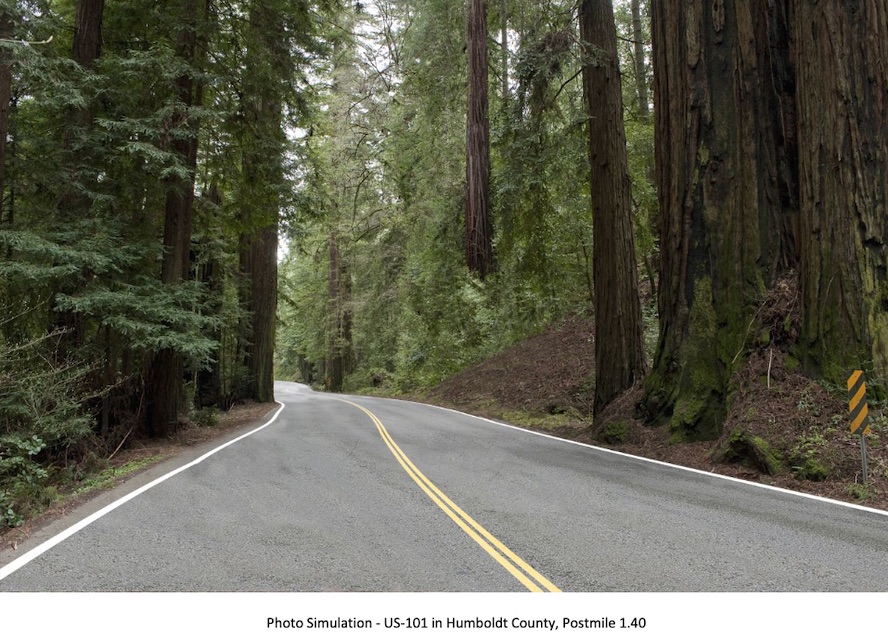
The dispute comes as the long-delayed project edges closer to a potential start date, with legal challenges unresolved and public concern over any tree removal inside one of the North Coast’s most iconic redwood parks remaining.
(Please note that the grandfather, father, and husband of the publisher of this website worked for Caltrans. Additionally, this author’s nephew is a Caltrans employee.)
RICO AND THE LIVING TRUST
by Paul Modic
When I took my old Toyota truck out for its weekly winter spin a few days ago, a winter ritual blasting the heater all the way to keep the mold factor down, I was surprised to return home a couple hours later with an incipient messiah complex.
I had printed off a copy of my how-to-make-a-trust essay and planned to give it to my egg connection in the next town over, the farmer who usually shows up for the weekly winter market. Last time I’d picked up a couple dozen I’d been stressed out about making the trust, after running into some complications, and we had talked about the more complicated one she was creating for her family’s large ranch. (When I wrote my cemetery story six years ago I had interviewed her because the one in Ettersburg was located on her land.)
I thought she might be interested in reading my essay but the vacant lot was vacant, no Friday afternoon vendors and I headed back to town. I stopped at a huge roadside yard sale, which looked like it had some interesting items unlike the usual junk, and it also seemed like a good place to bank some social contact units™. I got out with the trust story in my hand, played name-that-price with a Persian rug, guessing a hundred bucks, and the gone-to-seed hippie came over and said it was $1200.
He was trying to sell everything, multiple tables of memorabilia and many rugs spread out on tarps and then move to Santa Fe. He was grumbling about not wanting to live in California anymore and I pointed out that it was about who he was, not necessarily where he was.
I talked to his assistant, an Iranian guy named Kamran, who I’ve seen hitchhiking around for years. He loves to travel, at seventy-three considers himself homeless, and is a couch surfer who likes to fly. I told him I didn’t and recited my verse from forty-five hears ago: “The thrill of the thrust is the air traveler’s lust” and he agreed. The topic of weed came up, I said I’d give him some old stuff from 2024 and he told me where he was crashing currently in town with Merry.
“She’s really stressing out about her $5000 home insurance bill she can’t afford so maybe she can sell some of it,” he said. I said I’d bring it by as well as my guide to SSI for seniors for which he seemed very qualified.
(“I’ll look through it,” he said.
“No, read it carefully,” I replied.)
People were stopping by to look at all the interesting items including some hot Spanish girls from Switzerland who were touring with their boyfriends for a couple months. (She looks like a movie star Kamran said. Except for all those pimples I thought.)
Rico walked over from his car, a musician and mechanic I’ve seen around for decades but had never talked to. I mentioned I’d just made a living trust without a lawyer and told him I’d written an essay about how to do it yourself. He was interested, impressed then excited.
“I need this!” he said. “I’m trying to work on this kind of stuff and you really didn’t need a lawyer?”
“Here, you can have it,” I said and handed it to him. “Here’s my card, call if you have any questions. I learned a lot making mine.”
“You’re a godsend!” he said. “Think of the chances I would meet you like this…a godsend!”
“And I was trying to give it to someone else and just randomly stopped here for some social contact, really.” (I never buy anything at these things though I did grab five Old West postcards for a dollar, including one of Zapata, as I have a writer friend who’s in that whole postcard cult, mailing hundreds, or maybe even thousands, back and forth to fellow writers over the years.)
“I have to get my shit in order and pay off the mortgage. I’m eighty now and one of my kids is fifty-one. You know Lorna? She’s the mother.”
“Oh sure, I just ran into her last month up in Eureka.”
“A godsend!”
I started feeling a little messianic: I’d arrived with the holy tablets, the free info, demystified the trust and will-making process and now was spreading the good word.
“I’m ready to sell my Mexico place just south of Vallarta,” Rico said.
“Are you Mexican?” I asked.
“No, Spanish, from the Canary Islands. I’ve been playing music all over the world my whole life.”
He went looking for a pen to write down his number and came back with a postcard-size advertisement for his place in Mexico. It was a mansion, possibly garish to my uncultured eyes, sprawling above a pool with the blue Pacific presumably nearby. He had crossed out the rental information for Casa Canario and written in his local cell.

“No one’s there now except the caretaker,” he said.
“But how can you own a place near the coast as a foreigner?”
“I have resident status down there and the place is in my friend’s name.”
“You probably want a million for that?”
“That’s about right,” he said.
I drove away from there thinking wow, people could really use this information. I could have ended the story like that but here’s the embarrassing part:
I stopped at Chautauqua Natural Foods and started approaching random older people and asking if they needed to do a trust. I didn’t have my rap planned, my pitch wasn’t clear that it was free advice and I wonder what they thought about this guy coming up to them, probably a scam, right? After having my volunteer services turned down a couple times I left with a big smile, laughing at myself for being like the guy who can’t accept that the party’s over and just call it a day.
(The reason it’s attractive to bypass a lawyer isn’t just saving the money, $2500-$3000, it’s saving the appointment time, travel and anticipation, sitting in the office and sometimes waiting months for it to be finished, while I’ve learned to do it in just days if not hours. I wonder if they stretch it out for months sometimes so it seems like they’re actually doing a lot of work when they already have the standard form which they fill out with your info which you can just do yourself. One advantage of doing it with a law firm is that you’re under their malpractice protection if there’s problems later.)
MEMO OF THE AIR: Good Night Radio all Friday night on KNYO and KAKX!
Soft deadline to email your writing for tonight's (Friday night's) MOTA show is six or eight. If that's too soon, send it any time after that and I'll read it next Friday.
Memo of the Air: Good Night Radio is every Friday, 9pm to approximately 5am PST on 107.7fm KNYO-LP Fort Bragg and KNYO.org. The first three hours of the show, meaning till midnight, are simulcast on KAKX 89.3fm Mendocino.
Plus you can always go to https://MemoOfTheAir.wordpress.com and hear last week's MOTA show. By Saturday night I'll put up the recording of tonight's show. You'll find plenty of other educational amusements there to educate and amuse yourself with until showtime, or any time, such as:
A paean to Silent Running, a movie that made a big impression on me when I was thirteen. I don't even remember what the double feature was with it. https://theawesomer.com/how-silent-running-influenced-science-fiction-aesthetics/795323
True gruesome history of the whaling industry. (15 min.) https://www.neatorama.com/2026/02/04/The-Gruesome-History-of-the-Whaling-Industry
And "Madame, we greet you, and rejoice to perceive that our last prolonged visit to Luna has not proven detrimental to your health, but hereafter we must endeavor to be more prudent. Now, I pray you, attentively listen to what I may say to you…" https://publicdomainreview.org/collection/journeys-to-the-planet-mars
Marco McClean, [email protected], https://MemoOfTheAir.wordpress.com
WAITING FOR, GODot, er, THE ABSOLUTE
Warmest spiritual greetings,
Am sitting here on a public computer at the Martin Luther King, Jr. Library in Washington, D.C., happily digesting the morning meal of sashimi, boiled edamame beans, chopped squid, and coffee. I have nothing to do, nowhere to go, and am waiting for the Absolute to use this body-mind complex (dualistically speaking). If you wish to do anything crucial, feel free to make contact. Otherwise, I will assume that everything is alright, and we may just sail on and on and on…
Craig Louis Stehr, [email protected]
‘IT HAS NO HEART’: Why Levi’s Stadium is the worst-rated Super Bowl site
by Hanna Zakharenko & Daniel Echeverria

Levi’s Stadium is having a big year. It will host its second Super Bowl in the span of a decade this weekend, before turning around to host several World Cup games this summer, not to mention several major concerts along the way.
Unfortunately, it seems lots of people hate the place.
Levi’s is rated as the second-worst NFL stadium in the country — and the worst rated to ever host a Super Bowl, according to a Chronicle analysis of over 500,000 online stadium reviews.
The stadium in Santa Clara has been plagued with problems since its early days when it opened in 2014. The turf was too slippery and falling apart; the sun beats down on half the seats in the stadium; the team struggled in the stadium’s early years, leading to small crowds and criticisms of a bad atmosphere; seat licenses used to fund the stadium priced out longtime season ticket holders early on.
But, perhaps most of all, 49er fans complain that the stadium has no soul.
“The fundamental flaw of Levi’s Stadium still exists: it’s unremarkable and conservative, in a region that celebrates its big swings. The facility is not a joyful ice cream sundae with a square of Ghirardelli chocolate on top like where the San Francisco Giants play,” the Chronicle’s own Peter Hartlaub, a lifelong Niner fan, wrote in 2023 ahead of the stadium’s 10-year anniversary.
“It’s the Chipotle burrito bowl of sports stadiums. (With no guac.),” he added.
The Chronicle gathered the user ratings for every currently active NFL stadium from Google Maps, Trip Advisor and Yelp to get a sense of how widely liked they are. The number of reviews from each site was used to weight the average rating across the three sites. In situations where a stadium held listings under different names, we used the listing with the most reviews.
Lambeau Field, the home of the Green Bay Packers, is the highest rated NFL stadium. Built in 1957, it’s the oldest continuously operating NFL stadium. (Soldier Field, where the Chicago Bears play, was opened in 1924, but didn’t become the team’s stadium until 1971, according to ESPN.)
Many of the complaints about Levi’s are echoed in the stadium’s Google Map reviews, which make up the vast majority of its ratings.
“By far one of the worst stadium[s] I’ve ever visited,” one reviewer wrote. “No shade in the summers (so make sure when you’re buying seats that it’s not facing the sun or you will be cooked during the game). Parking is an absolute and chaotic mess. The seats are uncomfortable. If I didn’t love the 49ers as much as I do, I would avoid this place like the plague.”
“Never should this Stadium host another bowl game,” another wrote. “Someone will have to pay me to go back here.”
And for some, it’s simply that the 49ers left San Francisco for a stadium 45 miles away that still stings.
“I am a lifelong 49ers fan. This is the worst stadium in history. It has no heart. I can’t believe they left the city of San Francisco for Santa Clara. It’s horrible, disgusting, disrespectful,” wrote one reviewer a year ago.
Despite the problems (both physical and intangible), the stadium successfully hosted the Super Bowl once before. And it’s not to say that Levi’s has entirely bad reviews. Its overall average ranking is still a 4.2, which suggests that, while more people hate it than hate other stadiums, most people are actually just fine with it.
In fact, Niners fans outside of the Super Bowl Fan Zone at Yerba Buena Gardens on Tuesday weren’t so sure about the online ratings.
Season ticket holders Bruce and Margie Carrington, Arlene Illa and superfan Forty Niner Mark, dressed on Tuesday in his signature head-to-toe Niners gear, said that they were surprised to hear that Levi’s was one of the worst ranked — they all enjoy the stadium. But they acknowledged that it’s had some growing pains over the years.
In its first few seasons, stadium operators hadn’t figured out the flow of traffic. The sun, especially on afternoon games in the early part of the season, can really come down and surprise people who aren’t prepared for it.
“You have to know how to dress,” said Illa, whose season tickets are in the sun.
And as for the complaint that it doesn’t have the character that the team’s previous stadium did? Well, that’s a little unfair, Forty Niner Mark said.
“Candlestick had a lot of legacy,” he said, noting that the 49er’s five Super Bowl wins were all while the team called Candlestick home. Levi’s just hasn’t had the chance to build that legacy yet, he said.
Charles Davis and Joel Perez, friends who’ve been to every home game for the last two and a half years, said that they love the stadium. The tailgating is great, the amenities are nice and the Niner Faithful bring the atmosphere.
“When you walk up to that stadium, it’s almost like you can feel the heartbeat of all the fans,” Davis said. And as for the sun issue — “people need vitamin D.”
And besides, the two added, would a stadium that sucks get to host the Super Bowl again?
Levi’s does have a logistical advantage. Several requirements are in place for a stadium to host the Super Bowl: it has to have a certain number of seats, parking spaces and hotel rooms, specific media and electrical requirements, relatively warm weather or a dome and equal practice space available for both teams, to name a few. Being recently constructed also helps.
After meeting those requirements, cities also have to prepare a bid for the Super Bowl years in advance — for this year, every professional sports team in the Bay Area got involved, the Chronicle previously reported.
And though Levi’s will have hosted the Super Bowl twice in the span of a decade, it isn’t anywhere close to the most frequent hosts: that would be Caesar’s Superdome in New Orleans, which has hosted eight times, and Hard Rock Stadium in Miami, which has hosted 6 times.
Both of those stadiums are a little more loved by fans — at least those online — as well: they each have ratings of about 4.6.
(sfchronicle.com)
BLOOD IN THE WATER
by James Kunstler
“Subversion works by importing an inverted moral frame and getting the target population to install it as its own conscience.” — Yuri Bezmenov’s Ghost on X

Even in the deep-frozen fastness of midwinter, events and tensions surge, and America awaits . . . Bad Bunny! You perceive that there is some message in the genderfluid Puerto Rican songster’s upcoming Superbowl halftime gig, but what is the message? A 180-degree counterpoint to the earnest bashing and mashing of giants on the field? The official annunciation of Reconquesta? A thumb in the eye of President Donald Trump and the white supremacist horse he rode in on?
This bread and circuses routine is looking pretty played out. The bread, of course, is pizza, the Soylent Green of these seeming end-times, underwriting the nation’s romance with morbid obesity (and perhaps with degenerate sex). The circuses — last week’s Grammy Awards, the Winter Olympics tonight, Sunday’s looming Superbowl — give off an odor of utter cultural exhaustion. What will it finally take for Western Civ, and its avatar, the USA, to stop embarrassing itself before God and history, and find better things to do?
You have been following the Epstein papers, no doubt. The sordidness grows like a yeast infection in the body politic, and yet to date hardly one prosecutable crime? What gives with that? Last week’s release of the final super-batch of Epstein papers brought on a harvest of reputations, at least. The docs revealed Microsoft zillionaire Bill Gates conniving with the late (possibly) Jeffrey Epstein to turn pandemics and vaccines into a profitable enterprise, with a spate of email discussions years before Covid got sprung on the world.
Then, it just happened that Mr. Gates sponsored the Event 201 pandemic exercise in October 2019 (with Johns Hopkins and the World Economic Forum), around the same time that the first outbreaks of Covid-19 occurred in Wuhan China with the World Military Games, a sort of Olympics for soldiers. Many athletes from various countries (including the U.S., France, Germany, and others) fell ill with a respiratory infection.
Naturally, you wonder how long, exactly, was the Covid prank in the works and among whom? If Mr. Gates was involved with Johns Hopkins planning Event 201, wouldn’t you suppose he was also in contact with US NIAID, Dr. Anthony Fauci’s agency, and with Dr. Fauci himself? Dr. Fauci had a special talent for augmenting taxpayer funding of his activities with money from outside government, and Bill Gates certainly had a lot of it, plus an obsessive drive equal to Dr. Fauci’s for messing around with viruses. And 2019 was exactly the time that scientists at the Wuhan Virology Institute happened to be experimenting with corona viruses associated with bats. Whoops.
It happens that Rep. James Comer (R-KY), chair of the House Oversight Committee now looking into the Epstein matter, indicated this week that he was interested in calling Bill Gates to testify about his activities with Jeffrey Epstein. Wouldn’t it be nice to hear from Bill about his adventures in virology? Bill Gates is not a doctor or an accredited medical researcher, by the way. Virology is his hobby.
As a sort of tail on the donkey, an email written by Jeffrey Epstein in 2013 surfaced this week stating that Bill Gates said he caught a sexually transmitted disease from Russian girls and sought help from Epstein getting antibiotics to secretly dose his then-wife Melinda with. It blew up the Internet, but do you detect a whiff of a cockamamie story (no pun intended)? Bill Gates surely had the resources to virtually buy a doctor and have him prescribe whatever Mr. Gates wanted. In any case, Bill Gates’s long-running consort with Jeffrey Epstein has apparently sunk his reputation as a medical philanthropist, so expect him to look for another hobby as he skulks off into the gloaming of ignominy.
Then, there is the case over in the UK of Lord Peter Mandelson (Baron Mandelson of Foy), erstwhile UK ambassador to the USA, lately cashiered out of the job for his relations with Jeffrey Epstein. Photos emerged of Lord M less than fully clothed with others in Jeffrey Epstein’s troupe, also less than fully clothed. In the notorious 2003 birthday book, he wrote that Epstein was “my best pal.” He received payments from JE over the years and, in return, it appears, Mandelson, then working as a senior minister after the 2008 financial crisis, allegedly forwarded to JE confidential UK government emails, market-sensitive details (e.g., on EU bailouts for Greece, banker bonus taxes, and notes from meetings with US officials in Britain for JE’s investment purposes. Bottom line: Mandelson ruined. Ambassadorship terminated. . .resigned from the House of Lords. . .King Charles III reportedly looking to revoke his title (Baron of Foy), leaving him a mere commoner in ruin.
Next up (looks like): Bill and Hillary Clinton are called by subpoena to testify before Mr. Comer’s House Oversight Committee on Feb 26 and 27. They’ve got some ‘splainin’ to do about how Jeffrey Epstein helped them construct the fabulous engine of wealth known as the Clinton Foundation and its various spinoffs such as the Clinton Global Initiative, the Clinton Health Access Initiative, the Clinton Family Foundation, and the Clinton Presidential Library.
This followed a months-long tussle to get the Clinton’s to submit to in-person interviews under oath in closed session. The Clintons wanted to just hand in some written bullshit of their own and leave it at that. They were on the verge of being voted in contempt of Congress — like other political luminaries, Peter Navarro and Steve Bannon recently were, with months of jail time — when they gave in. Hillary got all snippy about it yesterday, demanding the hearing go pubic on TV so she could grandstand. Denied. Curiously, no one is rushing to the Clintons’ defense. You might suspect their many friends and associates smell blood in the water and nobody wants to get wet.
Speaking of things wet and bloody, the final super-batch of Epstein papers has revived rumors of a dastardly Satanic child abuse cult among the anointed. . . all kinds of horrifying activities, such as those represented in Tony Podesta’s art collection. Even the cuckoo story of PizzaGate is back up for review. I can’t state that I actually believe any of it, but the chatter is deafening so you are advised to stand by and see what turns up.
(kunstler.com)
THERE IS A HUGE BODY OF EVIDENCE to support the notion that me and the police were put on this earth to do extremely different things and never to mingle professionally with each other, except at official functions, when we all wear ties and drink heavily and whoop it up like the natural, good-humored wild boys that we know in our hearts that we are…. These occasions are rare, but they happen — despite the forked tongue of fate that has put us forever on different paths…. But what the hell? I can handle a wild birthday party with cops, now and then. Or some unexpected orgy at a gun show in Texas. Why not? Hell, I ran for Sheriff one time, and almost got elected. They understand this, and I get along fine with the smart ones."
— Hunter S. Thompson, Fear and Loathing in Elko

"FOR EIGHT LONG AND DEGRADING DAYS I had skulked around Houston with all the other professionals, doing our jobs — which was actually to do nothing at all except drink all the free booze we could pour into our bodies, courtesy of the National Football League, and listen to an endless barrage of some of the lamest and silliest swill ever uttered by man or beast … and finally, on Sunday morning about six hours before the opening kickoff, I was racked to the point of hysteria by a hellish interior conflict…
I'd been wondering, all week, why I was feeling so low and out of sorts … but it never occurred to me that a giant leech had been sucking blood out of the base of my spine all that time; and now the goddamn thing was moving up towards the base of my brain, going straight for the medulla … and as a professional sportswriter I knew that if the bugger ever reached my medulla I was done for.
…Almost anything would have been better than that useless week I spent in Houston waiting for the Big Game. The only place in town where I felt at home was a sort of sporadically violent strip joint called the Blue Fox, far out in the country on South Main. Nobody I talked to in Houston had ever heard of it, and the only two sportswriters who went out there with me got involved in a wild riot that ended up with all of us getting maced by undercover vice-squad cops who just happened to be in the middle of the action when it erupted."
— Hunter Thompson, Fear and Loathing at the Super Bowl, Rolling Stone 1974
THE ACTUAL GAVIN NEWSOM IS MUCH WORSE THAN YOU THINK
by Norman Solomon
California Governor Gavin Newsom has made headlines this winter by vowing to defeat a proposal for a one-time 5 percent tax on billionaires in the state. Many national polls now rank him as the frontrunner for the Democratic presidential nomination in 2028, but aligning with the ultra-wealthy is not auspicious for wooing the party’s voters. Last year, Reuters/Ipsos pollsters reported that a whopping 86 percent of Democrats said “changing the federal tax code so wealthy Americans and large corporations pay more in taxes should be a priority.”
Newsom has drawn widespread praise for waging an aggressive war of words against President Trump. But few people outside of California know much about the governor’s actual record. Many Democratic voters will be turned off to learn that his fervent opposition to a billionaire tax is part of an overall political approach that has trended more and more corporate-friendly.
A year ago, Newsom sent about 100 leaders of California-based companies a prepaid cell phone “programmed with Newsom’s digits and accompanied by notes from the governor himself,” Politico reported. One note to the CEO of a big tech corporation said, “If you ever need anything, I’m a phone call away.” While pandering to business elites, Newsom has slashed budgets to assist the poor and near-poor with healthcare, housing and food – in a state where 7 million live under the official poverty line and child poverty rates are the highest in the nation.
The latest Newsom budget, released last month, continues his trajectory away from social compassion. “The governor’s 2026-27 spending plan balances the budget by dodging the harsh realities of the Republican megabill, H.R. 1, and maintains state cuts to vital public supports, like Medi-Cal, enacted as part of the current-year budget,” the California Budget & Policy Center pointed out. “Governor Newsom’s reluctance to propose meaningful revenue solutions to help blunt the harm of federal cuts undermines his posture to counter the Trump administration.” The statement said that the proposed budget “will leave many Californians without food assistance and healthcare coverage.”
So far, key facts about Newsom’s policy priorities have scarcely gone beyond California’s borders. “National media have focused on Newsom as a personality and potential White House candidate and have almost completely ignored what he has and has not done as a governor,” said columnist Dan Walters, whose five decades covering California politics included 33 years at The Sacramento Bee. “It’s a perpetual failing of national political media to be more interested in image and gamesmanship rather than actual actions, the sizzle rather than the steak, and Newsom is very adept at exploiting that tendency.”
Walters told me that Newsom “has generally avoided direct conflicts with his fellow millionaires, such as discouraging tax increases, and has danced between corporations and labor unions on bread-and-butter issues such as minimum wages. He’s also quietly moved away from environmental issues, most notably shifting from condemnation of the oil industry for price gouging and pollution to encouraging the industry to increase production and keep refineries operating.”
Newsom angered climate activists last fall by signing his bill to open up thousands of new oil wells. Noting that “Newsom just championed a plan to dramatically expand oil drilling in California,” the Oil and Gas Action Network said that he “can’t claim climate leadership while giving Big Oil what it wants.” Third Act, founded by Bill McKibben, responded by denouncing “Newsom’s Big Oil backslide” and accused the governor of “backtracking on key climate and community health commitments.”
Great efforts to curb the ubiquitous toxic impacts of PFAS “forever chemicals” hit a wall in October when Newsom vetoed legislation to ban them in such consumer items as cookware, dental floss and cleaning products. “This bill had huge support from both within the state and beyond, and yet, apparently, the governor was interested only in the one sector opposing it – the cookware industry,” said Clean Water Action policy director Andria Ventura. The organization put the veto in context, observing that “the governor seems determined to move away from his pro-environment past.”
As with the environment, so with workers’ rights. In 2023, Newsom vetoed a bill to provide unemployment compensation to workers on strike. In 2024, he vetoed a bill to help protect farmworkers from violations of heat safety regulations, while temperatures in California’s agricultural fields spike above 110 degrees.
The latest Gallup polling of the party’s rank-and-file indicates a wide ideological gap between Newsom and the party’s base. Fifty-nine percent of Democrats described themselves as “liberal” or “very liberal,” while 32 percent said “moderate,” and 8 percent “conservative” or “very conservative.” And the trendline is striking: Democrats’ self-identification as liberal or very liberal has doubled in the last two decades.
It might be tempting to believe that Newsom’s services to corporatism and the rich are less important than the possibility that he would be an adept Democratic nominee to defeat the GOP ticket in 2028. But pursuit of such “moderate” politics was harmful to Democratic turnout in 2016 and 2024. Newsom’s current political attitude is similar to the timeworn approach that undermined the candidacies of Hillary Clinton and Kamala Harris.
Newsom says he’s eager to pitch a big tent for the Democratic Party, declaring that he welcomes the likes of former U.S. senator Joe Manchin as well as New York’s socialist mayor Zohran Mamdani in the fold. “I want it to be the Manchin to Mamdani party,” Newsom said in November. “I want it to be inclusive.” He did not mention that during the Biden presidency, while in the Senate, Manchin wrecked prospects for transformational Build Back Better legislation and other measures that would have benefitted tens of millions of Americans.
It’s telling that Newsom and former president Bill Clinton, a longtime backer, have voiced profuse mutual admiration. Interviewed after he came off the stage with the former president in a joint appearance at a Clinton Global Initiative event a few months ago, Newsom praised “the ability to reach across the aisle.” That formula is a throwback to what propelled Clinton into the presidency with a pledge to find common ground, only to toss the working class overboard from the Oval Office. The disastrous results – made possible by Clinton’s reaching “across the aisle” – included passage of the NAFTA trade pact, the “welfare reform” law that harshly undermined poor women with children, the mass-incarceration-boosting crime bill and the media monopoly-enabling Telecommunications Act.
Launching his podcast “This Is Gavin Newsom” a year ago, the host began warmly showcasing extremist bigots by featuring Charlie Kirk as his first guest. When Kirk was assassinated in September, Newsom lavished praise on him, tweeting: “The best way to honor Charlie’s memory is to continue his work: engage with each other, across ideology, through spirited discourse.” From the governor’s office, Newsom issued a statement that explained: “I knew Charlie, and I admired his passion and commitment to debate.”
The praise raises the question: how far right would someone need to be before no longer meriting Newsom’s admiration for “passion”? Clearly, Kirk wasn’t far right enough to be disqualified. He only said things like asserting that “Islam is the sword the left is using to slit the throat of America,” proclaiming “we made a huge mistake when we passed the Civil Rights Act in the 1960s” and castigating Supreme Court Justice Ketanji Brown Jackson, Congresswoman Sheila Jackson Lee and others as affirmative-action hires: “You do not have the brain processing power to otherwise be taken really seriously. You had to go steal a white person’s slot to go be taken somewhat seriously.”
Newsom’s show has continued to give a friendly platform to such extreme right-wingers as Steve Bannon and Ben Shapiro. In effect, Newsom is engaged in a podcast form of triangulation – by turns validating and disputing his guests’ attacks on progressivism.
On no issue is Newsom more out of step with the Democratic electorate than U.S. support for Israel. Last summer, a Quinnipiac survey found that 77 percent of Democrats believed Israel was guilty of genocide in Gaza – but last month Newsom said the opposite, declaring “I don’t agree with that notion.” Like most Democratic officeholders who combine their denial of genocide with support for the nonstop weapons flow to Israel, Newsom lays blame narrowly on Prime Minister Benjamin Netanyahu, saying that he is “crystal clear about my love for Israel and condemnation of Bibi.” The same Quinnipiac poll found that fully three-quarters of Democrats were opposed to sending further military aid to Israel, a position that Newsom refuses to take at the same time that he dodges questions about the right-leaning Israel lobby group AIPAC.
Newsom can expect a direct challenge from another California Democrat likely to be on debate stages when the party’s presidential campaigns get underway next year. Congressman Ro Khanna said of Newsom in January: “He doesn’t want to offend the AIPAC donors. He doesn’t want to offend the donor class. And that explains his position on going to give Netanyahu a blank check right after October 7, on not being willing to ever call out the funding we were giving, and not willing to call out that clearly it was a genocide, and then not willing to challenge the billionaire class on tax policy.”
For anyone who wants a truly progressive Democratic Party, Gavin Newsom is bad news.
(Norman Solomon is the national director of RootsAction.org and executive director of the Institute for Public Accuracy. His latest book, War Made Invisible: How America Hides the Human Toll of Its Military Machine, is published by The New Press.)

THE STORY OF JUAN HERNANDEZ
by Jeffrey St. Clair
Many rivers to cross
– Jimmy Cliff, Many Rivers to Cross
And it’s only my will that keeps me alive
I’ve been licked, washed up for years
And I merely survive because of my pride
Juan Hernández is 52 years old. He came to the US with his father when he was eight. Two years later, Juan’s father was caught in an immigration sweep in California and deported back to Mexico. Juan remained, staying with relatives outside of Lodi, where he’d enrolled in school, began to learn English and worked as a farm laborer in the Central Valley, harvesting lettuce – grueling, back-breaking work – for less than $3 an hour.
When Juan was 12, the matriarch of the family that took him in was detained by Border Patrol after visiting her family in Mexico and deported. She’d lived in California for 15 years and had seven children, five of whom were US citizens, born in Fresno. “At that point, I was on my own,” Juan told me. “Moving from house to house, living mainly with people from our church.” He kept going to school. He played soccer and baseball in middle school. “Not great at either,” he confessed. Juan worked before school started and after school ended, mowing lawns, washing cars and scrubbing floors. He even maintained beehives in the vast fields of the valley.
His English improved, but his prospects didn’t. “I quit high school after my freshman year and went to work in a chicken killing factory in Stockton,” Juan told me. “The killing line was manned by Mexican guys, mostly a little older than me.” He worked the night shift, 10 PM to 6 AM. Six days a week. “That’s where I lost these,” Juan said, as he flashed me his hands, missing two fingers on the right and three on the left. “I probably would have lost them all if I’d stuck around, but that place gave me nightmares. The chicken feet gave me bad dreams. They looked like the hands of little babies. I quit that place and stopped eating chicken. Stopped eating meat, mostly. Which was hard for a Mexican kid like me.” Juan laughed, rubbing his knotty hands through his closely trimmed hair.
The week after he quit his job, Juan learned that his mother was ill and he bummed several rides down to Oaxaca to see her. But he arrived too late. She had died a few days earlier from ovarian cancer. “I was so mad – at myself, at the government,” he said. “Why do they make it so difficult? My dad, he warned me not to come back. ‘It’s too hard to return to the States. It’s a long way from San Lucas Oojitlán. Don’t risk it.’”
But after a few weeks, he did risk it. Juan’s father had hurt his back and couldn’t work. His mother had run a small restaurant and been the primary breadwinner. It was up to teenage Juan now to support the family: two sisters, a disabled brother and three grandparents. He’d been sending back a couple of hundred dollars a month for a year to help out, but now the Hernández family would subsist almost entirely on his remittances from “El Norte.”
I met Juan Hernández last month at a park outside the small town of Canby, Oregon. We had been introduced by a mutual friend who attends Juan’s church. “A Christian church,” Juan emphasized. “Not Catholic.” I knew all about the church. My friend is the musical director. It’s an ecstatic church. Lots of shouting and dancing with the spirit. It’s also a church without walls. A moveable church that goes out into the fields and housing units of the valley, spreading the Gospel and caring for people in need, nearly all of them immigrants or the children of immigrants. Lots of them are undocumented. It’s a church that provides refuge for the needy.
“Yes, they hoot and shake and talk in tongues,” Juan said of his church, “I don’t make much of that, except maybe it means the language you speak doesn’t matter. We’re all basically the same, just trying to get by.” His accent is heavy, but he speaks these words in precise English in full sentences. There was no question about his fluency with the language, which, with its odd sentence structures and nonsensical grammatical rules, is not an easy language to learn.
Juan is about my height, but lithe and wiry. He had strong, tensile arms, the dark skin fissured with scars. He noticed me looking at them. “Trees bite back,” he said. For the last three decades, Juan has worked as a tree-trimmer, though that understates his skills. He’s an arborist, really, working on trees from suburban subdivisions to orchards, clearing limbs from power lines or sculpting shade trees in business parks. “The trees called me to Oregon,” he said. “It didn’t come without a price, though.” And that price was more than the scars on his arms.
Juan Hernández is not Juan Hernández’s real name. He didn’t ask me to use a pseudonym for him, but it seemed prudent. Juan is a grandfather now, with two grandsons and one granddaughter. They live with Juan and his wife of 28 years, Maria, because their father, Jorge, was deported to Guatemala two years ago under Biden. Jorge had been living in the US for 12 years. Working. Paying taxes. Not getting into any trouble. Then, he was pulled over in a traffic stop in Salem, Oregon, on his way to Safeway, detained, sent to Texas, and deported. “It happened so fast,” Juan said. “He was vanished almost before we knew he was missing. Just ripped from our daughter and his children’s lives in an instant. Just gone.” There’s a void in the Hernández house and it’s not the only one.
Juan and his family now live outside Woodburn, Oregon, one of the largest immigrant communities in the Northwest, consisting largely of farm and vineyard workers in the fertile (though increasingly less so) fields of the Willamette Valley. But Juan has left the strenuous labor of the fields for the more surgical work of trimming trees. “I found that even these claw-like hands of mine could handle a chainsaw or an orchard saw pretty well,” he said. “I don’t like cutting them down, especially the old ones. Trees store a lot of knowledge. I try to cut them so they don’t have to be taken down. I like to find a way for them to live without intruding on the people who might get pissed off at them for dropping their leaves or branches in a windstorm.”
For the past 20 years, Juan has run his own tree-trimming company. He has his own crew. He pays them more than minimum wage and provides insurance. He knows from experience that many of them have obligations that extend back to Mexico, Honduras, El Salvador and Guatemala, family members and loved ones, living on the margins amid the daily depredations of gangs and paramilitaries, who depend on them.
Juan Hernández arrived in Oregon in 1994, after sneaking back into the States in a refrigerated truck of fruit and vegetables from Mexico. “I nearly froze to death in the stalled line to cross the border,” he recalled. He hitched a ride up I-5 from a black truck driver, hauling appliances from the Port of Los Angeles to Seattle. “I was fortunate,” Juan said. “Mexicans and Blacks, we don’t have too much luck hitchhiking.”
Juan jumped off in Salem, about 45 miles south of Portland and began looking for work. “I harvested everything growing in the Valley,” Juan said, shaking his head at the memory. “Hops, hazelnuts, grapes, sunflowers, irises, tulips.” He made just enough money to rent a small apartment with two other Mexican laborers and send half of his pay back home. “There wasn’t much left over for beer.” He tried day labor in the winter months: tearing down and replacing roofing, landscaping, and putting up drywall. He got a driver’s license and a Social Security card. “I’ve been paying social security for 30 years and won’t see any of it,” he said. “But that’s alright. At least, they can’t say I cheated anyone. They cheated me, maybe.”
Later that year, Juan met Maria, who worked as a maid at a $50-a-night motel on I-5, did other people’s laundry and made tamales for sale at lunch carts in the fields outside of town. Maria is a couple of years younger than Juan. Like Juan, Marie entered the United States as a child. She was only two when her parents left Ciudad Juárez for El Paso. They moved every couple of years, looking for better work, eventually landing in Oregon’s Willamette Valley. Her father was a plumber, and her mother took care of other people’s children. Marie went to school. Learned to read and write in English. Sang and played the piano at church. Maria’s father was arrested for a DUI when she was a freshman in high school. The arrest led to a deportation order and he was eventually picked up by CPB and sent back to Mexico, crippling the family financially. Maria quit school and worked two jobs to help support her mother and younger siblings. There’s little margin for error in undocumented America and few places to turn for help.
Maria turned to her church and that’s where she first encountered Juan. “I wasn’t a regular in those days,” Juan chuckled. “To be honest, I mainly went to check out the new girls.” A few months later, they were married and Maria was pregnant with their first child. Four more babies would follow over the next five years. Maria quit her jobs to care for the kids. Then she started taking in other children. She taught the young migrant kids English. She gave them clothes for the dismal Oregon winters. She helped get them checkups and vaccinations at the local clinic. Eventually, she became a vital resource for migrant mothers up and down the valley.
By then, Juan had found his career as a tree-trimmer. “These hands don’t look like much, but they could hold a chainsaw and work a pruning saw,” Juan said. The pay was good, better than picking marionberries and gathering hazelnuts, anyway. And he was a quick learner. He learned by watching and doing. Experiential learning in a dangerous occupation. But five years later, Juan had his own battered truck and his own company. But he still worked to perfect his craft by taking classes on the care of fruit and ornamental trees at a local community college, which is where he first came into contact with the immigrant rights movement in Oregon. “The trees and the movement changed the course of my life,” he said. “Gave it a new purpose.”
Juan took on apprentices. All of his workers were either young migrants themselves or the children of migrants. He takes the time to teach each of them his craft, which is an art, really: how to scale trees, how to trim limbs, how to prune fruit and nut-bearing trees. “I also teach them how to listen,” Juan said. “They talk, you know. Well, they communicate. Mainly with each other. But you can still hear them. They tell you what they need.”
Hernández has about 20 workers now, doing jobs from Albany, 20 miles south of Salem, to Troutdale, at the entrance to the Columbia River Gorge, east of Portland. Two of his workers have been detained and released by ICE in the last three months. “They carry more documents proving who they are than you need to get on a plane,” Juan joked bitterly.
We talked about the recent Border Patrol shooting in Portland, where a Venezuelan couple was pulled over and shot in their car, only a day after the murder of Renee Good. Both the man and the woman were immediately smeared as gang members by DHS without any evidence to back up the claim, because, as we now know, no evidence exists. Neither was there any evidence that the young couple tried to run over the Border Patrol agents who had surrounded them with guns drawn and later dubiously claimed that’s why they shot them.
“The people who come here have run out of choices,” Juan said. No one really wants to leave their home and make that journey. There’s so much that can happen, most of it bad. This is the only choice left, not a good choice, the only choice.”
As successful as Juan’s business has become, by the end of the month, there’s not much left of Juan and Maria’s income. What there is, he gives to the church. “Our church is there to help,” Juan told me. “That’s the ministry. We’re not there to hear your confession or dunk you in the river or make you proclaim your faith or to take your money. We can do most of that if you really need it, but we want to help you survive in this strange new place.” How to find shelter, where to find food and work. How to get your kids into school or daycare and what to do if ICE shows up and who your family can turn to if you get detained.
Hernández supposes his “church-on-wheels” has a base congregation of 250 people. In the last year, at least 15 of them have been seized by ICE. “And they haven’t really started yet,” he said. “There’s bad stuff coming our way and people need to be ready.”
Last week, Juan’s oldest, Luis, was grabbed by two ICE agents while he was filling his car with gas on the way to work in Newberg, Oregon. Luis was born just a few miles away in Salem. Despite his protestations that he was a US citizen, ICE agents cuffed him and jammed him into the back of a black SUV. They took his wallet and his phone and left the keys and gas pump hose inserted in the car. They held him for about 20 minutes after they had confirmed his identity, before they cut off the Plasticuffs and let him go. “No apologies,” said Juan, shaking his head. “Those guys didn’t even think Luis’s REAL ID was real.”
The suspicion, the harassment, the arrests don’t end when you become a citizen. They don’t end even if you’re born here. You’re not treated like one of us. You’re one of them. Brown skin is all the probable cause ICE needs to treat you like a suspect, like someone they could disappear without question.
Finally, I asked him about the risk that he’s taking in helping people who have targets on their backs. “You can be arrested for doing nothing these days,” Juan said. “So why not risk being arrested for doing something good, for helping desperate people?” It was a sentiment that had echoes from the Catholic Workers’ and Central American Solidarity movements of the 1980s.
As Juan Hernández got up to leave, he scanned the tall Doug-firs that sheltered us from a late January drizzle and said, “I still think about those chickens, you know, those little feet. How callously they were treated and those who the bosses got to do the killing for them. Here one minute and gone the next. The chickens and the people.”
(Jeffrey St. Clair is co-editor of CounterPunch. His most recent book is An Orgy of Thieves: Neoliberalism and Its Discontents (with Alexander Cockburn). He can be reached at: [email protected] or on Twitter @JeffreyStClair3. CounterPunch.org.)

‘MELANIA’ IS SO, SO, SO BAD
by Drew Magary
I’m in Philadelphia. I’ve just smoked a joint in a back alley and then checked into my hotel. My room is on the 10th floor: a corner room with a beautiful view of downtown Philly in front of my bed and to the right of it. I plop down on the hotel bed and close my eyes, taking in the late afternoon sun blasting through the windows. I feel the sun on my skin. On my face. The THC does its work and now I no longer feel as if I’m in Pennsylvania at all. I feel as if I’m lying in a great glass case, on display for the angels to see. I feel transported. Safe. Glorious.
And for just a lone, unpleasant second, I think to myself, “Hey man, this must be how Melania Trump feels all the time.”
This is because I’d just seen “Melania” the day before this. For work, mind you. I’d never actually go see this film of my own accord, although a handful of our most gullible Americans did just that over the weekend. The first lady’s self-produced “documentary” made $7 million at the box office over that period, defeating initial expectations that it would gross $0 million. Like Jimmy Kimmel, I’m not convinced that everyone who bought a ticket to “Melania” actually bothered to attend “Melania.” But honestly, you and I have bigger lies to debunk right now. The only important thing here is that “Melania” exists, even if barely so. It’s the least essential movie I’ve ever seen. That it exists at all is a damning indictment of all the backroom deals that went into its production and of all the people involved in those deals, the first lady included.
A quick rundown of said deals: Amazon/MGM, owned by Trump donor Jeff Bezos, purchased “Melania” for $40 million and then spent an extra $35 million to promote it, somewhat negating that initial $7 million box office haul. The film was directed by Hollywood exile Brett Ratner, who was credibly accused of sexual assault by multiple women back in 2017, and reportedly acted like a pig while on the set of this film as well. Ratner was also just hired to direct “Rush Hour 4” because President Trump wants one, and because we all remember the “Rush Hour” films exclusively for Ratner’s keen direction. Hence, this Melania documentary was never intended to make a profit. It was only made so that it could be made.
And it shows. “Melania” isn’t really a movie, and it certainly doesn’t qualify as a documentary. It has no journalistic value and even less entertainment value. It reveals nothing about its subject, and makes no effort to. To watch “Melania” is to watch Mrs. Trump glide through a meticulously curated existence, with designers and chefs and aides welcoming the first lady with smiles every time she walks into a room. Unless you count the stagehands who wave to Mrs. Trump as she walks through an arena concourse, you will not see her interact with actual Americans. And instead of seeing the first lady volunteer in times of crisis (during the LA wildfires, for instance), you’ll see her solemnly watch those events unfold on TV. You’ll get to watch her attend memorial services for fallen servicemembers, and you’ll hear her voiceover — read with about as much conviction as a fifth grader delivering an oral book report — tell you that their deaths make her sad. None of it will move you.
You WILL get to see intense close-ups of Melania’s maxed-out stiletto heels as she steps out of an SUV, though. So that’s neat. You’ll get multiple shots of Melania as she stares out of car windows. You’ll hear great, expensive-to-license songs like “Gimme Shelter” used violently out of context. And you’ll get revealing exchanges between Ratner and Melania like this one:
Ratner: “What’s your favorite Michael Jackson song?”
Trump: “‘Billie Jean.’”
Ratner: “Oh, wow.”
Quite the deep cut she chose. And of course, get to see Melania meet and greet with other members of this cloistered ruling class: her husband, her 9-foot-tall son Barron, her loser stepkids, vice president JD Vance, Tesla Nazi Elon Musk, Apple CEO Tim Cook and, hold your surprise, Jeff Bezos. All of these members of the Trump circle are busy living the high life, and none of them have time for the problems of the little people, even if they happen to be the root cause of those problems. It’s like watching “Succession” if “Succession” had no plot.

About that nonexistent plot: Ratner filmed this movie over the course of 20 days leading up to Donald Trump’s second inauguration early last year. That’s right: It’s a hype video from one of the least hyped events in American history.
“Everyone wants to know,” Melania tells the audience at the beginning of the movie, “so here it is.” No, ma’am. No one wanted to know about this. YOU GUYS WERE ALREADY INAUGURATED. And I didn’t watch that ceremony either, because I don’t like having to vomit.
So what am I dying to know about a f—king rerun of this thing? How you picked your dress? The fact that you were the first person to get a look at the invites for the ball? That every dinner guest got an amuse-bouche featuring a gold leaf-coated egg topped with a generous dollop of caviar? That you and your husband interact with each other like he’s your grandpa? That you sound like Derek Zoolander if Derek Zoolander was a real person? No. No, I don’t want any of that garbage. I would have preferred you make something USEFUL out of the suffering that you and your friends have inflicted, instead of spending $75 million on the celluloid equivalent of a 108-minute ad for a perfume sold at Macy’s.
It’s incredible to watch this film knowing how openly tone-deaf, and how openly dated, it is throughout its entire running time. Melania Trump is an uninteresting person, and strategically so. Here’s a woman from Eastern Europe who knows she’s got it better now than she did back when she was a nobody. If she has to make herself into a public blank to keep living that high life, it’s well worth it. Hence, you rarely see her facial expression change through this film, and you hear her say nothing of import. That glaring lack of human expression makes it impossible for anyone under 85 in the audience to feel empathy with Melania Trump, which therefore makes it impossible to ignore all of the things that her movie doesn’t say and would never dare to show.
Because here’s an incomplete list of everything that’s happened since Trump’s husband was re-inaugurated. He appointed RFK Jr. to head up Health and Human Services, quickly reintroducing measles back into the general population. He sent Immigration and Customs Enforcement to shoot and kill Minnesotans. He razed an entire section of the White House, including the Rose Garden that Melania claims, in her doc, that she helped restore during her husband’s first term. Everything at the grocery store costs $30 now. Musk started up a racist version of Wikipedia, and Bezos just killed his Washington Post in broad daylight. The first lady’s own cryptocurrency went into the dumper. Oh, and her husband and many of his besties were revealed to have deep ties with the world’s most notorious child molester.
Again, this list is incomplete. Obviously.
So I watched “Melania” and could only think of how extravagantly wasteful everything about it is, especially in light of the damage her husband is inflicting on the ground. Ratner hired three of the best cinematographers in the world to help make him look like an actual director. Their efforts, while gorgeous on screen, go to waste. As does everything else involved with this vanity production: the remarkable design efforts of Melania’s personal cadre of Tim Gunns, the work of all those stagehands and caterers, the gallons upon gallons of fuel used to transport Mrs. Trump from one gilded space to another, the good faith of the holy men greeting the First Lady at St. Patrick’s Cathedral, the invites, the elegant places settings and the caviar. All of it may as well have been thrown into an incinerator.
I felt that waste even more keenly in the back half of the film, which takes us through Trump’s second inauguration seemingly in real time. I had to listen to President-elect Trump complain that the CFP national title game was taking place the same day as his inauguration. I had to watch him dance with Melania like he was about to topple over onto her (my son: “He stands in italics”). I had to watch all of the gross, smiling faces in attendance that night. Look at them pretend everything is wonderful. Look at them laugh while the world they run burns. And look at Melania Trump, always in the center of the frame, pretending she’s at a cool remove from all of it. It was f—king gross. All of it. These people are gross, and they deserve none of the shine they spend all day basking in. They deserve tribunals, and soon.
So I’m back in my Philly hotel room, getting my gummy on and soaking up whatever sunshine I can. And then I remember my drive home from my “Melania” showing, and I remember seeing a big ICE OUT banner that someone hung from a highway overpass. When I think about that sign, and the people who made it, the light on my face feels just that much brighter.
(sfgate.com)

WHITE HOUSE SUGGESTS SMITHSONIAN ADD A TRUMP DISPLAY
Administration officials met with staff at the Smithsonian’s National Portrait Gallery and discussed putting multiple artworks of the president in a section of the museum.
by Zachary Small & Robin Pograbin
Trump administration officials have suggested that the Smithsonian’s National Portrait Gallery create a section in the museum to display multiple images of the president in addition to his official portrait.
The concept initially came up during a Dec. 19 tour of the museum that included Abby Jones, the acting chief of protocol at the State Department, and the White House photographer, Daniel Torok, according to three people familiar with the discussions. They said the administration officials noted that the White House often received artworks of Mr. Trump created by Americans that could make for a display in a corner of the museum.
Ms. Jones is taking an increasing role in presenting the president’s viewpoint on what he sees as necessary changes in Smithsonian content.
Though the museum has displayed multiple depictions of other presidents, such as Washington, Lincoln and Kennedy, in what is known as the “America’s Presidents” exhibition, those images were typically placed after the men left office.
White House officials declined to comment on any discussions with the Smithsonian. But they released a statement that said: “President Trump receives an unprecedented amount of beautiful artwork from patriotic Americans all across our great country, and it is important to the People’s President that their creations are showcased throughout the halls of our Nation’s Capital.”
A spokeswoman for the National Portrait Gallery declined to comment, and it was unclear to what extent the idea of adding more images of Mr. Trump remains under consideration. The Smithsonian has not received a formal proposal as yet, said two people familiar with the discussions.
Last month, the Portrait Gallery agreed to replace a photo of the president that served as his official portrait with another photo that he preferred. At the same time, the museum removed wall text that referred to his two impeachments — language that had upset the White House.
The Portrait Gallery said in a statement at the time that the replacement was part of a planned update of the “America’s Presidents” exhibition and that it was exploring the concept of wall labels that held more limited information.
“The history of presidential impeachments continues to be represented in our museums,” the statement said.
The president’s interactions with the Smithsonian, which asserts that it operates outside the purview of the executive branch, have been contentious since Mr. Trump took office for his second term last year. He has said he finds some of the content put forward by the Smithsonian’s museums, including the National Portrait Gallery, overly negative and ideologically biased.
The White House has demanded that the Smithsonian submit volumes of information about its content, plans and finances and threatened the loss of federal funds if the request was not complied with.
The portrait gallery has been a consistent point of scrutiny, and Mr. Trump announced last year that he was firing the gallery’s director, Kim Sajet. White House officials cited a list of grievances that included the language about the impeachments that had been in the wall text of what was then his official portrait.
Smithsonian officials responded by restating their autonomy on personnel matters, but Ms. Sajet resigned anyway, saying it was in the best interests of the institution.
Recent sitting presidents have had their photographs installed in the gallery during their terms. Since the mid-1990s, the gallery has also commissioned painted portraits to replace those photographs after the president leaves office. These portraits are later unveiled and hung for public viewing.
In asking for multiple images of Mr. Trump to appear in the portrait gallery now, White House officials are continuing a trend that has seen the president take bold steps to stamp his identity on Washington. Most notable has been the addition of his name to the John F. Kennedy Center for the Performing Arts, which was built as a memorial to the slain president.
But Mr. Trump’s interest in promoting himself as a brand can also be seen in the creation of Trump Accounts, savings vehicles for children; TrumpRx, a program for discount drugs; and “Trump-class battleships.”
Like all presidents since George H.W. Bush, Mr. Trump was the subject of a painted portrait commissioned by the National Portrait Gallery during his first term in office. But the portrait by Ronald Sherr, who died in 2022, was never unveiled to the public.
A spokeswoman for the museum said: “Traditionally, the museum doesn’t unveil or display its presidential commissions until the end of a president’s final term in office or after they leave office.”
The portrait currently inside the “America’s Presidents” exhibition features Mr. Trump with his fists on the Resolute Desk that sits in the Oval Office; it’s a black-and-white photograph by Mr. Torok.
(NY Times)

TRUMP’S OBAMA DERANGEMENT SYNDROME
by Maureen Dowd
It seems etymologically, metaphysically, geologically and ethically impossible that President Trump could reach a new low. But he has.
Every Friday, when I’m planning my column, I find fresh evidence that the president is unfit for his office. He taunts his foes in crude, creepy ways and tries to tattoo his name on everything.
Late Thursday night, a vile clip appeared on Truth Social, depicting Barack and Michelle Obama as apes in a jungle cartoon, to the Tokens’ “The Lion Sleeps Tonight.” It was at the end of a video filled with baseless conspiracy theories about the 2020 election. The man who pushed the despicable “birther” conspiracy is still at it, using a racist meme from a far-right Pepe-the-frog-loving acolyte.
Like many of Trump’s actions, it was both shocking and predictable.
As The Times reported, Trump has a “history of making degrading remarks about people of color, women and immigrants,” and the Obamas in particular, with “the White House, Labor Department and Homeland Security Department all having promoted posts that echo white supremacist messaging” in his current term.
Karoline Leavitt, the White House press secretary, offered a pathetic defense for our pathological president: “This is from an internet meme video depicting President Trump as the king of the jungle and Democrats as characters from ‘The Lion King.’ Please stop the fake outrage and report on something today that actually matters to the American public.”
Well, Karoline, I think Americans do care that your boss is a racist and off his rocker.
“His presidency is enclosed in a bubble wrap of darkness and hatred and resentment,” Rahm Emanuel, who served as Obama’s chief of staff, told me.
Once the White House realized the outrage was real, the post was deleted. Officials blamed a staffer, though you know Trump was in on it. On Wednesday, he said he does “retruth” conspiracy theories himself.
He went so far that even a few Republicans in Congress, looking down the barrel of the midterms, objected.
On X, Tim Scott of South Carolina, the only Black Republican in the Senate, called it “the most racist thing I’ve seen out of this White House.”
Senator Katie Britt, an Alabama Republican who has been increasingly put off by some of Trump’s offensive actions, said on X, “This content was rightfully removed, should have never been posted to begin with, and is not who we are as a nation.”
Trump had a Dostoyevsky-esque moment on Thursday at the National Prayer Breakfast in Washington, when he confessed that his ego would not let him lose the 2020 race.
“You know, they rigged the second election,” he said. “I had to win it, had to win it. I needed it for my own ego. I would have had a bad ego for the rest of my life. Now I really have a big ego, though.”
He was admitting that our ginned-up election integrity crisis was simply an exercise in bending the truth to his bottomless vanity. “His ego could not handle the fact that he lost, so he had to pretend there was a voting crisis,” David Axelrod told me. “The world is still paying for that.”
(Trump also confessed to the religious gathering that he gets annoyed when Speaker Mike Johnson asks to pray before meals. Trump dryly noted: “I say, ‘Excuse me? We’re having lunch in the Oval.’”)
After obscenely slapping his name on everything from the Kennedy Center to a gold card for rich aspiring immigrants to warships, and planning a gargantuan triumphal arch and an outsize White House ballroom as reflections of his bloated ego, Trump is now trying to strong-arm Congress into naming more things after him by holding congressionally approved funds hostage.
The administration tried extortion tactics on Chuck Schumer, threatening not to unfreeze billions for a new railroad tunnel under the Hudson River unless he helped rename Penn Station in New York and Washington Dulles International Airport after Trump.
Trump’s dragging his own name and America’s name in the muck. The word “Trump” is an epithet in many circles. But in a bizarre manifestation of insecurity, the president still wants to stamp his moniker everywhere, just as he did when he was a New York businessman prone to bankruptcy.
Trump had another quintessential Trump moment on Tuesday when he lambasted CNN’s Kaitlan Collins for not smiling as she asked him, in light of the latest release of Jeffrey Epstein filth, what he would say to the pedophile’s survivors “who feel like they haven’t gotten justice.”
He told her that it was time to move on — the latest deflection from the fact that he has never come clean about his association with the odious Epstein.
Like a shuddersome image of worms slithering from underneath a rock, a bunch of powerful and formerly respected people in America and beyond have been exposed by the Epstein files.
Many of the ultra-elite who insisted they did not know the truth about Epstein’s depravity have been unmasked as liars. Instead, as The Wall Street Journal wrote, prominent people from Noam Chomsky to Stanley Pottinger to Peter Mandelson to Michael Wolff “actively consoled him, cast him as a victim and in some cases offered advice on how to rehabilitate his image.”
And the shoes keep dropping. CNN reported on Friday that Navy Secretary John Phelan was listed as a passenger on Epstein’s private plane in 2006.
As The Times’s David Fahrenhold told CNN, the louche role of some tech billionaires in the Epstein scandal is particularly chilling because our lives in the coming years will be defined by these billionaires.
Once we saw the lords of the cloud as heroic — young geniuses who would improve our lives. Now, as Fahrenthold said, the personal failings, insecurities and midlife crises of these men are dictating the way they run their companies. We were, he said, “a little bit misplaced in sort of putting our hopes in these folks.”
They are not keeping hope alive.
(nytimes.com)

TRUMP’S RACIST POST ABOUT OBAMAS IS DELETED AFTER BACKLASH DESPITE WHITE HOUSE EARLIER DEFENDING IT
There is a long history in the U.S. of powerful white figures associating Black people with animals, including apes, in demonstrably false and racist ways.
by Bill Barrow & Josh Boak
President Donald Trump’s racist social media post featuring former President Barack Obama and his wife, Michelle Obama, as primates in a jungle was deleted Friday after a backlash from both Republicans and Democrats who criticized the video as offensive.
The Republican president’s Thursday night post was blamed on a staffer after widespread backlash, from civil rights leaders to veteran Republican senators, for its treatment of the nation’s first Black president and first lady. A rare admission of a misstep by the White House, the deletion came hours after press secretary Karoline Leavitt dismissed “fake outrage” over the post. After calls for its removal — including by Republicans — the White House said a staffer had posted the video erroneously.
The post was part of a flurry of overnight activity on Trump’s Truth Social account that amplified his false claims that the 2020 election was stolen from him, despite courts around the country and Trump’s first-term attorney general finding no evidence of systemic fraud.
Trump has a record of intensely personal criticism of the Obamas and of using incendiary, sometimes racist, rhetoric — from feeding the lie that Obama was not a native-born U.S. citizen to crude generalizations about majority-Black countries.
The post came in the first week of Black History Month and days after a Trump proclamation cited “the contributions of black Americans to our national greatness” and “the American principles of liberty, justice, and equality.”
An Obama spokeswoman said the former president, a Democrat, had no response.
‘An internet meme’
Nearly all of the 62-second clip appears to be from a conservative video alleging deliberate tampering with voting machines in battleground states as 2020 votes were tallied. At the 60-second mark is a quick scene of two jungle primates, with the Obamas’ smiling faces imposed on them.

Those frames originated from a separate video, previously circulated by an influential conservative meme maker. It shows Trump as “King of the Jungle” and depicts Democratic leaders as animals, including Joe Biden, who is white, as a jungle primate eating a banana.
“This is from an internet meme video depicting President Trump as the King of the Jungle and Democrats as characters from the Lion King,” Leavitt said by text.
Disney’s 1994 feature film that Leavitt referenced is set on the savannah, not in the jungle, and it does not include great apes.
“Please stop the fake outrage and report on something today that actually matters to the American public,” Leavitt added.
By noon, the post had been taken down, with responsibility placed on a Trump subordinate.
The White House explanation raises questions about control of Trump’s social media account, which he’s used to levy import taxes, threaten military action, make other announcements and intimidate political rivals. The president often signs his name or initials after policy posts.
The White House did not immediately respond to an inquiry about how posts are vetted and when the public can know when Trump himself is posting.
Mark Burns, a pastor and a prominent Trump supporter who is Black, said Friday on X that he’d spoken “directly” with Trump and that he recommended to the president that he fire the staffer who posted the video and publicly condemn what happened.
“He knows this is wrong, offensive, and unacceptable,” Burns posted.
Congressional Black Caucus Chairwoman Yvette Clarke, D-N.Y., told The Associated Press she does “not buy the White House’s commentary.”
“If there wasn’t a climate, a toxic and racist climate within the White House, we wouldn’t see this type of behavior regardless of who it’s coming from,” Clarke said, adding that Trump “is a racist, he’s a bigot, and he will continue to do things in his presidency to make that known.”
Condemnation across the political spectrum
Trump and White House social media accounts frequently repost memes and artificial intelligence-generated videos. As Leavitt did Friday, Trump allies typically cast them as humorous.
This time, condemnations flowed from across the spectrum — along with demands for an apology that had not come by late afternoon.
At a Black History Month market in Harlem, the historically Black neighborhood in New York City, vendor Jacklyn Monk said of Trump: “The guy needs help. I’m sorry he’s representing our country. … It’s horrible that it was this month, but it would be horrible if it was in March also.”
In Atlanta, Rev. Bernice King, daughter of the assassinated civil rights icon Martin Luther King Jr., resurfaced her father’s words: “Yes. I’m Black. I’m proud of it. I’m Black and beautiful.” Black Americans, she said, “are beloved of God as postal workers and professors, as a former first lady and president. We are not apes.”
The U.S. Senate’s lone Black Republican, Tim Scott of South Carolina, called on Trump to take down the post. “Praying it was fake because it’s the most racist thing I’ve seen out of this White House,” said Scott, who chairs Senate Republicans’ midterm campaign arm.
Another Republican, Sen. Roger Wicker of Mississippi, is white but represents the state with the largest percentage of Black residents. Wicker called the post “totally unacceptable” and said the president should apologize.
Some Republicans who face tough reelections this November voiced concerns, as well. The result was an unusual cascade of intraparty criticism for a president who has enjoyed a stranglehold over fellow Republicans who stayed silent during previous Trump’s controversies for fear of a public spat with the president or losing his endorsement in a future campaign.
NAACP President Derrick Johnson called the video “utterly despicable” and pointed to Trump’s wider political concerns that could help explain Republicans’ willingness to speak out. Johnson asserted that Trump is trying anything to distract from economic conditions and attention on the Jeffrey Epstein case files.
“You know who isn’t in the Epstein files? Barack Obama,” he said. “You know who actually improved the economy as president? Barack Obama.”
A long history of racism
There is a long history in the U.S. of powerful white figures associating Black people with animals, including apes, in demonstrably false, racist ways. The practice dates to 18th century cultural racism and pseudo-scientific theories used to justify the enslavement of Black people, and later to dehumanize freed Black people as uncivilized threats to white people.
Thomas Jefferson, author of the Declaration of Independence, wrote in his famous text “Notes on the State of Virginia” that Black women were the preferred sexual partners of orangutans. President Dwight Eisenhower, discussing school desegregation in the 1950s, suggested white parents were rightfully concerned about their daughters being in classrooms with “big Black bucks.” Obama, as a candidate and president, was featured as a monkey or other primates on T-shirts and other merchandise.
In his 2024 campaign, Trump said immigrants were “poisoning the blood of our country,” language similar to what Adolf Hitler used to dehumanize Jews in Nazi Germany.
During his first White House term, Trump called a swath of majority-Black, developing nations “shithole countries.” He initially denied saying it but admitted in December 2025 that he did.
When Obama was in the White House, Trump pushed false claims that the 44th president, who was born in Hawaii, was born in Kenya and constitutionally ineligible to serve. Trump, in interviews that helped endear him to conservatives, demanded that Obama prove he was a “natural-born citizen” as required to become president.
Obama eventually released birth records, and Trump finally acknowledged during his 2016 campaign, after having won the Republican nomination, that Obama was born in Hawaii. But immediately after, he said, falsely, that his Democratic rival Hillary Clinton started the birtherism attacks.
(AP)

ON-LINE COMMENT OF THE DAY
I saw a man in the grocery store the other day with large tattoos on both sides of his neck. He must have been late 60's/early 70's. Did he get those 50 years ago, or did he decide that 50/60 years old was a great time to get neck tattoos.
LEAD STORIES, SATURDAY'S NYT
Prosecutors Began Investigating Renee Good’s Killing. Washington Told Them to Stop.
Why Trump’s Calls to ‘Nationalize’ Voting Have Raised Midterm Fears
Hegseth Says Defense Department Will Cut Ties With Harvard
‘I Didn’t Make a Mistake’: Trump Declines to Apologize for Racist Video of Obamas
U.S. Judge Says Trump Cannot Halt Funding for Gateway Tunnel Project
Psychiatrist Says Kennedy Was ‘Not Accurate’ in Discussing His Keto Studies
Trump Opens Marine National Monument in Atlantic to Commercial Fishing
Trump Is Hosting Governors at the White House, but Only Republicans
White House Suggests Smithsonian Add a Trump Display
Mexican Cartels Overwhelm Police With Ammunition Made for the U.S. Military
“COMPARED with the average man of a hundred years ago, the average individual is a weakling, a nervous wreck, a selfish, self-centered, foolish person who has exchanged common sense for his commodities.”
— Manly P. Hall (1939)

UKRAINE is being devastated. … The threat of escalation to nuclear war intensifies. Perhaps worst of all, in terms of long-term consequences, the meager efforts to address global heating have been largely reversed. Some are doing fine. The US military and fossil fuel industries are drowning in profit, with great prospects for their missions of destruction many years ahead. … Meanwhile, scarce resources that are desperately needed to salvage a livable world, and to create a much better one, are being wasted in destruction and slaughter, and planning for even greater catastrophes.
— Noam Chomsky
AFTERWARDS
When the Present has latched its postern behind my tremulous stay,
And the May month flaps its glad green leaves like wings,
Delicate-filmed as new-spun silk, will the neighbours say,
"He was a man who used to notice such things?"
If it be in the dusk when, like an eyelid’s soundless blink,
The dewfall-hawk comes crossing the shades to alight
Upon the wind-warped upland thorn, a gazer may think,
"To him this must have been a familiar sight."
If I pass during some nocturnal blackness, mothy and warm,
When the hedgehog travels furtively over the lawn,
One may say, "He strove that such innocent creatures should come to no harm,
But he could do little for them; and now he is gone."
If, when hearing that I have been stilled at last, they stand at the door,
Watching the full-starred heavens that winter sees
Will this thought rise on those who will meet my face no more,
"He was one who had an eye for such mysteries?"
And will any say when my bell of quittance is heard in the gloom
And a crossing breeze cuts a pause in its outrollings,
Till they rise again, as they were a new bell’s boom,
"He hears it not now, but used to notice such things?"
— Thomas Hardy (1917)

As one of the highest paid officials in our county couldn’t the DA afford to pay for the annual Broiler dinners and then be able to avoid pretending that it is a training session?
One would think.
I know the broiler dinners were what the state auditor focused on in the asset forfeiture spending issue, but that’s a distraction benefiting the DA. The real damage was done by his bullying the BOS (presumably) and Cubbison illegally out of a job. I wonder what the final bill on that will be and if the state will look into it?
Alot of us wonder about that. Any updates on the civil case? The State should, but I seriously doubt they will. And the beat goes on.
I used to respect Dave a whole lot. Now, I wish I could pierce his inner noise so that he may see how loathsome he has become. It’s sad for me. 😌
Melania suffers from fashionism, a fetish common among the woke.
Mark,
“Strategically, Mendo and the Inland Water and Power Commission should try to retain some leverage with the feds to get some big bucks for Potter Valley storage by withholding agreement on dam removal until the feds come up with some storage money. Cline would seem to be the right choice for that angle.”
Leverage cannot be “retained” where it never existed in the first place.
PG&E has filed a surrender application and has clearly committed to exiting the project. The decision reflects the project’s chronic lack of economic viability and the increasing legal and financial exposure associated with continued ownership of aging dams. It was not a decision made by federal, state, or local government officials, because private property decisions in America do not work that way. While the surrender is ultimately subject to FERC action and conditions, PG&E cannot simply reverse course. Discussion about whether dam removal should be delayed pending alternatives, or whether repair might be more cost-effective, does not change the fundamental reality that the private owner has chosen abandonment. Our opinions today have no practical bearing on that decision, which was made years ago.
The Federal Energy Regulatory Commission controls licensing and oversight of non-federal hydropower dams. FERC can impose conditions on surrender and removal, but it is not realistically positioned to deny surrender in order to compel continued ownership or operation.
As a result, there is very limited leverage. While there is a pending surrender proceeding, there is no discretionary approval that can be “withheld” to extract funding for storage.
The Trump administration could, in theory, take over the project, but that would require an extraordinary policy and funding commitment. More likely we will see statements about crazy California policy rather than the billion-plus dollars needed to change the outcome. Words won’t alter the result. Ironically, this is federal policy playing out, not state or local preference.
“Hold PG&E accountable” is often synonymous with “hold ratepayers accountable.” In other words, shifting costs onto people who do not directly benefit from the project.
When the dams come down, a new diversion will be needed to ensure water security. With PG&E’s diversion removed, do any other entities have the legal right to take water from the Eel River? Round Valley Indian Tribes. They are not obligated to collaborate. They are not obligated to lease or share that right. Do we see any risk to future water security if we show disrespect, which could include “People Before Fish!”-style campaigns?
IWPC’s approach is not without risk, but I have not seen a better alternative. If we are not collectively careful, the only identified path forward could fail to materialize. In that scenario, the greatest risk may not be imposed from outside, but created by our own actions, as burned bridges foreclose the only viable path away from a dry future for Potter Valley.
best regards,
ted
RE: the Eyster brew- ha- ha; maybe I’m wrong, but isn’t that a typo in the state report? I believe the word is grift, not gift.
“PG&E owns and operates the dams, but they have concluded that the dams are structurally unsound and, since they no longer produce the power they were originally built for, PG&E wants to abandon them. Nobody seems to have the wherewithal to take them over from PG&E. PG&E has stated that the dams’ structural problems make them vulnerable to failure which would make them potentially liable for downstream damage that might result from failure.”
It is unclear what PG&E’s motivations are other than political. Any discussion about the PV project dismantling has to start with Jared Huffman’s invention of the Two Basin Solution, that PG&E has expressed to comply with it. Huffman placed economic interests in the project’s water flowing into the Russian against chosen philosophical and political interests on the other. Two don’t even live in the Russian or Eel River watersheds. Lake County where Lake Pillsbury exists, was deliberately left out. Huffman made the philosophical and political side the majority. There was also no representation from water users in the Eel, other than the tribes in Covelo who might have riparian rights, and it they do those rights don’t appear to have been violated
Don’t blame PG&E. They don’t appear to be looking out for the rate payers, or or their share holders. Earthquake risk? Dubious. A once in a 1,000 year chance of an earth quake could destroy Scott Dam. How many dams in California have a similar risk, and no one is batting an eye. And if Scott were to fail, who is at risk of getting flooded out? The big city of Van Arsdale? What is going to be PG&E’s cost to remove the two dams compared to their stated $5 million dollars lost every year with the project in place. Who pays for the removal? Of course the rate payers will. How come PG&E didn’t take up the offer from the Inland Water and Power Commission to take over the project? Because the IWPC couldn’t afford the $20,000,000 required study. If PG&E was really looking out for its share holders and rate payers they would have offered to pay for the study, just to wash its hands of the project. Of course that would have been in conflict with the political establishment, and Jared Huffman’s plan to dismantle the project. So it wasn’t going to happen.
George,
The Two-Basin effort didn’t “invent” PG&E’s exit. Huffman began convening stakeholders in 2018, and PG&E’s formal withdrawal filing followed in January 2019. PG&E’s stated rationale is chronic economic non-viability plus risk and liability exposure associated with aging dams. The Two-Basin framework is best understood as a regional attempt to manage the consequences of a private owner exiting, not the cause of that exit.
Conspiracy theories are often more compelling than the boring truth. Some will insist politicians forced PG&E’s decision behind closed doors. Whatever one chooses to believe does not change the trajectory. The only mutable component is what happens next. The approaches we take have consequences, and it remains entirely possible to reach a worse outcome.
ted
Everybody knew long before 2018 that the diversion was up for relicensing, and Huffman’s intent was to make sure that did not happen. He said that. No conspiracy. PG&E’s chronic economic non-viability was never considered against the cost of decommissioning that could be in the many hundreds of millions of dollars. Just the NEPA, and CEQA review by itself will cost, what, maybe $75,000,000 +. There is no conspiracy to note that PG&E has one client, the California Public Utilities Commission, that is political body. It is no conspiracy to hear PG&E say that they will comply with the Two Basin Solution. If the Two Basin Solution is a regional attempt, then who in the region will benefit besides some politically connected government funded non-profits?
George,
Then it’s your belief PG&E was generating a profit on the PVP?
ted
Profits for PG&E come from rates set by the CPUC. PG&E does what the CPUC wants, and they get paid for that. The argument of profitability of the PVP is hollow. From a nonpolitical business profit standpoint, PG&E loses money on most of what they do. That is why our electric rates are so high. A loss of $5 million a year is chump change compared to other ventures the CPUC requires PG&E to do. The CPUC, appointed by the governor, holds a lot of cards here, if they wanted to play them, particularly in the interest of rate payers. Of course there is no way that will happen.
“Of course there is no way that will happen.”
It seems we agree. The dams will come down. Future water will depend on alternatives. We should be working together toward the best alternative. If it’s not IWPC’s current approach, share other feasible ideas.
There are alternatives to Jared Huffman, the CPUC, and PG&E. The power generating license is federal, and the the administration is pro-water, and pro-water development. That is where the Board of Supervisors needs to look. A majority of the Board has to first recognized this , and vote policy that recognizes the problem. There are no alternatives to the PVP for water. Lake Mendocino will never be raised. New water storage in general in California is impossible. The proposed high water diversion from the Eel has more uncertain than real. The water users that are going along with the Two Basin Solution are doing so because they are being forced to by the political cards they are being dealt. In return there is a faint hope of a crumb being thrown their way.
George,
I don’t know of an instance of FERC ever forcing indefinite operation just to preserve local benefits. Do you?
The federal government can use eminent domain for dams with congressional authorization and funding. I think this is the path to your outcome… seems far fetched to me, but I never thought we’d be talking about taking land from Denmark so who knows…
It should be noted that it is the Main Branch of the Eel River that is directly affected here, not the South Fork (which originates in the Branscomb area). In addition to the Round Valley Tribe, Potter Valley, and the Sonoma County Water Agency, the are numerous cities and farms down stream from Lake Mendocino which could be adversely affected by the project. Another interest that did not get a seat at the table is the County of Lake, which is home to most of the headwaters of the Main Branch. To say this is a complex issue would be an understatement. Supervisor Cline seems to be doing a good job, and is representing her constituents well. I view Haschak, Mulheren and Williams as sharing the Democratic Party position and the interests of the tribe, SoCo Water Agency, and the fish lobby. Full disclosure: I am a 52-year Democrat.
I suppose it may not be a really important mistake, but I have pointed it out to Mark Scaramella several times.
As Norm points out the dams in question are not on the South Fork:
https://en.wikipedia.org/wiki/South_Fork_Eel_River#/media/File:Eelrivermap.png
Norm,
The Tribe has power.
The county has no power.
I agree that Supervisor Cline is doing a good job representing her constituents. I also see the potential for fallout that harms those same people. It’s their destiny to choose a path and accept the consequences.
Tribes don’t control this project. PG&E owned it and quit. FERC oversees the surrender. The State chose not to replace the water system. That’s the whole story. Calling this “tribal power” just dodges the fact that rural ag got written off.
If the State decided tomorrow to fund and build new storage or a diversion on the Eel, it has the authority to do so through statute and regulation.
The California Public Utilities Commission could require PG&E to look at all their options with the best interest of rate payers in mind. And they could require PG&E to pay for some of water users needs that would serve the rate payers as well. That will not happen, not with this CPUC.
George,
The California Public Utilities Commission regulates electric and gas rates, not water-user benefits. They can recover costs from ratepayers only where reasonable, necessary, and directly tied to providing electric service. The CPUC can’t force PG&E to subsidize unrelated users of waste water through additional fees to electricity customers across their service area.
Your idea lacks legal basis.
Who will pay for the decommissioning? The rate payers. There is a lot of room for rate payers to be saved a lot of money and water users to be accommodated. The CPUC could have acted in the rate payers interest to see PG&E surrendered their license, left the dams in place, and turned the operation over to water users.
But as I have said, the political establishment would be in an uproar, so it would not happen. Rate payers, and water users be dammed.
George,
“The CPUC could have acted in ratepayers’ interest to see PG&E surrendered their license…”
The California Public Utilities Commission does not have authority to dictate license disposition or force transfer of operational control to third parties. That authority belongs exclusively to the Federal Energy Regulatory Commission.
“…left the dams in place, and turned the operation over to water users.”
That would require a willing licensee, FERC approval of license surrender or transfer, a qualified new operator and Federal environmental review. That path was attempted. There were no willing and able potential licensees.
George, your issues are with the federal government. Trump’s ink could turn this around in an instant. The Trump administration controls next steps.
OK, then supporting the Trump administration is where the Board of Supervisors need to go. Let’s see, a resolution before the Board in 2 weeks? With your vote it would pass.
George, you want a resolution asking Trump to transition the PVP to federal government? And the water to be available at market rates or subsidized with federal dollars?
There are many other options out there other than a federal bailout. Speak with one of your knowledgeable Board associates about it. You know who that would be. It is not a violation of the Brown Act. PG&E could be a source of money, if they seriously want out, because of financial losses. That is where the leverage would be.
The County does have the power, if they wished to exercise it. At this point, a majority of the Board have failed to do so. “The Tribe” only has the power because Huffman gave it to them, exclusively, and left all other tribes with an interest out. Huffman also gave power to Friends of the Eel who have an office in Petaluma. One of the signers of the Two Basin Solution was CalTrout that has no presence in the Eel River to my knowledge, and has been hell bent on taking out Scott Dam despite a wealth of knowledge that its removal will have no impact on salmonid populations on the Eel. Put the blame for an illegitimate political process where it belongs with Jared Huffman. There are those who willingly drank the Kool Aid, those who were forced to drink the Kool Aid, and a bunch of folks who want nothing to do with the Kool Aid Huffman has been handing out.
“The County does have the power”
George, what vote by the county would force PG&E to keep the dams up?
Ted, your are hopeless, and forgiven.
George, in regard to PVP, I think we’re at different stages in the Kübler-Ross model.
I believe that PVP is the Potter Valley Project. Please correct me if I’m wrong. The Kübler-Ross model is commonly known as the five stages of grief: denial, anger, bargaining, depression, and acceptance.
“BOARD OF SUPERVISORS DIRECTS STAFF TO DRAFT COUNTYWIDE SHORT-TERM RENTAL ORDINANCE, REJECTS PROPOSED LIMITS.”
Elise Cox notes in her informative summary on this issue: “(County Planning and Building) staff also proposed a series of potential limits, including restrictions on corporate ownership, caps in areas with high concentrations of short-term rentals, protections for workforce housing near major employers, and limits in neighborhoods with smaller parcel sizes. These were rejected.”
One can’t avoid asking, “Why and for what reasons!” With housing availability on the Coast now quite limited, and rental costs quite high, this is a damn shame. I wonder what some of those staff—the ones who actually studied and know the issues and made these community needs-based recommendations—would say to these BOS decisions? We are reaching a near crisis point where the working class—the ones who hold things together and make services and businesses work, really the life-blood of our towns—can barely afford to live here, can barely find rentals. It is very different from the past, and very concerning for our little towns. At least Bernie Norvell tried, but got shot down.
The first 4 areas, much of it coastal, total 616 residences that currently not available for families and others for full time living quarters. That’s a lot of housing, and that’s a good part of why we don’t have enough housing in our County. All so that out of town folks can go with great ease to Air B&B, rent a place that could be an actual home for local folks, and avoid the structures in place—motels, and there are lots of them on the coast, as well as regular B&B’S—that have long well-served as short-term hosts for visitors. The folks who engage in such tourist behaviors should know that their actions exact a cost to the lovely places they visit.
Again, the BOS ignores-downplays-writes off the needs of the working class folks of Mendocino County. Not good enough, our dear entitled leaders, who no doubt all have nice homes. Who are you pandering to? I ask that of Ms. Cline and others. And I hope Bernie Norvell will try harder on this issue, a big one for his district.
A question on this issue for Ms. Cox or Mark– Is there a written report available that contains the recommendations and reasons for them by the Planning and Building Dept. staff? I’d like to know more specifics about the recommended restrictions that were outright rejected by the BOS.
Re: Lambert Lane?
On my walk up to the top of Lambert Ranch Road this morning, I looked for the view depicted in the photo, but could not find it. It could be on the other side of the pair of gates at the top. Good photo, nonetheless.
Noam Chomsky, friend of the child molester Jeffrey Epstein, the terrorist Ehud Barak, the fascist ideologue Steve Bannon, and the step-daughter marrying Woody Allen, has a schtik. He says things that are obvious, but he says them is such a way that he gets called a great intellectual.
His most famous work, Manufacturing Consent, says that the empire and its media likes to talk about the crimes of its adversaries and likes to play down its own crimes and the crimes of its allies. It takes him 480 pages to prove what ought to be common sense.
In today’s quote he says… war with a nuclear power like Russia could lead to nuclear war. The MIC makes a lot of money. Resources are scarce and they’ll be used for bad things instead of good things. Wow – who woulda thunk it, Noam?
Recently we learned of some previously unpublished insights from Professor Chomsky. In his letter to Jeffrey Epstein in February 2019 (after Epstein had been convicted of sex crimes and had served his sweetheart sentence), Chomsky advises Epstein (emphasis added):
“Ive [sic] watched the horrible way you are being treated in the press and public. It’s painful to say, but I think the best way to proceed is to ignore it. I’ve had plenty of experience, though of course not on this scale. A Google search will bring up tons of hysterical accusations of all sorts, even groups devoted to vilifying me. I pay no attention, unless I’m approached for a comment on a specific matter. It’s a nuisance, but it’s the best way. The same conclusions from experiences of others, in some cases close friends.
What the vultures dearly want is a public response, which then provides a public opening for an onslaught of venomous attacks, many from just publicity seekers or cranks of all sorts — which are impossible to answer (how do you prove that you are not a neo-Nazi who wants to kill the Jews, or a rapist, or whatever charge comes along?). That’s particularly true now with the hysteria that has developed about abuse of women, which has reached the point that even questioning a charge is a crime worse than murder. For virtually everyone who sees any of this, the reaction will be “where there’s smoke there’s fire, maybe raging fire” (whatever the facts, which few will even think of investigating).
In general, it’s best I think not to react unless directly questioned, particularly in the current mood — which, I presume, will fade away, even if not in time to prevent much torture and distress.
Hard to say, but it’s the best advice I can think of.”
Chomsky has also said “I am a supporter of Israel’s right to exist as a secure, viable Jewish state.” Anyone who understand the situation in Palestine understands that Israel cannot be both a “Jewish state” and a democracy which protects the rights of the indigenous people of the land.
On the idea of JFK assassination having been killed as part of a conspiracy – which was the conclusion of the House Select Committee on Assassinations – he said, “Who cares? Plenty of people get killed all the time.”
On the possibility that the US was involved in the events of 9/11 he said, “Who cares? It doesn’t have any significance.”
With regards to people who refuse vaccines, he said, “The right response is to insist that they be isolated [from society].” When asked how the “isolated” people would get food, he responded, “Well, that’s actually their problem.”
It’s time to stop thinking of Chomsky as some sort of intellectual. He’s a Zionist, a reactionary, and a friend to fascists, terrorists, and child molesters. Here he is yuking it up with one of his pals – https://pbs.twimg.com/media/G8ApqtUXsAU4Uq3?format=jpg