
Calm Weather | Workshop Welcome | Friday Results | County Attrition | Breaking Ground | Bridge Widened | Ukiah Trail | Fort Cad | Local Events | Abalone Ban | Coastal Fog | Yesterday's Catch | Racist Vandal | Mendo Book | Marco Radio | Little Darling | Ancient Lake | Provence Harvest | Perpetual Student | Cement Life | Salmon Poacher | Overpriced Gas | Poet Waldman | Tam View | Baseball Canto | Her Dog | FIP | Richard Orwell | Medical Cannabis | Harvest Watercolor | Eugenics | Woke Font | Absolute Collapse | Love Child | Empty Man | The Garret | Good King | Midwinter Bard | Harvest Oil | Cynic Might | Lead Stories | Being Irish | Bleeding Brown | Shore Leave | Human Nature
STEPHEN DUNLAP (Fort Bragg): Baby it's a cold outside 38F under clear skies this Saturday morning on the coast. Mostly clear thru the weekend but the fog is just offshore so you never know. Our forecast rain looks to arriving Monday evening at this point with a bit of a lull on Wednesday before ramping back up after that, although rainfall amounts looks lower today. As usual, we'll see ?
CALM WEATHER will continue this weekend. Persistent light to moderate rain will arrive Monday and Tuesday, mostly focused on the northern half of the area. Stronger rain spreading further south in likely later in the week. (NWS)
PUBLIC ENGAGEMENT, CITY OF UKIAH STYLE
by Andrew Lutsky
Here is how the City of Ukiah welcomed community members last night to its final workshop on the School Street redesign (aka the Pistache Tree Removal Plan).
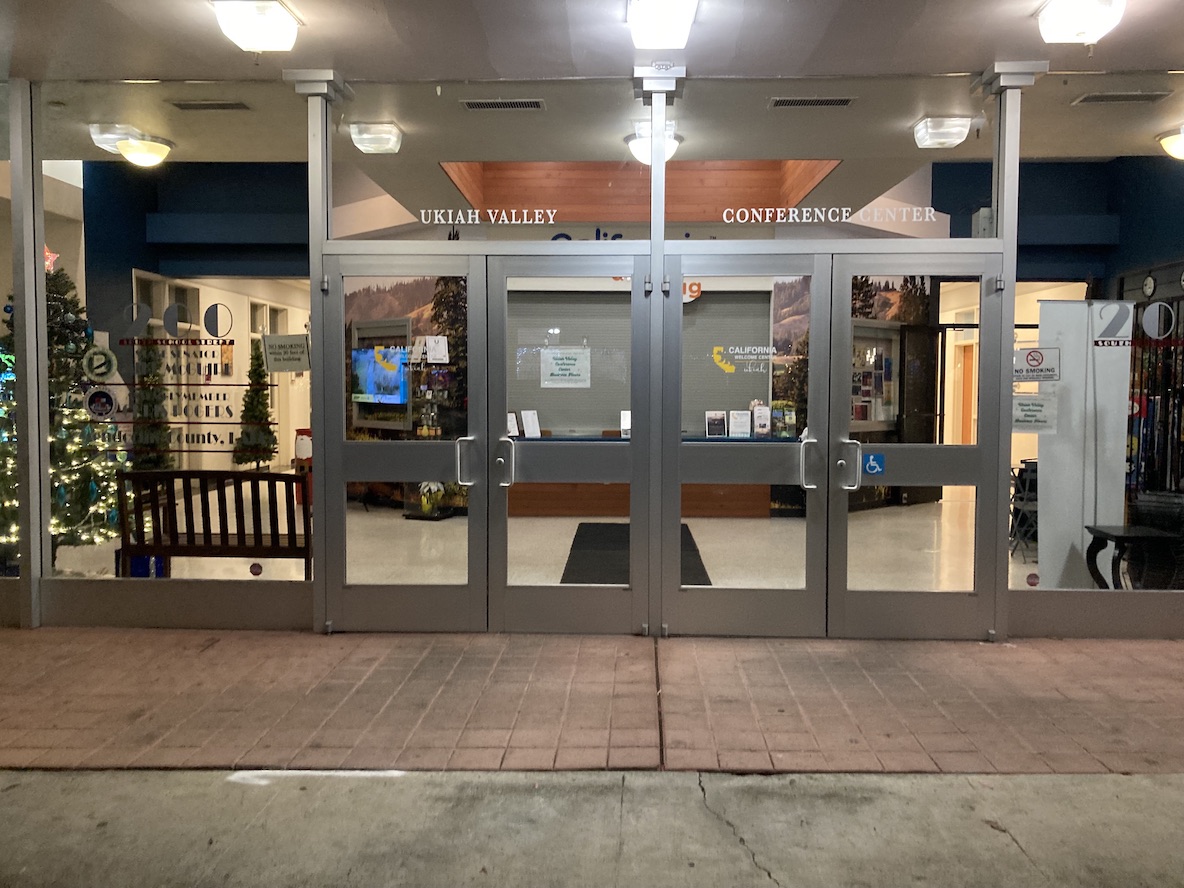
All of the doors in this photo are locked.
I took this photo a few minutes after 5:30 pm at 200 S. School Street, the address indicated by the City. If you zoom in closely you’ll notice a sign on one door which says “Ukiah Valley Conference Center Business Hours.” You can’t read the text below because it’s too small but it directs visitors to proceed to the “South Entrance” of the Conference Center (around the block and through a dark parking lot) if the doors are locked.
I found my way to that door because I’ve used it before. There was not a single sign posted anywhere – at the front or back entrance or inside the building – to indicate that a City-sponsored workshop was taking place.
I don’t expect a red carpet from my city government but please don’t knowingly direct us to locked doors at a dimly lit storefront … and then remind everyone how much you value our input.
FRIDAY'S BRACKET! Final day of the Sequoia Classic tomorrow Saturday. Go Panthers!

MENDOCINO COUNTY CEO DARCIE ANTLE:
To address the budget deficit as part of the FY 2025-26 Adopted Budget, County General Fund departments were required to take a cut to their Salary and Benefits (1000 Series) based on a 6% attrition factor, which totaled $5,246,657 across departments. This factor was calculated based on a historical average County-wide attrition rate. The 6% rate was conservatively adjusted to account for a degree of staffing variability throughout the fiscal year.
Based on year-to-date payroll actuals through December 12, 2025, plus utilizing the most recent payroll to annualize the remaining fiscal year payroll expenses, the County is anticipating realizing $4,440,000 or a little under 85% of the total $5,246,657. This has slightly decreased (.47%) from the last report.
The County must remain diligent and continue to follow the Strategic Hiring processes to realize the full attrition savings for FY25/26.
Additionally, the County must ensure one-time funds are utilized for one-time expenses.
SUPERVISOR MAUREEN MULHEREN:
Congratulations to the City of Ukiah and Vero Fiber on breaking ground on the new community owned fiber network. This is a huge accomplishment and I appreciate everyone who worked hard to bring this project together. Reliable internet is essential for students, families, small businesses, and health care, and this project is going to make a real difference. With the help of the CPUC grant, this network will reach more than 1,700 locations in our community. This is the kind of work that moves Ukiah forward. Congratulations to the team for making it happen.
JACK PETERS CREEK BRIDGE OPENS TO TWO-LANE TRAFFIC FRIDAY NIGHT
Temporary traffic signal to be removed
by Elise Cox
A year and a half after Caltrans launched a $15.5 million project to widen the Jack Peters Creek Bridge on Highway 1, the project is complete, barring a handful of finishing touches.

Geoff Wright, an area construction engineer, said the temporary traffic signal is set to be removed Friday evening. Mendocino Coast reporter Frank Hartzell has been covering the story after a projected opening date proved overly optimistic.
“We were optimistic that we were going to be wrapped up a little bit sooner, but because of scheduling delays, subcontractor availability, materials availability, and some last-minute revisions to the final plans for the sidewalk, that did delay the completion,” Wright said.
The project included widening the bridge to accommodate two 12-foot-wide lanes, two 6-foot-wide shoulders, and a 6-foot-wide separated pedestrian walkway, as well as upgraded railings.
The walkway links the California Coastal Trail from County Road 5000 to Lansing Drive.
Since the project began in May 2024, coastal travelers have endured delays, along with periodic nightly closures that led some to take backroad detours and others to adjust their travel plans.
Wright said the new project will improve safety for drivers and pedestrians. “We think we have a great project that has improved pedestrian mobility and made it safer for pedestrians and bicyclists to get across the bridge,” Wright said. “I know it’s been a little bit of a challenge for those who have had to negotiate the signal.”
With the signal gone as of Saturday and the days of the warning sign for a narrow bridge up ahead numbered, the drive to Mendocino can unfurl without warnings or interruptions along this stretch of coast.
(Mendolocal.news)
NEWEST SECTION OF UKIAH RAIL TRAIL PROVING POPULAR, city officials report
by Justine Frederiksen
The newest section of the Great Redwood Trail has significantly increased the length of the paved path that bisects Ukiah along its unused railroad tracks, and city officials are hoping it will also significantly increase public enthusiasm for the amenity.

Given the amount of people that are already using the Phase 4 segment west of Airport Park Boulevard, Public Works Director Tim Eriksen told the Ukiah City Council last week that “this is probably the thing that (Community Services Director) Neil Davis and I have always waited for, the one that would actually make the change, because it’s such a peaceful walk down in that area.”
When City Council member Mari Rodin asked if “all of the trees had been planted” along that section of the route, Eriksen said that “a ton of them are, and I think there are supposed to be 200 of them.”
“I just want to keep reminding everybody that promising to plant trees is part of the grant (the city received),” said Rodin, pointing out that the project includes “209 trees, it isn’t just the pavement.”
Previously, Rodin told the council that she had walked the Great Redwood trail with members of the Coastal Conservancy, which provided a $350,000 grant for construction, as well as members of the Great Redwood Trail Agency, “and staff was showing them the segments of the trail that the city of Ukiah has completed,” including the north end at Brush Street, as well as what could be done in areas near the new Mendocino County Courthouse that is currently under construction near Perkins Street.
“And they were all very excited, and interested, and proud of our accomplishments,” she said. “They’re anxious to help us further develop the park-like elements we all want to see.”
While the finishing touches such as benches and railings were still being added in November, Senior Engineer Andrew Strickland told the City Council that the newest section of the Rail Trail from Commerce Drive to Plant Road “is a lovely walk, and I highly recommend it,” noting that the tree planting would be continuing for the next couple of months.
When Council member Juan Orozco asked if there would be lighting added, Strickland said “there is not lighting on this phase of the trail, (but) we do have a couple of bridges there, very handsome bridges, (along with) some bicycle stations for repairs, some shade structures and some picnic benches.”
City Manager Sage Sangiacomo pointed out how the trail connects with some of the businesses along Airport Park Boulevard with stairways and ramps.

“In fact, we’ve had new businesses in that area that have asked specifically for access considerations, so it’s nice to see that project come alive and integrate with our community,” Sangiacomo said, describing that southern section as a “really nice portion of the trail to be able to walk, (offering) a whole new perspective of the Western Hills, the valley, the airport and the vineyards.”
“And it kind of gives you an element of what is to come, as that trail hopefully extends out to Hopland, and what that could mean for economic development and use,” Sangiacomo continued. “It is on its way to becoming a real asset for our community.”
The first three phases of the trail provided nearly two miles of a paved path along the railroad tracks for pedestrians and bicyclists, and the fourth phase doubles its length with another 1.9 miles, making the total path just under four miles so far.
(Ukiah Daily Journal)
BESIEGED IN FORT BRAGG: "I have been flashed, attempts to touch my neck and body three times after I smacked their hand away, talked to about peckers, slapped on my thigh by different men at the Safeway bus stop and Red Rhino gas station in Fort Bragg. All in two months. I swear since Fort Bragg police think I should call them every day it happens now. Do you condone this behavior to a disabled woman? Has this happened to other women you know? Can Fort Bragg do things about vagrant men hanging around loitering?
LOCAL EVENTS (this weekend)


CALIFORNIA BANS ABALONE HARVESTING UNTIL 2036
by Claire Barber & Anna Hoch-Kenney
Just outside Mendocino in the middle of Van Damme Beach, a weathered placard educates bystanders about the region’s red abalone, a once prolific sea snail whose mild taste and iridescent shell attracted throngs of divers up the Northern California coast.
But in November, the beach was quiet aside from small waves lapping against the shoreline and a steady stream of cars racing along Highway 1. Commercial abalone fishing has been illegal for decades, and recreational diving for abalone has been banned since 2018 due to significant population decline. Now all that remains of abalone culture here is the old sign, with its illustrated abalone fading in the sun.
“Abalone diving was part of Northern California culture. It was huge,” said Matt Mattison, a lifelong abalone diver and president of NorCal Underwater Hunters, a spearfishing nonprofit based in the region. “It was a big deal for a lot of families.”
It will be at least 10 more years before Californians get the chance to dive for abalone again. On Thursday, the state’s Fish and Game Commission voted to extend a ban on abalone harvesting in Northern California until 2036, citing continued decline in red abalone populations and ongoing environmental challenges — the longest extension since its initial 2018 closure.
The contentious vote is the most recent example of how this small mollusk has become a big political and cultural controversy. State managers and impassioned divers are still struggling to agree on how to manage the species moving forward, including when and how to open recreational abalone diving in the future.
For Mattison, as for many other enthusiasts, abalone diving has defined much of his life. At age 5, he was scouring rocky tide pools in Santa Cruz with his mother, searching for the sea snail in crevices between rocks. By age 7, his father had taught him how to fill his small lungs with air and free dive through kelp to retrieve abalone from the bottom. Eventually, anticipating a closure of recreational abalone diving in Santa Cruz, the Mattison family chased abalone up the coast, landing in Sonoma County in the 1980s.
By 1997, amid a crisis spurred by continual commercial fishing pressure and environmental stressors, California prohibited commercial diving completely, and restricted recreation diving to the rugged Northern California coast, where red abalone blanketed the kelp beds “like popcorn,” Mattison said. In the early 2000s, upward of 30,000 recreational divers would purchase abalone permits for the season, traveling to Van Damme and a smattering of dive spots up the coast.
But in the early 2010s, the Northern California fishery, like the rest of California before it, experienced significant decline. The region’s kelp forests, the abalone’s source of food, died off in huge numbers and abalone started to starve. By 2018, Northern California’s recreational abalone fishing season — the last remaining abalone fishery in the state — closed temporarily, taking with it what had evolved into a $44 million local industry.
The closure was extended for a few seasons, then another few. Business slowed along the coast and Fort Bragg’s only dive shop shuttered. Now, “the diving community is basically gone,” Mattison said.
‘Rows and Rows of Dead Abalone’
Abalone had always been a source of food and cultural significance for Native American tribes. But commercial abalone diving began only in the 1850s in Central and Southern California, reaching a peak between 1952 and 1968, with an average of 4.5 million pounds of abalone per year.
But by the late 1960s, continual fishing pressures, environmental stresses and disease caused abalone populations south of San Francisco to significantly decline, prompting the state to close the entire recreational and commercial abalone fishery below San Francisco in 1997.
The Northern California segment, which had always been closed to commercial abalone fishing and scuba diving, evaded the decline that Southern California experienced. It would remain healthy and accessible to recreational abalone divers, who had to hold their breath and free dive, for another few decades. Here, divers could take only red abalone, which was the most prolific species in the region.
During this time period, “you would go down and look at the bottom on a clear day, and from one spot, see several hundred abalone,” said Sonke Mastrup, a retired California Department of Fish and Wildlife employee.“They were that abundant in places. Just being in the water with the kelp and the fish and the abalone, it was magical.”
But by 2011, Northern California’s red abalone fishery would face a series of detrimental events and unprecedented decline. “We never anticipated … seeing what we saw actually happen,” Mastrup said. “An environmental phenomenon pretty much wiped out the fishery.”
The mass die-offs began when a red tide algal bloom struck Sonoma County in 2011. Soon after, in 2014 and 2015, a marine heat wave commonly referred to as “the blob” combined with a strong El Niño season to cause unprecedented high ocean temperatures that killed off mass amounts of kelp, the primary food source for abalone.
In 2013, a seastar wasting disease killed off large numbers of sunflower sea stars, a predator to sea urchins. Without their predator, purple sea urchins moved in, eating what little kelp there was.
In response to kelp decline, red abalone moved to shallow water in search of any kelp they could consume, eventually starving to death. “We would go underwater and see just piles and rows and rows of dead abalone,” Mastrup said.
Red abalone in the region, which is usually so tough you have to tenderize it painstakingly with a mallet, soon became soft from digesting their own muscle. “You could actually put your finger through their foot,” said Mastrup, referring to the edible portion of their bodies.
By 2017, the red abalone population had declined by more than 80%.
No Diving, Less Monitoring
In 2017, Mastrup, along with other high-level managers, suggested that the state close the Northern California fishery. An abalone lover himself, he “dove until the bitter end.” Mastrup owns a home in Fort Bragg, and as with many abalone divers, diving was woven into the social fabric of his life, “We’d have campouts. We’d have big dinner parties. We taught all the kids how to do it,” he said.
As a scientist, Mastrup knew it was the right call. As an abalone diver, “ it was devastating.” he said.
Fish and Wildlife Department officials have been working to create a new management framework for red abalone, a process full of tension. In 2014, abalone fishermen, scientists and the department staff started to develop the Recreational Abalone Fisheries Management Plan, which sought to “ensure long-term management of the resource” while still prioritizing a recreational abalone fishery.
When the species continued to show decline, however, it became clear to the department that it needed to switch from fishery management planning to “restoration planning.” In 2022, just before Mastrup’s retirement, the Fish and Game Commission, which sets fishing policy enforced by the Fish and Wildlife Department, transitioned to the Red Abalone Recovery Plan. The new plan prioritized population recovery and officially sidelined considerations for a recreational abalone fishery, leaving many former abalone divers frustrated.
“I don’t have any faith in the department or commission anymore,” Josh Russo, president of the Watermen’s Alliance, a recreational diving group that organizes urchin removal efforts in Sonoma and Mendocino counties, said in November. Russo, who died in December, reflected a widespread view among many divers that a limited fishery should be considered in future planning. “Nobody wants to deplete a resource, but as fishermen, we want to be able to access that resource if we could do so responsibly and sustainably,” he said.
Craig Shuman, Marine Region Manager with the Department of Fish and Wildlife, has also noticed these tensions. “ The history of the relationships between the department and abalone divers is not great. There’s not a lot of trust there,” he said.
Further complicating red abalone management are funding woes. Before its closure, the surveys monitoring red abalone populations were financed by the sale of abalone “passports,” similar to a fishing permit. When the recreational abalone fishery closed, the sale of passports stopped and annual revenue dropped from more than $550,000 in 2017 to $0 by the next season.
“We’ve been scrambling to try to readjust and find other fund sources to go out there and do that fieldwork,” Shuman said. Each survey can cost upward of $100,000, not including staff salaries, he said.
Many worry that survey reductions since 2018 may hinder informed decision making. While Mastrup agrees that red abalone are in decline, he, like many abalone divers, is troubled by the decreased scale of data collection since the fishery closure. “You can’t write a recovery plan, ultimately, unless you have data on the current status of stock to orient yourself where you are. There’s no data to drive anything right now,” Mastrup said.
Even with the reduced surveys, Shuman rejects this sentiment. “ You always have to make decisions in the absence of perfect data, you will never have enough, it’s just the reality of doing biological research,” he said.
The Fish and Wildlife Department monitors 11 abalone survey sites along roughly 125 miles of coastline. In the seven-year period before the recreational fishery closed, the department conducted 27 surveys; from 2018 and 2024, the department has conducted 22 surveys — all of which show the red abalone populations in decline.
In 2023 and 2024, the conservation nonprofit Reef Check conducted 33 surveys, indicating that abalone populations are very low, but stable.
“There’s enough data to know that we cannot support a fishery yet,” Shuman said. “I am very confident in saying that.”
While the ban on legal abalone harvesting significantly reduces pressures on abalone, poaching still occurs. The Fish and Wildlife Department has issued over 100 citations since 2019 and recently arrested a man on suspicion of poaching 15 red abalone on the Sonoma Coast.
Preliminary data shows that abalone poaching citations have increased since 2019, but Shuman said that the ban on harvesting generally makes it easier to recognize poaching.
Eating Abalone, Legally
With red abalone populations still declining and the closure extended, there are limited opportunities to encounter the sea snail. But enter a trapdoor at the end of Municipal Wharf Two in Monterey Bay and you might get lucky.
Below the dock is a small but bustling abalone farm. “We go through about five tons of kelp per week,” said Dominic Villarreal, customer service lead at Monterey Abalone Co. Close to 200 cages, holding around 100,000 abalone at any given time, dangle in the water, stuffed with abalone and kelp.
Monterey Abalone Co. is one of only two abalone farms left on the California coast. The farm caters to a small number of walk-up clientele and white tablecloth restaurants, where a plate of two or three red abalone might go anywhere from $56 to $80. Today, farms offer the only legal way to eat Californian abalone.
Below the dock, workers feed the abalone a healthy diet of kelp every week. Abalone grow anywhere from four to over eight years on the farm. When ready to be harvested, they range from 3.5 to 5.5 inches in size and go for $10 to $50 apiece. In the wild, many Northern California abalone divers would search for “trophy size” red abalone, which usually spanned from 10 to 11 inches.
Before the closure, divers would perfect their technique of tenderizing, egging, breading and frying their abalone in a schnitzel style popularized along the Monterey wharf in the early 1900s. Beachside cook-offs and backyard abalone feasts were tradition.
Today, fresh abalone from Monterey Abalone Co. is served at a handful of restaurants on Monterey’s Fisherman’s Wharf, mostly upscale and targeting tourists.
Executive Chef Juan Ponce holds up a squirming abalone in the bustling kitchen of Old Fisherman’s Grotto as he assembles ingredients for the dish. “We buy it every day, fresh,” Ponce said. “They’re still moving from yesterday — when they’re fresh, they move like crazy,” he went on, imitating the snail’s rolling motions with his hands.
Abalone has a mild, buttery flavor that is easy to overpower. For 23 years, Ponce has perfected how to prepare the shellfish and refuses to rush the process. Chefs cook the abalone to order, which requires at least 15 minutes of undivided attention. Kitchen staff spend up to five minutes pounding each abalone until the tough muscle is tender and thin enough to rub a hole through with your finger. They are then buttered, dipped in flour, and cooked for a minute or two over medium-high heat.
But for many abalone divers, the food is about more than a satisfying dish. “You can go buy farm abalone, but there was something to the fact of the whole ritual,” Mattison said. “Putting on that uncomfortable wet suit. Getting in the cold water. Finding that ab, finding it off the rocks. It all made it taste better.”
Ecological Judgment Calls
Managing abalone is partially dependent on making a series of ecological judgment calls. What environment are we restoring the Northern California coast back to? How do you restore a devastated ecosystem in the first place?
“The average person wants the fishery to look like they remember it, but that’s not a normal natural fishery,” Russo said.
The abundance of abalone in the mid- to late 20th century was a partial result of the decimation of otters by fur traders in the 18th and 19th centuries. Otters were a key abalone predator, and without them, the sea snails flourished. Since the population collapse of red abalone, it is an open question as to what level abalone should be restored to in the first place.
“ It’s a policy call,” Shuman said. “What should we as society want that population to look like, and what resources do we want to put into getting it there?”
Up and down the Northern California coast, efforts to restore abalone habitat are a patchwork. Groups are removing or crushing purple urchin with hammers to restore kelp beds, others are growing sea stars in a lab. Kelp restoration overall has begun to show some promise.
“ All these little pilot studies, even though they seem like these small scale results and successes, all kind of add to these pieces of knowledge that we now have in our pockets,” said Annie Bauer-Civiello, restoration program director at Reef Check.
Reef Check and its partners have found what Bauer-Civiello calls a “magical threshold” for Northern California. Removing urchins down to two per square meter leaves enough space for kelp to recruit and grow. In locations where kelp is healthier, the removal of urchin may need to be less extreme. Regardless, “restoration in specific sites may not be all equal across the region,” said Bauer-Civello. Scaling conservation efforts is also a major challenge. “I don’t think we’ll ever have enough divers with hammers to smash urchins to be ecologically meaningful across the scale of the state,” Shuman said.
While methods and studies have shown preliminary success, there is still a long way to go. “The scientific community doesn’t really know how to fix this problem. We’re still in the experimental phase,” Mastrup said.
What is evident is that a recreational abalone fishery is probably at least a decade away.
Abalone grow slowly, and their recovery could be impacted by disease or another ocean heat wave. Population quotas and fishing limitations are both political and scientific decisions. Some, like Shuman, want to wait until the population can support an abundant fishery. Others, such as Mastrup and Mattison, believe that some sort of fishery could open as recovery occurs, even if it is small.
What is true across the board is that red abalone are missed and Northern Californians want them back.
“I got pictures, you know, pounding abalone with my son when he was 3 or 4 years old,” Shuman said. “I’m still hopeful we can still do that together as a family and maybe with my grandkids.”
(sfchronicle.com)

CATCH OF THE DAY, Friday, December 12, 2025
ZACHARY ALLEN, 23, Fort Bragg. Domestic battery.
NICHOLAS BAWDEN, 23, Ukiah. Parole violation.
ARMANDO GARCIA-BARRERA, 42, Redwood Valley. Assault weapon, silencer, stolen property, ammo possession by prohibited person, short-barrelled rifle, felon-addict with firearm, narcotics for sale.
JAMES MORRISON, 50, Ukiah. Controlled substance, paraphernalia.
ANDY NAVARRO JR, 38, Rohnert Park/Ukiah. Failure to appear.
KURTIS SMITH, 39, Ukiah. Battery, parole violation.
JOHN SULLIVAN, 53, Ukiah. Unlawful entry-refusal to leave campus, domestic violence court order violation, disobeying court order, probation revocation.
STEPEHN SUTAK, 55, Ukiah. Paraphernalia, disobeying court order, failure to appear, probation revocation.
RUBEN VIZCAINO, 20, Ukiah. Assault weapon-machine gun, evidence tampering, conspiracy.
LEWIS WILLIAMS, 26, Fort Bragg. Disorderly conduct-alcohol, resisting.
LARRY WOLFE JR., 36, Ukiah. Failure to appear.
A READER WRITES:
I was also wondering if you are familiar with the Facebook SONOMA BASKETBALL COACH and former Harlem Globetrotter says his car was vandalized with racist slurs in Petaluma
MEMDO BOOK ANNOUNCEMENT
We're excited to share the cover of MENDO by Charlie Harris, designed by Victoria Maxfield with art direction by Nicole Caputo!

MENDO hits bookstores on June 23, 2026 and is available to preorder now!
About the book:
A whip-smart and entertaining work of narrative history that shows how an unlikely partnership borne of necessity spawned a lucrative marijuana industry that changed the world.
California's homegrown weed industry helped launch the solar power industry, and that's not all. Mendocino county — or Mendo — sits within California’s Emerald Triangle, a sprawling, sparsely populated region that has produced billions of dollars’ worth of weed, and since the 1970s, virtually every inhabitant has either been involved in the pot trade or been a beneficiary of it — including the government.
Mendo was formed by the confluence of back-to-the-land hippies fleeing San Francisco and longtime locals who held more traditional, conservative beliefs. These two groups shared little in common beyond a strong antiauthoritarian streak and a need to create new opportunities after the logging industry retreated from the region. A tight-knit, backwoods, outlaw culture arose from this uncommon alliance. MENDO tells the fascinating and often humorous story of how, for over fifty years, this cabal of iconoclastic characters not only sustained the county through the illegal cultivation of marijuana, but also developed a legal framework that has been adopted in decriminalization efforts across the United States.
Today, Mendo is again on the precipice of economic ruin as the weed industry emerges from the shadows, mirroring challenges faced across the nation where traditional industries that have long sustained working-class communities are in decline, causing suffering, economic strife, and political divisiveness. MENDO, just like the nation, is fighting to find itself in the twenty-first century.
http://www.counterpointpress.com/
MEMO OF THE AIR: Good Night Radio all Friday night on KNYO and KAKX.
Soft deadline to email your writing for tonight's (Friday night's) MOTA show is six or eight. If that's too soon, send it any time after that and I'll read it next Friday.
Memo of the Air: Good Night Radio is every Friday, 9pm to 5am PST on 107.7fm KNYO-LP Fort Bragg and KNYO.org. The first three hours of the show, meaning till midnight, are simulcast on KAKX 89.3fm Mendocino.
Plus you can always go to https://MemoOfTheAir.wordpress.com and hear last week's MOTA show. By Saturday night I'll put up the recording of tonight's show. You'll find plenty of other educational amusements there to educate and amuse yourself with until showtime, or any time, such as: A donkey's favorite toy. I've seen videos of horses doing this; apparently it is a pan-equine thing. They love a squeaky toy. https://twitter.com/tradingMaxiSL/status/1997088602535481482
Xmas ads of yore. https://misscellania.blogspot.com/2025/12/christmas-ads-of-yore.html
And in 2030 Donald Duck and The Great Gatsby will both be public domain. https://www.neatorama.com/2025/12/05/Its-Time-for-More-Dramatic-Disney-Classics
Marco McClean, [email protected], https://MemoOfTheAir.wordpress.com

ANCIENT LAKE REAPPEARS IN DEATH VALLEY after record-breaking rains
Repeated fall storms led to the temporary lake, known as Lake Manly, appearing in basin 282ft beneath sea level
by Monica Dunbar
After record-breaking rains, an ancient lake in Death Valley national park that had vanished has returned to view.
The temporary lake, known informally as Lake Manly, has appeared once more at the bottom of Badwater Basin, which sits 282ft beneath sea level, in California. The basin is the lowest point in North America, according to the National Park Service.
Repeated storms from September through November filled the flat with runoff, forming a thin layer of water. This year’s version is smaller and shallower than the one seen two years prior, when remnants of Hurricane Hilary drenched the area – and briefly even made it possible to kayak there.
The park received in just two months more precipitation than it usually does in an entire year. From September to November, 2.41in of rain fell in Death Valley, according to the National Weather Service. November alone brought 1.76in, surpassing the 1923 record of 1.7in.
Between 128,000 and 186,000 years ago, glaciers blanketed the Sierra Nevada. Meltwater from those ice sheets fed rivers that drained into a massive valley lake, the original Lake Manly, which once stretched nearly 100 miles (160km) long.Today, the basin is ordinarily bone-dry, its surface cracked by sun and wind. But the recent deluge transformed it once again, offering visitors a glimpse of how the desert might have looked millennia ago.
Experts have also warned of the broader environmental shifts taking place in Death Valley. When temperatures in recent years climbed near 130F (54.4C), so-called heat tourists flocked to experience the extreme conditions first-hand. The rising heat has prompted concerns about the risks posed to native plants, birds and wildlife.
In August 2023, more than 2 inches of rain fell in a single day in Death Valley, breaking previous records for rainfall. The flooding washed away trails, causing the park to close until mid-October. In July of that same year, the valley broke heat records by reaching temperatures of 128F (53.3C). The hottest temperature ever recorded on Earth is 134F (56.7C) in July 1913 in the same section of the park.
In 2016, a series of storms with heavy rainfall brought a rare superbloom of millions of wildflowers to Death Valley. The National Park Service says it is still too early to predict whether current conditions could lead to another flourish of yellow flowers.
(www.theguardian.com)

“THERE IS THE PERPETUAL STUDENT, the omnivorous reader, the brilliant naturalist, the curious questioner, the skilled and retentive observer, the careful expository, the temperamental teacher, the assiduous cultivator of the statistic, and the elemental. He was superstitious in the presence of the mysteries, rubbing his lucky stones between his calloused palms, turning to and then away from the Church… There is the romantic liar for whom the line between fact and fiction was thinner than a hair…”
— Carlos Baker on Ernest Hemingway
DEEP DIVISIONS ON THE NORTHCOAST: Sorry Democrats, you suck, hard. Take your Cement life and head back to Southern California in your crappy lithium powered hunk of sheet metal. Take your entire family with you, and all of your plastik Chinese made crap, along with your $5k French mutant bulldogs as well. And don’t come back.
FIRST SALMON POACHER CAUGHT ON KLAMATH RIVER SYSTEM ABOVE FORMER DAM SITES
by Dan Bacher
For the second year in a row, thousands of salmon have returned to tributaries of the Klamath River above the former dam sites.
California Trout estimates that around 10,000 Chinook salmon have returned to the Klamath above the former locations of the PacifiCorp dams this fall.
But as always, somebody has to spoil the party.
The first criminal salmon poaching incident to the newly-reopened habitat was reported in the Oregon State Police Fish and Wildlife Division’s October Newsletter: www.oregon.gov/…
Specifically, an angler was caught with two Chinook salmon that he caught on Spencer Creek, a tributary of the Klamath in Oregon.
“A Klamath Falls Fish and Wildlife Trooper was contacted by ODFW about a subject reported to be actively angling on Spencer Creek,” the newsletter stated. ”They provided photos of an unlawful take of Chinook salmon. The individual was gone when the Trooper arrived a short time later.”
However, witnesses were able to provide vehicle license plate information and the vehicle was quickly located on Hwy 66 and stopped.

“The passenger admitted to fishing and advised he didn’t think wardens would be working due to the federal government shutdown. He surrendered two salmon and his rod and reel, and was criminally cited. The fish were provided to ODFW at their request. The driver was warned for aiding.”
The newsletter noted that this is the first documented criminal salmon case since the return of salmon to the Klamath Basin above the former dam sites since the dams were removed in 2023 and 2024.
The Fish and Wildlife Division didn’t release the names of the individuals caught in the poaching incident.
Sept. 30 was the last day to fish on Spencer Creek this year, as this tributary of the Klamath River closed on Oct. 1 to protect spawning fall Chinook salmon.
Preliminary data from California Trout’s SONAR fish counting station below the former Iron Gate Dam site reveals nearly 10,000 salmon and counting this fall. The nearly 10,000 adult-sized fish (≥ ~2 feet) migrated upstream between September 12 and November 14, according to a social media post by CalTrout.
CALIFORNIANS OVERPAID $59 BILLION AT THE GAS PUMP FOR A DECADE!
by Dan Bacher
If you live in California, let this soak in: California Energy Commission (CEC) data reveals that Californians have overpaid $58 billion for gasoline at the pump over the past decade.
At Monday’s business meeting of the CEC, climate justice and environmental advocates expressed outrage at the oil industry’s stonewalling of reform and the findings of the 2024 annual report on gasoline market conditions that Californians have overpaid $59 billion for gasoline over the past 10 years, according to a press release from Consumer Watchdog.…
POET ANNE WALDMAN’S STAR TURN
by Jonah Raskin

It was the first Saturday night in December and it was bitter cold by San Francisco standards. The credits rolled on the big screen at the hip Roxie Theater on 16th Street in the Mission District. The house lights came on and Anne Waldman, wearing one of her signature scarfs, sauntered to the front of the auditorium where she greeted her fans and autographed copies of her new book, Mesopotopia, a kind of mosaic that defies logic except the logic of the imagination. The word “Mesopotopia,” which sounds like it describes a messed-up utopia or dystopia, is a word that Waldman has invented to capture the complex contemporary world she struggles to comprehend in verse.
At the edge of the stage, I told Waldman that I liked Outrider, a movie which is about her and her poetry. It comes with the subtitle “Take the whole ride.” There has never been anything half-way or middle-of-the road about Waldman, whom Percy Bysshe Shelley might have had in mind when he said that “Poets are the unacknowledged legislators of the world.”
To the “outrider” herself, I added, “Now, in addition to everything else, you’re a movie star.” Waldman smiled. She is definitely the star of Outrider, a new documentary written and directed by Alystyre Julian that runs about 90 minutes and that takes viewers through the life and times of a poet who often felt, as she says on screen, “like the only woman in the room.”
If Waldman felt that way, and no doubt she did, it was probably because she was at times the only woman in the room, whether it was at St. Mark’s Episcopal Church— a gathering place for poets on East 10th Street in New York— or at Naropa University in Boulder, Colorado, home of the Jack Kerouac School of Disembodied Poetry, which she co-founded.
The men in the rooms have included Allen Ginsberg, William Burroughs, Bob Holman, the founder of the Bowery Poetry Club, and her own son Ambrose Bye, who appears in the movie and who she calls “my anchor.” Of all the Beat men, she’s probably closest to Burroughs.
Of course, there were other women in the room, such as Diane di Prima, Joanne Kyger and others who appear in Women of the Beat Generation, edited by Brenda Knight. A team player, Waldman has never been alone.
Now 80 years old, she has mostly been read and appreciated by other poets and avant-garde writers, not by a mass audience. She is best known for her 1974 book, Fast Speaking Woman. She still speaks fast and she is definitely a woman for the ages. Outrider might introduce her to a wider readership than she has so far enjoyed. Her new book, Mesopotopia, might also help her transcend the label “cult writer.”
Put into print by Penguin, Mesopotopia is Waldman’s first book that has not been issued by a small publishing company. Coffee House Press, a nonprofit independent press in Minneapolis, is perhaps the most notable company to put Waldman’s work (her memoir, Bard, Kinetic) in print. Waldman has been as independent and as nonprofit as Coffee House.
My dictionary defines an “outrider” as “a person in a motor vehicle or on horseback who goes in front of or beside a vehicle as an escort or guard.” One had best not take the title of the movie literally. Perhaps Julian, the writer and director, meant to say that Waldman has been ahead of the pack of contemporary poets, though her film shows her following rather than leading or influencing.
Still, she has carved out a unique space for herself as a matriarch, a gnostic, an oracle, a Buddhist, a magician, a mystic and a humanist. She is also, as Publishers Weekly called her, “a countercultural giant.”
On the website for the movie, Julian describes it as “a cinekinetic portal.” She also describes it as a “love letter.” She writes that Waldman “has been guided by ancestors of the Beat Generation and poetic kinships with radical female musicians.” Waldman definitely belongs in the Beat orbit.
One of the great values of Julian’s documentary is that it shows Waldman in action, performing her own work with passion and intensity. At City Lights Bookstore two days before the screening of Julian’s movie, she read for an hour without stopping. One might describe Waldman as a “force of nature,” but that’s a cliché and there’s little if anything that is clichéd about Waldman. Indeed, she’s an American original.
The other great value of Julian’s doc is that it depicts the communities that have gathered around Waldman, and that she has also gathered intentionally for support and for mutual creativity. Those communities, she says, are organic entities to which she feels a sense of moral and ethical responsibility. Some of Waldman’s affinity groups are composed of poets, others are composed of musicians like Patti Smith, and still others are made up of anti-war protesters and activists who take on the patriarchy and much more.
Waldman is an unusual figure at demonstrations in that she rejects ideology. She’s not motivated by Marx or Mao, Camus or de Beauvoir. Over the past 50 years she has not needed or wanted an ideology to fuel her protests against the manufacture of nuclear warheads, the murder of George Floyd, anti-semitism and “the slaughter in Palestine” as she calls it.
If ideology doesn’t drive her, what does? The exploration of darkness for one thing and all of human experience for another. An alchemist as well as an artist, her primary loyalty is to poetry. Julian’s film, like Waldman herself, wanders across the twin boundaries of time and space and becomes a kind of mosaic.
Near the end of the film, the star of the show herself says, “I feel very exposed.” Outrider shows her on stage, behind the stage, and in the wings of the stage, but it does not reveal any secrets or uncover hidden facts about Waldman life, though there is some information about the poet’s bohemian mother. One wonders if Waldman rebelled against her or followed in her mother’s trajectory. Perhaps a bit of both.
A rebel and a traditionalist who was raised in Greenwich Village listening to Lead Belly, Odetta and Nina Simone, Waldman is not all one thing or all another. She’s a living, breathing mosaic. Julian’s film shows as many different sides of her as can be shown. If Waldman has a private life it’s not revealed. Another writer/ director might make another film about Waldman. But for now Outrider is the best account of the life and time of the quintessential fast-speaking woman as there is. If it comes to a theater near you, see it. Readers of Counterpunch may find Waldan obscure and difficult, but they will probably find the effort to comprehend her work rewarding.
(Jonah Raskin is the author of Beat Blues, San Francisco, 1955.)

BASEBALL CANTO
Watching baseball, sitting in the sun, eating popcorn,
reading Ezra Pound,
and wishing that Juan Marichal would hit a hole right through the
Anglo-Saxon tradition in the first Canto
and demolish the barbarian invaders.
When the San Francisco Giants take the field
and everybody stands up for the National Anthem,
with some Irish tenor's voice piped over the loudspeakers,
with all the players struck dead in their places
and the white umpires like Irish cops in their black suits and little
black caps pressed over their hearts,
Standing straight and still like at some funeral of a blarney bartender,
and all facing east,
as if expecting some Great White Hope or the Founding Fathers to
appear on the horizon like 1066 or 1776.
But Willie Mays appears instead,
in the bottom of the first,
and a roar goes up as he clouts the first one into the sun and takes
off, like a footrunner from Thebes.
The ball is lost in the sun and maidens wail after him
as he keeps running through the Anglo-Saxon epic.
And Tito Fuentes comes up looking like a bullfighter
in his tight pants and small pointy shoes.
And the right field bleachers go mad with Chicanos and blacks
and Brooklyn beer-drinkers,
"Tito! Sock it to him, sweet Tito!"
And sweet Tito puts his foot in the bucket
and smacks one that don't come back at all,
and flees around the bases
like he's escaping from the United Fruit Company.
As the gringo dollar beats out the pound.
And sweet Tito beats it out like he's beating out usury,
not to mention fascism and anti-Semitism.
And Juan Marichal comes up,
and the Chicano bleachers go loco again,
as Juan belts the first ball out of sight,
and rounds first and keeps going
and rounds second and rounds third,
and keeps going and hits paydirt
to the roars of the grungy populace.
As some nut presses the backstage panic button
for the tape-recorded National Anthem again,
to save the situation.
But it don't stop nobody this time,
in their revolution round the loaded white bases,
in this last of the great Anglo-Saxon epics,
in the territorio libre of Baseball.
— Lawrence Ferlinghetti (1972)

ASK THE VET: Feline Infectious Peritonitis: Understanding A Complex Feline Disease
Karen Novak, D.V.M., Mendocino Village Veterinary
Feline Infectious Peritonitis, commonly known as FIP, is one of the most challenging and emotionally difficult diseases seen in feline medicine. For decades it carried an almost universally fatal prognosis, and while that has begun to change with the development of new antiviral treatments, FIP remains a complex condition. Understanding where it comes from, how it acts in the body, and what treatments are now available help give pet owners a clearer sense of what they may face if their cat is affected.
FIP is caused by a mutation of a very common virus, feline coronavirus (FCoV). It’s important to know that the vast majority of cats who encounter coronavirus never become sick from it. In fact, many cats, especially those in multi-cat homes, shelters, and catteries may carry the harmless form without any outward signs. The trouble begins when this mild intestinal virus mutates inside an individual cat. When that happens, the virus gains the ability to spread through the body and hide within the immune system’s own cells. Instead of clearing the virus, the immune system ends up fueling the inflammation that leads to FIP. Because the mutation happens within the cat rather than through exposure, FIP itself is not considered directly contagious, even though the original coronavirus is easily spread.

care.
FIP tends to appear most often in young cats under two years old, though it can occur at any age. Stress, overcrowding, recent adoption, or other illnesses seem to increase the likelihood of the virus mutating, but there’s no single known trigger. Once the mutated virus begins affecting the body, it tends to show itself in one of two forms, one commonly known as the “wet” (effusive) form and the other the “dry” (noneffusive) FIP. The wet form is typically more dramatic and develops faster. Cats with wet FIP often accumulate fluid in the abdomen or chest, leading to a pot-bellied appearance, difficulty breathing, or both. The dry form progresses more slowly and involves inflammatory lesions in organs such as the eyes, kidneys, and nervous system. These cats might show weight loss, chronic fever, eye inflammation, wobbliness or seizures, or subtle behavior changes. In both forms, a persistent fever that doesn’t respond well to typical medications is one of the hallmark signs. Because symptoms can be so varied, diagnosis can be very challenging, and no single test is perfect. Veterinarians typically rely on a combination of bloodwork, imaging, and clinical signs to arrive at a diagnosis.
For many years, the treatment options have been heartbreakingly limited. FIP was considered a terminal disease, and supportive care was the only option. That changed dramatically with the development of antiviral drugs that specifically target the virus responsible for FIP. These medications, most famously GS-441524 and similar compounds, have changed the landscape of the disease. GS-441524 is in a legal gray area however in the U.S. with some states having some restrictions Luckily though, in general it is available today through licensed compounding pharmacies with a veterinary prescription, following a recent FDA stance allowing its use for FIP under specific conditions. Treatment typically lasts several weeks to months and requires consistent dosing, monitoring bloodwork, and watching for any signs of relapse.
For owners willing and able to commit to the therapy, many cats go on to live healthy, normal lives. Even so, treatment can be expensive, emotionally taxing, and requires close partnership with a veterinarian familiar with FIP protocols.
Supportive care remains an important part of managing the disease, whether or not antiviral therapy is used. This may include medications to reduce inflammation, appetite stimulants, fluids, pain management, and nutritional support. Early diagnosis and prompt treatment greatly improve the chances of success. Because the original coronavirus is so widespread, preventing FIP entirely is difficult, but reducing stress in multi-cat environments, maintaining good litter box hygiene, and slowing the introduction of new cats into a household may help reduce risk.
Although FIP can be frightening, especially with its long history of a dismal prognosis, the story is no longer the same. Today, veterinarians and owners can approach FIP with cautious optimism. With a better understanding of how the disease works and options for treatment, we are finally able to give many cats a chance that didn’t exist before.
("Ask the Vet" is a monthly column written by local veterinarians including Clare Bartholomew of Mendocino Coast Humane Society, Colin Chaves of Covington Creek Veterinary, Karen Novak of Mendocino Village Veterinary and Kendall Willson of Mendocino Equine and Livestock.)

REVIEW OF MEDICAL CANNABIS USE FINDS LITTLE EVIDENCE OF BENEFIT
Researchers found a chasm between the health reasons for which the public seeks out cannabis and what gold-standard science actually shows about its effectiveness.
by Jan Hoffman
To treat their pain, anxiety and sleep problems, millions of Americans turn to cannabis, which is now legal in 40 states for medical use. But a new review of 15 years of research concludes that the evidence of its benefits is often weak or inconclusive, and that nearly 30 percent of medical cannabis patients meet criteria for cannabis use disorder.
“The evidence does not support the use of cannabis or cannabinoids at this point for most of the indications that folks are using it for,” said Dr. Michael Hsu, an addiction psychiatrist and clinical instructor at the University of California, Los Angeles, and the lead author of the review, which was published last month in the medical journal JAMA. (Cannabis refers to the entire plant; cannabinoids are its many compounds.)
The analysis arrives amid a surging acceptance and normalization of cannabis products, a $32 billion industry. For the review, addiction experts at academic medical centers across the country studied more than 2,500 clinical trials, guidelines and surveys conducted mostly in the United States and Canada. They found a wide gulf between the health purposes for which the public seeks out cannabis and what gold-standard science shows about its effectiveness.
The researchers distinguished between medical cannabis, sold at dispensaries, and pharmaceutical-grade cannabinoids — the handful of medicines approved by the Food and Drug Administration with formulations containing either low-grade THC, a psychoactive compound, or CBD, a nonintoxicating compound. Those medicines, including Marinol, Syndros and Cesamet, are available by prescription at conventional pharmacies and have had good results in easing chemotherapy-related nausea, stimulating the appetite of patients with debilitating illnesses like H.I.V./AIDS, and easing some pediatric seizure disorders.
The researchers found that doctors themselves do not have a firm understanding of medical cannabis. They cited a 2021 review in which only 33 percent of clinicians globally were confident in their knowledge about medical cannabis, and 86 percent said they needed more education.
Pain is a leading reason people use medical cannabis, but the review found no evidence to indicate that cannabis could ease acute pain. It cited the 2024 guidelines for the American Society of Clinical Oncology, which said there was insufficient evidence for, or against, recommending cannabis for cancer pain.
Treating chronic, noncancer pain produced more nuanced results. Several medical societies noted by the JAMA authors recommended against using cannabis as a first-line therapy because the evidence of its efficacy was limited. They specifically cautioned against inhaling cannabis, because of the risks of chronic bronchitis and exposure to toxic substances.
But they highlighted an analysis of eight trials which found that some formulations with a higher ratio of THC to CBD could ease pain, though it made no discernible impact on function. Even so, the analysts felt that quality investigations were needed before they could draw a definitive conclusion.
A desire to sleep is another popular reason that people turn to cannabis and cannabinoids. But the researchers said that sleep trials had also produced weak or inconclusive results, precluding major sleep organizations from making strong recommendations. Yet many daily users who inhale or ingest cannabis before bedtime attest to its success, noting that if they skip a night, they sleep poorly — proof, they maintain, that cannabis works.
But Ryan Vandrey, a Johns Hopkins University professor who helps run its Cannabis Science Lab and was not involved in the JAMA review, said that the return of insomnia can suggest something else: the patient is in cannabis withdrawal.
“If they were to go back to not using cannabis for a month, they might find that their sleep improves. But most never get to that one month because after a day or two of not sleeping, they convince themselves, ‘Oh, this is the only thing that helps me sleep. So I’ve got to keep using’,” he said.
For anxiety treatment, the new study again showed cannabis’s mixed results. Researchers cited a trial of 80 veterans with PTSD that found no significant difference in outcome among those administered cannabis with a range of dosages of THC and those receiving placebos.
But oral CBD, such as that found in gummies, significantly reduced anxiety symptoms, compared with patients who took placebos, a 2024 analysis of 316 patients found. Overall, however, medical societies cautioned that treating psychiatric disorders with cannabis could exacerbate or initiate mental illness, including psychosis and suicidality.
Patients have also tried to treat Parkinson’s disease, glaucoma and rheumatoid arthritis with cannabis, but the researchers said there was insufficient evidence that cannabis or cannabinoids were effective for addressing those medical conditions.
State laws establish whether cannabis can be sold as medicine, for recreation or both. But in practical terms, the paper notes, the baseline ingredients of each type of product are largely indistinguishable, with some variation in dosing and potency. The term “medical cannabis” typically refers to a customer’s reason for using it, rather than indicating something unique about its properties.
“There are some legitimate purposes for these compounds,” said Dr. Kevin Hill, one of the authors of the JAMA review, who directs the Division of Addiction Psychiatry at Beth Israel Deaconess Medical Center in Boston. “And there’s a whole other group of people who are saying they’re using it medically, but they’re really not. They’re just rationalizing their recreational use.”
Aside from the approved prescription medications, cannabis is classified federally along with heroin and LSD as having no medical purpose and a high propensity for misuse. In 2024, the Department of Justice proposed moving it to a less restrictive category.
There is no national regulation of dispensary cannabis; supervision falls to individual states where it is legal. State standards for labeling, quality control and testing are highly variable and unevenly enforced, regardless of whether a product is promoted for recreational or medical use.
Without reliable monitoring, the JAMA review said, cannabis products sold at dispensaries remain at risk for contamination by mold, pesticides and heavy metals.
So even consumers who are responsible and diligent in seeking products for their ailments may be thwarted, Dr. Hsu said, “because you may not be necessarily getting what you’re hoping for.”
The increasing rates of cannabis use disorder was a major impetus for undertaking a review of the research, the researchers said. They pointed to a 2024 meta-analysis that showed that 29 percent of those who used medical cannabis had symptoms of the disorder. Earlier this year, research published in JAMA Psychiatry found that among cannabis users, 34 percent developed such symptoms, which were more frequent and pronounced among those who used the drug for medical rather than recreational reasons.
In the last few years, cannabis products generally have become more potent and more addictive. “That underscores the importance of getting the education right and having better information for both clinicians and patients,” Dr. Hill said.
Given the array of identified health risks associated with cannabis use, the researchers urged doctors to conduct more thorough screening of their patients’ use and also to monitor them for any potential dangerous drug interactions.
And they repeatedly called for robust clinical trials to determine the correct use and dosing, a critical safety measure for their patients.
Dr. Vandrey at Johns Hopkins is not holding his breath: “There’s no business incentive for a company to spend $20 million on a randomized controlled trial,” he said, “because they can sell their products without it.”
(NY Times)

KEN BAKER: Eugenics was once a "science" that was enthusiatically embraced and promoted by all the Right People, including prominent politicians, the usual activist loudmouths, newspaper publishers, professors, and Supreme Court justices. Also the Grand Dragon of the KKK…
FINALLY!! NO MORE WOKE FONTS!
Marco Rubio has spoken—get out of here, Calibri!
by Alexandra Petri
Marco Rubio here, with an important announcement: No more Calibri in official State Department communications! Get out of here with your ungarnished lines and provocatively naked terminals! The Biden administration may have shot the serif, switching from Times New Roman on the grounds that serif-less fonts such as Calibri are more accessible to readers with disabilities. That’s all over now.
The State Department Action Request reads: “To restore decorum and professionalism to the Department’s written work products and abolish yet another wasteful DEIA [Diversity, Equity, Inclusion, and Accessibility] program, the Department is returning to Times New Roman as its standard typeface.”
Now you can read a sentence like “Yes, the United States did just seize an oil tanker off the coast of Venezuela! Don’t worry about it,” and bask in the sense of absolute decorum that comes from seeing a little serif on all of the relevant letters.…
https://www.theatlantic.com/newsletters/2025/12/marco-rubio-woke-font-calibri/685212/
ON-LINE COMMENT OF THE DAY
The uniparty hasn't done a fucking thing to fix anything and stupid Americans continue to vote for the incumbent. It's hard to wrap one's brain around this stuff. How can millions of people be so duped, so clueless, so damned stupid.
I have long believed that DJT is not a solution to what ails America. DJT is a symptom of a very sick political system and a people who have nowhere to turn for healing of that sick system.
We are boned and we are going down hard. Nothing but absolute collapse will fix what we have now.
DONALD TRUMP IS THE LOVE CHILD of P. T. Barnum and Triumph the Insult Comic Dog.


AN EMPTY MAN is full of himself.
— Edward Abbey, A Voice Crying in the Wilderness (1990)
THE GARRET
Come, let us pity those who are better off than we are.
Come, my friend, and remember
that the rich have butlers and no friends,
And we have friends and no butlers.
Come, let us pity the married and the unmarried.
Dawn enters with little feet
like a gilded Pavlova
And I am near my desire.
Nor has life in it aught better
Than this hour of clear coolness
the hour of waking together.
— Ezra Pound (1916)
HISTORY, AN ON-LINE COMMENT: I took high school civics in Twin Falls, Idaho 1960/1961. We were taught that the best form of government was a "good king." The problem, of course, being how you find a good king and what you do if he/she turns out not to be so good.
History has examples of "good kings" — autocrats who, on balance, did a good job. Sometimes a great job. Few of them were without fault, to be sure.
I would cite post-Mao China as an example. Certainly not without problems, but the lot of the average Chinese has vastly improved. Mao was a good example of the other side.
There are many more examples of autocrats that were horrible.
The history of man has been overwhelmingly that of autocratic rule. Mostly to the benefit of a tiny, tiny minority living in (relative) splendor while the masses lived lives that are "nasty, brutish and short."
The US has been described as an "experiment" in self-governance. We have had one hell of a good run, but the signs to this old man are that we are returning to the statistical mean — autocratic rule. Most of the time it doesn't work well for the ruled.
The Wilson era "Progressives" (love how that term got buried, then resurrected) basically declared that the self-governance experiment had failed, that the good king model was preferable. Of course, they had candidates for the job.
IMO, when the history of the late, great USA is written - assuming there is anyone to write it and anyone that can read it — Wilson will be near the top of the list of the principle causes of collapse. (The list is long)
TIS THE SEASONS: Midsummer in Midwinter with the Bard
by David Yearsley
Shakespeare’s A Midsummer Night’s Dream, now at the Sam Wanamaker Theatre on London’s Southbank, might seem to make for oddly out-of-season fare. Yet the play itself conjures calendric confusion and climate catastrophe.

In the midst of a speech delivered in the second act, Titania, Queen of the Amazons, mocks the expectations of “human mortals” who “want their winter here.” She concludes her weather report with an imagistic whirlwind that blows ill not just for the characters and setting of Shakespeare’s theatrical imagination (the Duke and eager-to-hook-up kids of Athens and its nearby wood thick with fairies), but also for those watching in the theatre, then and now:
The seasons alter: hoary-headed frosts
Fall in the fresh lap of the crimson rose,
And on old Hiems’ thin and icy crown
An odorous chaplet of sweet summer buds
Is, as in mockery, set. The spring, the summer,
The childing autumn, angry winter, change
Their wonted liveries, and the mazèd world
By their increase now knows not which is which.
Before that blast, Titania’s words had already proved prescient of the deteriorating present, what with the floods and evacuations of the Pacific Northwest just the latest set piece of doom, the the theatrics of the evening news serving up the entertainment, either freezing cold or searing hot, way wet or super dry, furious Nature letting loose her devastations at the wrong time of year:
Therefore the winds, piping to us in vain,
As in revenge have sucked up from the sea
Contagious fogs, which, falling in the land,
Hath every pelting river made so proud
That they have overborne their continents.
The utterer is a faerie queen, but for us carbonivorous moderns, her verdict is unambiguous. The problem is anthropogenic:
And this same progeny of evils comes
From our debate, from our dissension;
We are their parents and original.
Puck sums up the environmental, emotional stupidity in the play’s most famous line: “Lord, what fools these mortals be!”
Tucked against the River Thames directly across from St. Paul’s Cathedral, the Wanamaker is part of the Globe complex, a project that began with a reconstruction, finished in 1997, of Shakespeare’s original theatre of that name that stood just around the corner from the current location. Open to the elements, the Globe now hosts performances from May to October. The half-timbered Elizabethan front of the building shines whitely among the concrete blocks, old wharf buildings converted to luxury flats, towers of glass and steel spread along the riverfront.
Finished in 2014, the Wanamaker is a reconstruction of a later 17th-century theatre. It was named after the expatriate American actor and director, Sam Wanamaker, who, in the early 1950s, fled the New World—and its Blacklist—for the Old. Chagrined that his native country had several replicas of Shakespeare’s theater but none existed in England, Wanamaker fought tirelessly for the new Globe, finished a few years after his death.
Inside the Wanamaker Theatre the players do their business on a stage not raised much off ground level. Behind them a flat, neo-classically decorated façade that hearkens back to Roman theatres and their Italian Renaissance counterparts is cut through with an arched portal in the center and square doorways to either side. Through these the actors enter and exit, when they’re not appearing from out of the audience. The auditorium seats just 340 in a ground floor with a few tiered benches at the back, and a steeply raked balcony of a few rows above from which spectators look almost directly down on the action. The feeling of the space is cozy, connected, the close quarters encouraging interaction and improvisation with the audience.
There is no curtain to be raised, but half a dozen large chandeliers with real candles (I didn’t see how they were lit) are lowered when the performance begins. There is some electric safety and background lighting, too, but the flicker and glow of the candles add to the warmth and welcome of its magic.
The Globe complex is also right next to the brick behemoth of the Tate Modern, one of the world’s most popular contemporary art museums housed in the decommissioned and repurposed Bankside Power Station that, across a couple of postwar decades, burned vast reserves of oil that blackened skies while also warming Londoners and, ultimately, the earth. How fitting that this pipsqueak theatre dropped into place as if from 1599 could shout Shakespeare’s warnings up at the giant square smokestack and the much higher towers of finance across the river in the City of London. They weren’t listening, but it was still worth the shouting.
The show did not begin with a mouse that roared, but with a fairy in tights and tutu eating a banana. Puck, played with a winning mix of severity and ineptitude by Sergo Vares, strode onto a stage painted all severe white—not of cuddly Christmas snow but a place of penitence and seemingly fantasy-free. This Midsummer was cast completely against type.
Puck proceeded to perch on a banquet table, pulled out the banana and peeled it deliberately and ate it even more deliberately in four emphatic bites. This opening bit took a good two minutes—an eternity when one remembers, as one always does, that in a Shakespeare play there are five acts and hundreds of lines to get through. This literal chewing of the scenery didn’t seem like the best use of theatrical time. The point, I guess, was to show the madness of a globalized system that gets you tropical fruit any time of year. Nero fiddled while Rome burned. Puck ate a banana, while Athens and then the world did the same.
Before that bit of anarchic, slo-mo anachronism, the prelude had been provided from the gallery directly above the stage by music director Richie Hart at his keyboard playing soft-focus, shape-shifting Christmas carols—like canned music of the uncanny. Throughout the next text-truncated two-and-a-half hours, Hart also occasionally picked up his guitar, deployed a wooden clapper at moments of on-stage magic, and even blew a trumpet as the midsummer’s/midwinter’s dream dissolved back into the “reality” of the first illusion (Athens). While doing all that, he also led his quartet in clever and meaningful scene-setting and -changing effects and atmospherics: violinist Alice Barron’s melodies tickled the unconscious with high harmonics and whispered sweet-somethings; Carina Cosgrave on contrabass elicited doubts and desires and danced along with trippy ballet music of craggy expressionistic cool. Percussionist Kiyomi Seed trembled insinuations and evoked terrors, the ego of her own contrabass bow drawing out the id of her bass drum, not to mention her talents with the other psychoanalytic-acoustic tools of her trade.
Aided and abetted by these excellent musicians, the production played up the inherent violence of its misogynistic MacGuffin—that Hermia (the ardent and aggrieved Tiwa Lade) must wed Demetrius (craven, caddish Lou Jackson) or be killed or dispatched to a nunnery. The actors took double roles as humans and fairies, the forest hijinks rendered as a darkly comic nightmare awakened from back in the theatrical present at the close of the play, which is itself a dream, as Shakespeare reminds us at the end of the proceedings.
That initial banana was immediately followed by a Colt .45 wielded by deranged, dictatorial Duke Theseus (the manic, maniacal Michael Marcus). He stuck the sidearm to the throat of his betrothed, Hippolyta (Hedydd Dylan, who refused to be intimidated in that role and was also indomitable as Titania, portrayed by her as a Goth dominatrix). The gunplay-within-the-play returned at the close in a Sam Peckinpah–style bloodbath, the nuptial presentation of Pyramus and Thisbe not coming up to snuff, so its hero (the brazen and red-bearded Danny Kirrane as Bottom, the weaver of the original repurposed as head chief with an elevated palate for the herbs of the Shakespeare garden) and director (Jack Humphrey proud yet pathetic Quince/Egeus) both got snuffed out. Blood is at its theatrical best against a white background, just as snow shimmers more alluringly above the black like that of the ebony upright piano twice shelled on stage so that young lovers could croon pop songs at it—the only major misstep in this production, though harder to forgive in a play rich with its own songs.
The Midsummer-Midwinter had turned somber by the end, but no less edifying and entertaining for that change in the weather.
After the show, we walked across the Millennium Footbridge over the Thames towards St. Paul’s. One of the skyscrapers nearby was crowned by a green neon Christmas tree decked with blinking snow. It was nearly 60 degrees Fahrenheit at 10 at night in December: downright summery.
(David Yearsley is a long-time contributor to CounterPunch and the Anderson Valley Advertiser. His latest albums, “In the Cabinet of Wonders” and “Handel’s Organ Banquet” are now available from False Azure Records.)

A CYNIC MIGHT…
To the Editor:
A cynic might not believe that the seizure by the United States of an oil tanker or its more than 20 deadly drone strikes on boats in Caribbean and eastern Pacific waters since September have been carried out to prevent the smuggling of drugs.
What a cynic might believe, though, is that the next step is to cause the downfall of the current Venezuelan government, possibly by way of a United States military invasion. A cynic might also believe the next step after that is to have American oil companies invited to “help” Venezuela take advantage of its huge oil reserves.
Thomas Schneider
San Diego
LEAD STORIES, SATURDAY'S NYT
Venezuela Oil Tanker Seized by U.S. Was Part of Effort to Finance Cuba
Behind the Venezuelan Opposition Leader’s Daring Escape to Oslo
For Rubio the Cuba Hawk, the Road to Havana Runs Through Venezuela
In Trump’s Justice Dept., Failing in Court Might Be Better Than Bucking the Boss
Judge’s Order Complicates Justice Dept. Plans to Again Charge Comey
Amid Fractures on the Right, Tucker Carlson Continues His Attacks
Colorado Officials Reject Trump’s ‘Pardon’ of a Convicted Election Denier
For Republicans, Trump’s Hands-Off Approach to Health Care Is a Problem
Thailand Rejects Trump’s Claim That It Reached a Cease-Fire With Cambodia
BEING IRISH, he had an abiding sense of tragedy, which sustained him through temporary periods of joy.”
— Yeats
FEAR & LOATHING AT BIG BROWN
by Joe Allen
When a UPS cargo plane crashed on takeoff from Muhammad Ali International Airport in Louisville, Kentucky on November 11, it deepened an already growing anxiety among UPS workers about the future of the company and its safety priorities. The McDonnell-Douglas MD-11 cargo plane was 34 years old and had been grounded two months before the crash, and in-repair for serious structural problems for six weeks. The flight crew of three and eleven others on the ground were killed, and another twenty-three injured.
The fiery crash was captured by many people on cellphones and security cameras. The crippled and rapidly descending cargo plane came close to destroying a nearby bar and restaurant popular with workers from UPS’s mammoth Worldport, its global air hub, where the ill-fated flight was serviced and loaded on a planned flight to Honolulu, Hawaii. The Ford assembly plant, which employed thousands of workers near the crash site was also spared. In the wake of the crash both UPS and FedEx grounded their respective and ancient MD-11 cargo planes.

UPS released a statement on November 20:
“We continue to grieve for the lives lost in the tragic accident involving Flight 2976. Before the FAA issued its Emergency Airworthiness Directive for all MD-11 operators, UPS proactively grounded its MD-11 fleet out of an abundance of caution. We appreciate the National Transportation Safety Board’s prompt release of preliminary findings and will fully support the investigation through its conclusion.”
Well, UPS is not grieving that much. Absent from the statement are the names of the three members of the UPS flight crew and eleven others who died in the crash. Why are they missing from the statement? Would it make the crash more personal for Worldport workers?
I asked ground checker, and Teamsters Local 89 member, Eric Reynolds, what the atmosphere at Worldport is like today, he told me:
“This year the weight is a little different though. The crash settled over the place like a shadow. People do not talk about it much, but the heaviness, the darkness, is there. When a plane takes off, everyone looks up for a moment longer. The cold feels sharper because the memory sits close. The grief does not shout. It just stays. It changes the feel of the ramp in a way that does not really fade.”
Magic Happening?
Meanwhile the grind of work continues whether the top executives claim they are grieving or not. UPS has always had an insular cult-like culture — “bleeding brown” — that I’ve written about for years. Yet, Worldport is on another level. “UPS Worldport is a ‘one of a kind’ facility,” the UPS website cheerily reports, “but what really makes our Louisville operations special are our teams of dedicated UPSers who make the magic happen daily.”
Eric has a different take on it, especially during “peak season,” the UPS term for the Christmas shopping and shipping season:
“Worldport in peak season feels like a separate planet that spins faster than anything outside the fence. While the rest of the world gathers with family and slows down for the holidays, Worldport speeds up. The place swells with bodies, lights, and noise. Wide-eyed new hires show up, two energy drinks deep, standing outside the main gate at the new hire shed, vibrating in borrowed gloves. Veterans walk past with that tired half grin that says you have no idea what you walked into…but you will learn. Some of them will flame out within a week. Some will steady themselves.
“But on Day One they all look the same, jittery and overwhelmed, staring into the glowing ramp like they are about to enter into a different world. Thrust into package handler existence for peak. A strange world without time or edges. Hours blending together until you can’t tell where one shift ends and the next begins. Breaks get swallowed by radio calls. The lights make three in the morning look like noon. Maybe it is noon. You stop thinking about minutes and start thinking about aircraft. What’s the in and out again? Everything else falls away.”
“Completely Unforgivable”
Kentucky Public Media reported earlier this month,
“The families of two victims of the UPS plane crash last month — Angela Anderson and Trinadette ‘Trina’ Chavez — are suing UPS along with other companies involved in the manufacturing and inspection of the plane.
“The lawsuit filed in Jefferson County Circuit Court names five defendants: UPS; UPS Air; General Electric, the engine manufacturer; Boeing, who acquired the original plane manufacturer; and VT San Antonio Aerospace, Inc., who conducted inspections and maintenance on the plane before the crash.”
Attorney Robert Clifford said UPS was saving money and aircraft downtime by keeping “old, tired” planes in the air while not increasing the number of inspections. “This plane should have never been airworthy to be in the air that day, and this crash was preventable,” fellow attorney Bradley Cosgrove said at a press conference announcing the lawsuit. “We hope to find all of the reasons why it was preventable.”
An interim report by the National Transportation Safety Board found fatigue and stress fractures most likely led to the plane losing an engine on takeoff and crashing. “We think that those would have been long standing defects that should have been found and fixed long before this aged aircraft continued to be pressed to its max by UPS over and over with more than 21,000 cycles under its belt,” said Cosgrove.
Bloodbath
During the last year UPS has closed 93 buildings and laid off 48,000 workers, there is great foreboding that at the end of peak season, there will be another and deeper round of layoffs and closures. Several UPS workers I’ve talked to from across the country are all expecting a “bloodbath” starting in mid-January. This is quite a change for UPS where for nearly its entire modern history it was the jobs machine for the package industry and for the declining Teamsters union. UPS’s massive expansion from the 1970s onward cushioned, but never quite replaced what it lost in the freight industry following deregulation.
With a marginal and faltering campaign at Amazon and a diminishing presence at UPS, the Teamsters face a grave crisis. UPS not only provided the jobs but also the financial contributions that kept the union’s health and welfare funds a float. With more layoffs, the Teamsters face a potential financial crisis. Meanwhile, the Teamsters are largely bystanders to the unfolding crisis. Issuing memes and threatening to strike but never taking on UPS. Teamsters General President Sean O’Brien from his posts enjoys traveling, speech making, and hosting his podcast, while many members wonder where the union is.
If the layoffs and building closures are the bloodbath that many workers fear, how much is the union membership really prepared to put up with? The much desired package car and over-the-road driving jobs are joining the shrinking pools of high paid, blue collar union jobs, while many of the part time jobs will shrink considerably through automation. While UPS will continue to be a fabulously profitable, global behemoth, many are wondering what is the future for the worker there? The cargo plane wasn’t needed to bring to the surface the growing anxiety among UPSers, it was already there.
(Joe Allen is the author of Teamsterland: Reports on America’s Most Iconic Union and The Package King: A Rank and File History of UPS. He lives in Chicago. CounterPunch.org)

“HUMAN NATURE presents human minds with a puzzle which they have not yet solved and may never succeed in solving, for all that we can tell. The dichotomy of a human being into 'soul' and 'body' is not a datum of experience. No one has ever been, or ever met, a living human soul without a body… Someone who accepts—as I myself do, taking it on trust—the present-day scientific account of the Universe may find it impossible to believe that a living creature, once dead, can come to life again; but, if he did entertain this belief, he would be thinking more 'scientifically' if he thought in the Christian terms of a psychosomatic resurrection than if he thought in the shamanistic terms of a disembodied spirit.”
― Arnold Toynbee, ‘Experiences’
Just wondering: Didn’t he used to be e e cummings?
Toynbee?
FEAR & LOATHING AT BIG BROWN I experienced employment at UPS, and belonging to the Teamsters, in the late 70’s and early 80’s. Though I was fortunate to spend much of that time delivering packages in the Anderson Valley and along the coast, it was clear to me that it was not the job I wanted in the long-term.
Eric Reynolds, UPS worker and union rep, speaks like a human being and, really, a poet, when he weighs the impact of that plane crash on his fellow workers. No AI blather there, just a human being speaking of human grief:
“This year the weight is a little different though. The crash settled over the place like a shadow. People do not talk about it much, but the heaviness, the darkness, is there. When a plane takes off, everyone looks up for a moment longer. The cold feels sharper because the memory sits close. The grief does not shout. It just stays. It changes the feel of the ramp in a way that does not really fade.”
Newest section of GRT video:
https://youtu.be/H1wNgCZGh54?si=Jrt6uCzyMsfmXW1o
REVIEW OF MEDICAL CANNABIS USE FINDS LITTLE EVIDENCE OF BENEFIT
Yes, but did they test it as an aphrodisiac?
(That’s medicinal, isn’t it? I’ll testify…)